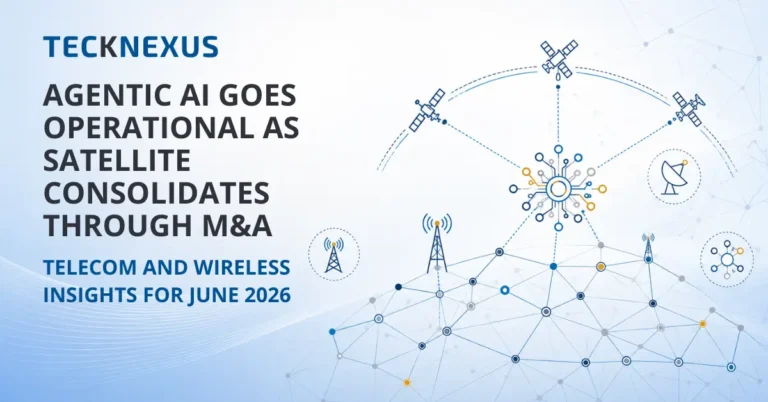
Telecom and Wireless Insights for June 2026’s roundup: agentic AI moves from pilot to operational core across telecom networks, satellite consolidates through Rocket Lab’s $8B Iridium acquisition and SpaceX‘s $75B IPO, AI–RAN‘s GPU divide matures into shipping products, US spectrum auctions return after a four-year hiatus, and telecom M&A accelerates globally.
At a glance – Telecom and Wireless Insights for June 2026
- Agentic AI moved from pilot to core telecom operations this month: Verizon targets Level 4 network autonomy integrating Anthropic‘s Claude, Nokia added an agentic AI framework to its Network Services Platform for commercial launch by year-end, and TM Forum, Linux Foundation, and NVIDIA all launched competing frameworks for governing telecom AI agents.
- Satellite consolidated through major M&A: Rocket Lab agreed to acquire Iridium for $8B, SpaceX priced its IPO at $75B valuing the company at roughly $2 trillion, and Gilat agreed to acquire the bulk of Comtech’s satellite operations for $157.5M.
- Ericsson formally launched “AI in RAN” as subscription software embedding AI models directly in radios and basebands — its answer to Nvidia‘s GPU-embedded AI-RAN approach, which Nokia is separately building toward 6G.
- The FCC completed AWS-3 Auction 113, its first spectrum auction in four years, with $3.5B in gross bids — Verizon led spending at $3.2B for 82 licenses — and scheduled a July 22 vote on rules for an upper C-band auction.
- Bouygues Telecom, Orange, and Free-iliad signed an MoU to acquire SFR from Altice France for €20.35B ($23.44B), reducing France’s mobile operators from four to three.
- Telia launched Sweden’s first commercial 5G Standalone network, and GSMA introduced a new standard for application-aware 5G network slicing as Airtel‘s slicing-based consumer offer faces net-neutrality scrutiny in India.
1. Satellite consolidates through M&A, capital markets, and constellation buildout
Satellite moved decisively from a connectivity story into a capital-markets and M&A story this month:
- Rocket Lab: agreed to acquire satellite operator Iridium Communications in an $8B cash-and-stock deal, planning to integrate Rocket Lab’s launch services and satellite manufacturing with Iridium’s global satellite communications network, licensed spectrum, and 500+ company partner ecosystem to form a vertically integrated space communications provider.
- SpaceX: priced its IPO at $135 per share to raise $75B, listing on Nasdaq with a 30-day underwriter option for additional shares — exceeding Saudi Aramco’s 2019 IPO in size. A Goldman Sachs projection tied to the listing cited $322B in AI-related revenue, with the largest component attributed to rental income SpaceX receives from Anthropic and Google. Separately, SpaceX president Gwynne Shotwell indicated the company is evaluating a Starlink-branded retail mobile service with potentially proprietary wireless infrastructure that could compete directly with AT&T and Verizon.
- Gilat Satellite Networks: signed a definitive agreement to acquire the bulk of Comtech Telecommunications’ satellite and space operations for $157.5M, including ground infrastructure, large antennas, modems, and network control/management systems supporting LEO and other satellite constellations.
- AST SpaceMobile: launched three BlueBird direct-to-device satellites via a SpaceX Falcon 9, advancing its satellite-to-cell constellation.
- Amazon: received a 24-month FCC extension to meet the first-half deployment milestone for its planned 3,236-satellite LEO constellation, despite objections filed by SpaceX.
- Jio: submitted a satcom proposal to India‘s IN-SPACe regulator for configuration and architecture review, and separately outlined plans to launch more than 1,600 LEO satellites within two to three years in partnership with Elon Musk’s firm, while evaluating a sovereign LEO constellation of its own.
- Rakuten Mobile: reportedly received roughly $912M (JPY148B) in Japanese government funding over three years to build a satellite communications network, covering procurement and launch, aligned with a national push for a domestic satellite system.
- D2D/NTN deployments broadened globally: Kyivstar launched a nationwide Starlink Mobile light data service for 4G smartphones in Ukraine; Eutelsat and Voimatel integrated LEO connectivity with terrestrial networks to enhance Arctic coverage in Finland; Telefónica Germany and OQ Technology tested two-way D2D satellite texting and voice messaging in Mecklenburg-Western Pomerania; Sateliot validated satellite-enabled NB-IoT for agriculture in a remote area of Brazil with CPQD; and Satellite Connect Europe (the AST SpaceMobile–Vodafone joint venture) added Vodafone Spain to its roster, targeting commercial D2D service by 2027.
- Clarus Networks: became an authorized reseller of Amazon‘s LEO satellite broadband for enterprise and maritime customers, adding to existing reseller arrangements with Starlink and OneWeb.
- Bigleaf Networks: launched Multipath Broadband, integrating Verizon 5G FWA and Starlink links on a single network performance control platform for multi-carrier, multi-path enterprise connectivity, developed with Connected Solutions Group.
Why it matters for buyers: Rocket Lab’s acquisition of Iridium and SpaceX’s $75B IPO are both vertical-integration plays that consolidate launch, manufacturing, and network operation under fewer owners, while Shotwell’s comments about a potential Starlink retail mobile service signal SpaceX may become a direct competitor to the very carriers reselling its capacity. Buyers relying on satellite partnerships should watch which of today’s partners might become tomorrow’s competitors. → Assess satellite/NTN partnership risk with TeckNexus Network Planning tools.
2. US spectrum auctions return after a four-year hiatus, global spectrum policy accelerates
Spectrum policy re-activated at scale this month, from a landmark US auction to global permitting reform:
- FCC — AWS-3 Auction 113: opened June 2 and closed June 23 after 72 rounds, marking the agency’s first spectrum sale in four years; all 200 licenses across the 1695–1710 MHz, 1755–1780 MHz, and 2155–2180 MHz bands (originally won by Dish Network in 2014 but never put into service) received bids from 17 qualified participants, with gross winning bids exceeding $3.5B. Results published June 26 showed Verizon (via Cellco Partnership) leading spend with 82 licenses for $3.2B, T-Mobile securing 102 licenses for $277.8M, and AT&T obtaining additional spectrum, while EchoStar and SpaceX received a small number of licenses.
- FCC — upcoming C-band auction: scheduled a July 22 vote on rules to auction 160MHz of upper C-band spectrum and to create a 440MHz “super-band” harmonizing lower C-band allocations; CTIA is urging the FCC to finalize the auction rules by late August and to advance further spectrum auctions to meet capacity needs tied to AI workloads and 6G.
- SES: estimated it will need to spend roughly $3.6B to migrate services and clear up to 160MHz of upper C-band spectrum, with costs driven primarily by deploying new Ku-band satellites that use C-band uplinks.
- FCC — broadband permitting: initiated rulemaking to explore capping or constraining state and local fees and timelines for broadband permitting (legal authority uncertain), and separately proposed streamlined permitting rules specifically to accelerate wireline broadband deployment.
- FCC — subsea cable security: adopted new rules to strengthen security protections for submarine cable systems and streamline deployment processes for subsea internet infrastructure in the US.
- India — Department of Telecommunications: issued rules governing administrative (non-auction) spectrum assignment under Schedule 1 of the Telecommunications Act.
- NCTA: requested an expedited FCC waiver allowing foreign-made consumer broadband routers requiring only minor memory or materials changes to proceed under a faster approval path.
- BLiNQ Networks: introduced a Private 5G Small Cell portfolio in Canada targeting enterprise, industrial, and smart infrastructure deployments.
Why it matters for buyers: the return of US spectrum auctions after a four-year gap, combined with a scheduled C-band auction and CTIA’s push for more, signals renewed federal urgency to free up capacity specifically for AI and 6G workloads — not just traditional mobile broadband growth. SES‘s $3.6B clearing-cost estimate is a reminder that satellite operators bear real migration costs whenever new spectrum is freed for terrestrial use, costs that flow into satellite service pricing. → Track spectrum roadmap and capacity planning with TeckNexus Network Planning tools.
3. Agentic AI becomes telecom’s operational core, not just a pilot
Multiple competing governance frameworks and production-grade platforms emerged simultaneously this month:
- Verizon: outlined a plan to reach Level 4 cognitive network autonomy, reporting 70 million autonomous configuration changes in 2025 via closed-loop platforms, and is integrating Anthropic’s Claude to assist with traffic management and performance optimization across a software-defined, self-healing core; separately shared early learnings from deploying agentic AI in network operations more broadly.
- Nokia: will add an agentic AI framework to its Network Services Platform (NSP), enabling operators to run trusted, explainable AI agents on real network data for IP network operations, targeting commercial availability by year-end; separately completed a joint proof-of-concept with Databricks demonstrating AI-driven autonomous telecom network operations using open-source generative AI agents.
- NVIDIA: introduced a secure AI agent runtime and synthetic data tools for autonomous telecom operations at DTW Ignite 2026, featuring NeMo Safe Synthesizer and NeMo Anonymizer for privacy-preserving synthetic data, NemoClaw blueprints for long-running agents, and the OpenShell secure runtime for policy-governed, sandboxed access to operator systems. Partner demonstrations included SoftBank‘s synthetic data for fine-tuning telecom models, AdaptKey’s self-healing 5G operations, Amdocs‘ proactive customer-care agents, and NTT DATA’s anomaly detection using Nemotron models. NVIDIA separately confirmed plans to demo the combined telco AI stack with SoftBank and NTT Data at the same event, targeting progression from task-based automation toward fully autonomous network operations.
- TM Forum: launched the first operational projects under its AI-Native Blueprint at MWC Barcelona — Model as a Service (MODaaS) to standardize AI model sourcing and lifecycle management across cloud, edge, and on-prem; Data Products Lifecycle Management (DPLM) to define governed, discoverable data products accessible by AI agents; and Agentic Interactions Security to establish guardrails and a common policy language for secure agentic AI at scale — developed with members including Accenture, AT&T, Databricks, Google, Huawei, Salesforce, Telstra, T-Mobile, and Verizon.
- Linux Foundation: launched OpenAN, an open, community-driven initiative to create a common technical foundation for telecom AI agents, backed by China Mobile, Orange, ZTE, and others.
- Ericsson: launched an initiative to accelerate AI adoption across telecom operations in collaboration with Vodafone, NTT, SK Group, and Chunghwa Telecom.
- NTT DOCOMO: outlined a global AI governance blueprint emphasizing agentic AI, governance controls, and a trust framework, referencing Accenture as a methodology partner.
- China Mobile: detailed an AI services architecture built on an intelligent agent framework and a large model library, positioning itself as an evolving “intelligent service provider.”
- Comcast Business: launched SecurityEdge Preferred, embedding AI-driven threat detection directly into its network to monitor traffic in real time and block malware, ransomware, phishing, and botnets for small business customers nationwide.
- Red Dot Technologies: deployed the Genome Shield platform to protect the data and models behind its own AI/ML systems.
- Neon Cyber: introduced AI-native browser security to govern workforce use of generative AI and SaaS tools.
- Telefónica Deutschland (O2): is building an in-house “Jarvis” AI platform to orchestrate network, application, and operational workflows across a complex multi-cloud environment.
- Spark New Zealand: piloted AI-equipped wildfire-detection sensors with Dryad Networks and the Far North District Council in the Waitangi Endowment Forest, including automated alerts to local authorities.
- Elisa: tested distributed acoustic sensing (DAS) over subsea fiber in the Baltic Sea to detect potentially harmful activity around subsea cables, following prior cable-cut incidents.
- Bouygues Telecom: expanded AI-driven analytics to monitor and improve broadband quality of experience across its French network.
- A German operator: deployed Multi-Domain Service Orchestration (MDSO) to coordinate services across network domains, with commentary suggesting agentic AI adoption will drive further orchestration-tooling refreshes industry-wide.
Why it matters for buyers: agentic AI in telecom has moved past isolated pilots into competing standards bodies (TM Forum, Linux Foundation) and production commercial platforms (Nokia NSP, Verizon’s Level 4 autonomy) simultaneously. That’s a meaningfully different maturity signal than a single vendor announcement — multiple parallel governance frameworks emerging at once usually means the underlying technology has become too consequential to leave ungoverned. → Evaluate agentic AI vendors against these emerging frameworks with the TeckNexus RFP Scorecard Generator.
4. AI-RAN’s GPU divide deepens into shipping products
This month’s throughline continues directly from May: the GPU-embedded and GPU-free AI-RAN approaches both moved from trials into real commercial products:
- Ericsson: formally launched “AI in RAN,” a subscription software package that executes telco-grade AI models directly inside 5G radios and basebands using Ericsson Silicon and the latest RAN Compute — targeting performance, energy efficiency, and automation across purpose-built RAN and Cloud RAN, with portability to partner platforms. Initial features are planned for Q2 2026 and require no new hardware — Ericsson’s clearest commercial answer yet to Nvidia’s GPU-embedded approach.
- Nokia & Nvidia: announced a collaboration to build an AI-RAN platform targeting 6G and integrate Nvidia AI processors into Nokia’s 5G radio/access equipment, engaging operators including T-Mobile and Orange on AI-driven network use cases, and adjusting Nokia’s network infrastructure sales outlook alongside the initiative.
- Marvell: is enhancing its OCTEON base station platform to interoperate directly with Nvidia GPUs, enabling AI workloads to run within wireless RAN infrastructure.
- Amdocs: field-validated a multivendor AI-RAN blueprint with Supermicro and 1Finity (Fujitsu), combining 1Finity Open vRAN software on Supermicro ARM-based 1U servers with Nvidia GH200 Grace Hopper compute, orchestrated on Red Hat OpenShift — the end-to-end setup included O-RAN radios, a 5G SA core, and commercial devices, with Amdocs codifying AI-driven RAN orchestration, optimization, and anomaly detection as a reusable Network Workflow in its aOS platform.
- Fujitsu: demonstrated Open vRAN running its 1FINITY software on a Supermicro ARM-based 1U platform, highlighting multi-vendor interoperability on commercial off-the-shelf hardware.
- KDDI & KDDI Research: launched a RAN Digital Twin collaboration with Nvidia, Keysight, and Samsung Research America to develop high-fidelity, AI-driven network optimization, targeting a prototype by March 2028 and broader validation on KDDI’s commercial network by FY2030.
- ETRI (South Korea): designated the National AI-RAN Global Leading Project Specialized Research Institute by MSIT/IITP, launched a KRW47B (through 2030) program to develop AI-native RAN technologies, building a virtual AI-RAN platform per 3GPP Releases 19/21, validating AI for massive MIMO, and including US collaboration on base-station energy saving.
- Samsung: has now deployed virtual RAN across nearly half of Verizon’s US network, with Ericsson support expected once ready — coverage notes Samsung’s approach also touches KDDI and Vodafone engagements, with ecosystem ties extending to Nokia, Ericsson, and Nvidia’s AI-RAN initiatives.
Why it matters for buyers: Ericsson’s formal “AI in RAN” launch — requiring no new hardware — is a direct commercial answer to Nvidia/Nokia’s GPU-embedded approach, which is now itself explicitly targeting 6G with named operator partners T-Mobile and Orange. Buyers finally have a genuine two-vendor, two-architecture choice with concrete shipping products on both sides, not just field trials. → Compare AI-RAN architecture and vendor roadmaps with the TeckNexus Technology Selector.
5. 5G-Advanced monetization, slicing standards, and industrial 5G expand
5G-Advanced monetization is now being tested at the standards, regulatory, and commercial levels simultaneously:
- Telia: launched commercial 5G Standalone across its entire Swedish network, becoming the first Swedish operator to offer 5G SA.
- GSMA: introduced a new standard for application-aware 5G network slicing, intended to align application requirements with slice behavior and enable new operator monetization models; Telefónica is backing the standard.
- Airtel: its consumer slicing-based offer (rebranded “Fast Lane”) is facing regulatory scrutiny in India over net neutrality; Ericsson’s India head stated that slicing can enable differentiated QoS without content-provider discrimination, as the debate continues.
- Ericsson: separately detailed how network slicing combined with mmWave spectrum can deliver differentiated QoS, isolation, and capacity for multiple service types (eMBB, URLLC, FWA) on shared infrastructure.
- Ericsson & Verizon: extended availability of the Ericsson Private 5G solution through Verizon to international markets, beyond the US.
- Ericsson — London showcase: hosted a technology showcase where Virgin Media O2 and Vodafone-Three signaled plans to monetize 5G SA through premium network offerings in the UK.
- Industrial 5G deployments broadened: China Unicom commercialized a 5G LAN at China Jushi’s No.5 factory in Zhejiang (part of its 5G Private Network Plus 3.0), embedding 5G terminals in control cabinets for tight PLC integration and real-time SCADA data exchange; CelcomDigi launched Malaysia’s first industrial 5G-SA intelligent warehouse and demo lab in Shah Alam, integrating AGVs, autonomous inventory drones, AI video analytics, and a digital twin platform; and Nokia partnered with Indosat Ooredoo Hutchison to deploy low- and mid-band 5G RAN for an AI-ready nationwide network in Indonesia.
- Rakuten Symphony & Celona: formed a private 5G partnership targeting autonomous enterprise networks, positioning against established suppliers such as Nokia.
- Nextivity: upgraded its 5G Enterprise DAS (CEL-FI QUATRA 100M) and introduced the CEL-FI GO G51 booster for the Americas, supporting 5G NSA and FirstNet for enterprise/private 5G and IoT coverage.
Why it matters for buyers: 5G-Advanced monetization is now being tested simultaneously at the standards level (GSMA’s slicing standard), the regulatory level (India’s net-neutrality scrutiny of Airtel’s Fast Lane), and the commercial level (Virgin Media O2 and Vodafone-Three’s premium SA plans) — a sign the industry is genuinely trying to answer the “how do we make money from 5G SA” question this year, not just build the network. → Model slicing-based monetization scenarios with TeckNexus ROI/TCO tools.
6. Fiber, cable, and telecom M&A accelerate globally
Fiber and cable capital scaled in parallel with a wave of ownership consolidation:
- Corning & Amazon: signed a multi-billion-dollar agreement to expand US-based fiber optics manufacturing, creating 1,000 manufacturing jobs in North Carolina — extending May’s Corning/Nvidia fiber-scaling story with a second hyperscaler partner.
- CableLabs: is drafting an optional DOCSIS 4.0 annex to extend HFC spectrum support up to 3GHz and enable roughly 25 Gbit/s-class services, with work in active analysis.
- Charter Communications: is deploying AOI’s “QuantumLink” remote management software to centrally manage 1.8GHz HFC amplifiers across its footprint, and separately launched “Latis,” a household intelligence platform via Spectrum Intelligence Ventures engineered to interoperate with home systems and support AI-native applications.
- AT&T: streamlined its fiber home internet plans, boosting entry-tier speed to roughly three times prior levels and including free internet backup on bundled plans; introduced four fiber speed tiers (300 Mbit/s to 5 Gbit/s) with wireless-bundle discounts; and extended its “Build-A-Plan” offering to bundle fiber and FWA home broadband alongside wireless.
- Telecom M&A wave: Bouygues Telecom, Orange, and Free-iliad signed an MoU with Altice France to acquire SFR for €20.35B ($23.44B), with Bouygues taking roughly 52% of carved-out revenue, Free-iliad 27%, and Orange 21% — reducing France’s mobile operators from four to three, pending antitrust review; Liberty Global received EU clearance to acquire Vodafone’s 50% stake in VodafoneZiggo in the Netherlands, assuming sole control of the joint venture; Sertex Broadband Solutions acquired Trenchworks Inc. to expand fiber construction capacity in northern New England; Ritter Communications and Great Plains Communications merged under the “Rightfiber” brand to pursue further fiber expansion and opportunistic M&A Omni Fiber acquired Citizens Fiber to expand its footprint in western Pennsylvania; Noble Mobile (a T-Mobile MVNO founded by Andrew Yang) acquired Helium Mobile to extend coverage via Helium’s small-cell network; Harmonic sold its video business to MediaKind for $145M to become a pure-play broadband technology company; Synamedia sold its video networks business to Lumine Group; and Carolina West Wireless is transitioning its network operations onto Verizon, affecting postpaid, Bark Mobile prepaid, and Clearstream FWA services.
- PwC: published fiber M&A guidance indicating buyers will pay premiums for rural operators with existing infrastructure, contiguous network footprints, demonstrated compliance, and credible plans to scale.
- Funding: DriveNets closed a $410M Series D (lifting cumulative funding past $1B), with AMD joining as a new investor to support AI infrastructure networking demand; AMD separately announced up to £2B in UK AI infrastructure investment over five years; AirTrunk plans up to 5GW of data center capacity in India for AI workloads; NTT, SK Group, and Chunghwa Telecom committed $500M to the IOWN AI Fund for photonics-based AI infrastructure; SK Telecom secured Horizon Europe research funding as the first Asian private company to participate, targeting next-generation quantum cryptography; AWS committed an additional $13B to India by 2030 (total India commitment $48B); and Cable One reported nearly $1B invested over three years to enhance its network.
Why it matters for buyers: Corning’s second major hyperscaler fiber-manufacturing deal in two months (Nvidia in May, Amazon in June) signals sustained AI-driven fiber demand, while the SFR deal and a wave of smaller US fiber M&A (Rightfiber, Sertex, Omni Fiber) show the operator landscape itself is still actively reshaping. Buyers should expect both capacity and ownership structures to keep shifting through year-end. → Model fiber and cable buildout and consolidation economics with TeckNexus ROI/TCO tools.
Every June item, with full source detail, is on the curated Telecom and Wireless Monthly Insights page →
A note on scope: per updated guidance this month, this roundup includes agentic AI and AI-RAN content directly relevant to network infrastructure, alongside traditional connectivity topics. Excluded: Anthropic’s Alibaba fraud allegations, Mythos access expansion, and IPO filing; Salesforce‘s Fin acquisition; Cursor’s AI coding tool adoption; Oracle‘s AI-linked layoffs; and pure media M&A (Fox/Roku, Comcast‘s NBCUniversal/Sky spinoff) — these sit outside connectivity infrastructure specifically. Routine personnel and organizational appointments carrying no strategic or technical signal were also excluded; market-moving leadership changes are noted only where directly relevant to a covered story.
What this means if you’re planning connectivity infrastructure
June’s throughline is that telecom’s AI transition and its infrastructure transition are now happening at the same production-grade pace — agentic AI frameworks, AI-RAN products, spectrum auctions, satellite consolidation, and fiber/cable capital are all moving from planning into shipped products, closed deals, and cleared auctions within a single month. Six moves follow directly:
- Evaluate agentic AI vendors against the competing governance frameworks emerging this month (TM Forum, Linux Foundation, NVIDIA) rather than a single vendor’s proprietary approach — multiple frameworks converging usually means the technology has become consequential enough to require it.
- Compare Ericsson’s no-new-hardware “AI in RAN” against Nvidia/Nokia’s GPU-embedded approach directly — both are now real commercial products, not roadmap items.
- If satellite is part of your coverage or partnership strategy, watch which partners are consolidating (Rocket Lab/Iridium, Gilat/Comtech) or might become direct competitors (SpaceX’s potential Starlink retail mobile service).
- Track the FCC’s C-band auction timeline closely if your spectrum planning depends on upper C-band access — CTIA is pushing for finalized rules by late August.
- Treat 5G slicing monetization as an active regulatory question, not a settled one — India’s net-neutrality scrutiny of Airtel’s Fast Lane could set precedent for other markets.
- If you operate in or rely on the French or European fiber/cable market, watch the SFR and VodafoneZiggo deals closely — both are reshaping competitive structure ahead of final regulatory approval.
Catching up? Last month’s edition is here: A Shared Satellite Future and AI-RAN’s GPU Divide: Advanced Connectivity Insights, May 2026 →
→ Start with the TeckNexus Intelligence Platform — independent, buyer-neutral tools for spectrum, TCO, architecture, and RFP decisions.
This analysis is drawn from TeckNexus’s full curated Telecom and Wireless Monthly Insights for June 2026. See every deployment, product, and partnership update →
The TeckNexus Intelligence Platform is buyer-neutral and TeckNexus-authored. Vendor co-branded Intelligence Packs are labelled as such and kept separate from the neutral core tools.
| RELATED TOOL
Which agentic AI, AI-RAN, or spectrum strategy fits your network’s next phase? With competing agentic AI governance frameworks, two shipping AI-RAN architectures, a reopened US spectrum auction cycle, and satellite consolidating through M&A, the decisive question is sequencing — which commitments to make now versus keep flexible. TeckNexus’s Technology Selector and Network Planning tools map these options against your deployment horizon, while the RFP Scorecard Generator and ROI/TCO tools help structure vendor evaluation and buildout economics. |