NTT

Live Streaming on Wed, 4 Mar at 12:00 - 13:00 CET
What does it take to truly challenge the status quo and redefine what is possible? In this keynote, we sit down with three visionary leaders who are harnessing deeply disruptive technologies to reshape industries and reimagine how we work, create, and play. From the future of sustainable connectivity in the AI era to the reinvention of professional services and the rise of new forms of digital companionship and entertainment, this session explores how bold ideas become real-world systems. Join us to hear their stories, their lessons, and their visions for a future transformed by imagination, scale, and ambition.
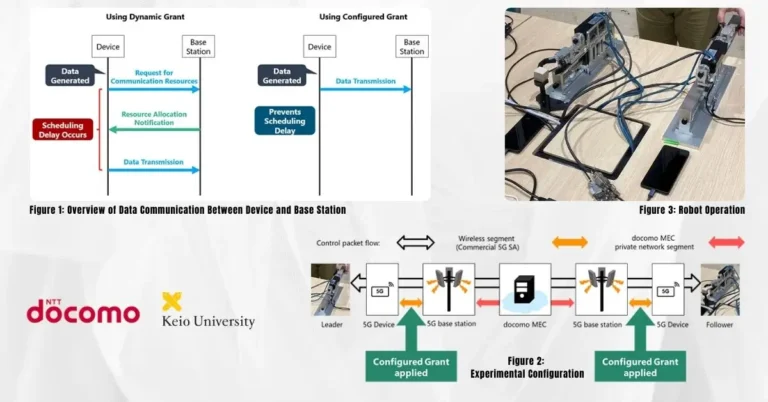
NTT DOCOMO and Keio University have validated that commercial 5G Standalone (SA) can stably support haptic-grade robot teleoperation using network slicing and configured grant—turning years of URLLC theory into practical results. By pairing 3GPP-configured grant scheduling with a low-latency slice and Keio’s Real Haptics technology, DOCOMO showed that public 5G SA can carry force and tactile feedback with the determinism required for safe, precise manipulation. The KPIs demonstrate material improvements in latency stability, force fidelity, and motion smoothness—indicators that the control loop is resilient enough for practical tasks.
NTT DATA’s private 5G rollout across 50 Cargill facilities signals that industrial connectivity is moving from pilot projects to standardized, multi-site execution. NTT DATA has deployed private 5G at Cargill manufacturing and processing locations worldwide—mostly in the United States with live sites in Europe—enabling a connected workforce, robotics, and edge AI across plants that are often too large and complex for conventional Wi‑Fi or wired networks to cover reliably. Manufacturers are consolidating on common digital platforms and need predictable, low-latency wireless for operational data, mobile human–machine interfaces, and autonomous systems; private 5G—built on 3GPP standards with SIM-based security and policy-based QoS—offers deterministic performance at scale where legacy networks struggle.
A new cross-industry consortium is forming to codify how trusted technology should be built, operated, and governed across borders. On February 13, 2026, fifteen companies spanning cloud, networks, semiconductors, software, and AI launched the Trusted Tech Alliance during the Munich Security Conference. The goal: define verifiable, provider-agnostic practices for a trustworthy technology stack—from connectivity and cloud infrastructure to chips, software, and AI—so customers and governments can rely on secure, resilient services regardless of where solutions are developed or deployed. Trust, sovereignty, and resilience are now gating factors for growth as AI scales and geopolitical risk reshapes supply chains.
NTT DATA and AWS have signed a multi-year strategic collaboration aimed at accelerating cloud modernization and responsible agentic AI adoption, with clear implications for APAC enterprises and telecoms. The agreement expands joint go-to-market and delivery across four pillars: AI-driven cloud transformation, industry cloud solutions, AI-enabled managed services and customer experience, and sovereign cloud for regulated workloads. NTT DATA has created a dedicated AWS Business Group with close to 11,000 AWS-certified experts and plans to certify nearly 10,000 more in three years. APAC boards want measurable AI outcomes, but legacy estates, data fragmentation, and compliance obligations slow progress.
NTT and Nishimatsu Construction Co., Ltd. have enabled ultra-remote control of heavy construction machinery using a combination of the All-Photonics Network (APN) and local 5G. This breakthrough deployment supports real-time operation of tunnel equipment from 200+ km away, with latency reduced to under 100 ms. Developed as part of the Tunnel RemOS system, the private 5G and APN network eliminates previous limitations of LTE and Wi-Fi, improving safety, visibility, and control precision. The project earned NTT DATA the “Private Network Excellence in Construction” award and offers a scalable model for smart infrastructure, digital twins, and future construction automation.
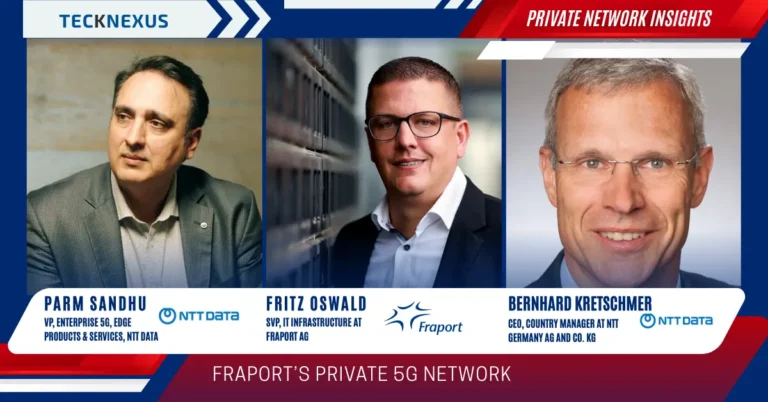
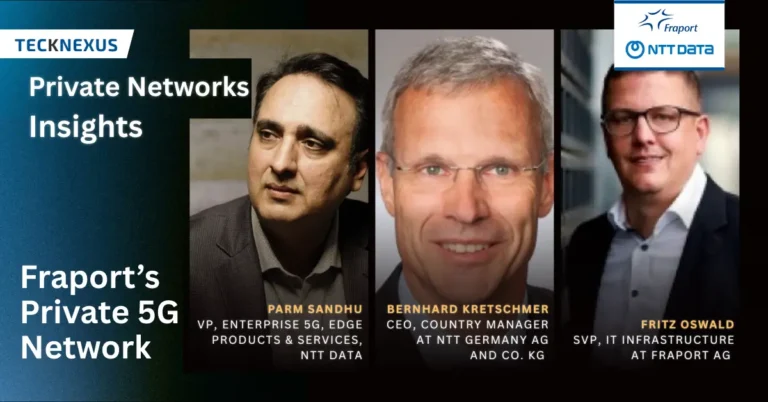
Winner – Private Network Excellence in Airports: NTT DATA, in partnership with Fraport AG, designed and implemented a large-scale private 5G network covering more than 20 km² at Frankfurt Airport. The 5G campus network provides secure, low-latency connectivity across the apron and perimeter where Wi-Fi is limited, enabling real-time data transfer, autonomous and remote operations, and a foundation for future airport digitalization. Nokia supported with private 5G RAN alongside NTT DATA’s architecture, deployment, and integration services.
Welcome to the TeckNexus Private Networks: Airports, Ports & Automotive Edition. Across transportation ecosystems, connectivity has shifted from an enabler to a strategic foundation. In airports, ports, and automotive environments, private LTE, 5G, and CBRS networks are delivering deterministic performance, real-time visibility, and secure operations—driving measurable gains in efficiency, safety, and resilience.

This edition showcases real-world deployments alongside exclusive insights from industry leaders shaping the future of mobility infrastructure. We also celebrate the 2025 TeckNexus Private Networks Award winners, recognizing organizations and partners setting new benchmarks for innovation and execution.

Through customer stories, executive interviews, and partner perspectives, the magazine highlights the power of ecosystem collaboration and introduces the Smart Airport and Smart Port Connectivity Blueprints—practical frameworks drawn from global deployments.

The message is clear: enterprises don’t invest in private networks for technology alone—they invest for outcomes.
Winner – Private Network Excellence in Airports, NTT DATA, in partnership with Fraport and Nokia is transforming Frankfurt Airport with one of the world’s largest private 5G networks. By integrating AI and edge computing, the network supports real-time communication, autonomous systems, predictive maintenance, and smart ground operations. Fraport is laying the groundwork for a scalable, future-ready airport infrastructure that benefits airlines, partners, and passengers.
Ericsson’s latest Mobility Report points to a clear shift: operators are turning 5G capabilities into differentiated, SLA-backed services rather than just selling more data at higher speeds. After years of building coverage and capacity, 5G networks are mature enough to commercialize features like guaranteed latency, uplink boosts, and application-aware prioritization. The catalysts are in place: more 5G Standalone (SA) cores, rising traffic from video creation and immersive apps, and enterprise demand for predictable performance across sites and clouds. The net result is momentum behind premium, differentiated connectivity that can be priced, assured, and exposed to partners.
A consortium led by NTT DOCOMO, NTT, Nokia Bell Labs, and SK Telecom has shown that applying AI to both transmitter and receiver—“AI-AI”—can materially lift outdoor 6G performance, pointing to an AI-native air interface that adapts in real time to messy, real-world radio conditions. Using 5G New Radio as the baseline at 4.8 GHz, the AI-AI approach improved average throughput by roughly 18% across mixed environments and delivered up to a 100% gain in the most challenging sections of a curved public road. The net: AI at both ends consistently compensated for channel fluctuations outdoors, not just in controlled labs.
Celanese and NTT DATA have deployed a fully managed Private 5G network at two Texas manufacturing plants, accelerating their Industry 4.0 roadmap. The solution enhances automation, safety, and real-time operational control by delivering reliable, high-speed connectivity at the edge. The deployment enables robotics, edge analytics, and secure communications, setting a model for digital transformation in chemical manufacturing.

Your Brand. Our Intelligence Tools.

Capture leads at the point of evaluation. Talk to Us →

Sponsored by Palo Alto Networks
⚡ Utilities ⏱ 8 min ✓ Free
This tool is built and hosted by TeckNexus.
Launch Tool →
Whitepaper
This whitepaper explains how utilities can use secure AI-enabled private mobile networks to modernize operations, support distributed intelligence, improve resilience, and strengthen cybersecurity across critical infrastructure. It covers AI applications, private network advantages, zero trust principles, multilayered security architecture, and governance considerations for AI-ready utility environments....
Whitepaper
Non-terrestrial networks are rapidly evolving from experimental satellite systems into an increasingly important part of the global 5G connectivity landscape. This eBook, developed by Radisys in collaboration with TeckNexus, explores how 3GPP standardization, satellite architecture innovation, and software-driven network design are reshaping NTN deployment models. It examines the transition from...
Whitepaper
Private cellular networks are transforming industrial operations, but securing private 5G, LTE, and CBRS infrastructure requires more than legacy IT/OT tools. This whitepaper by TeckNexus and sponsored by OneLayer outlines a 4-pillar framework to protect critical systems, offering clear guidance for evaluating security vendors, deploying zero trust, and integrating IT,...
Scroll to Top

Map your security gaps to real threat scenarios – including Salt Typhoon, Volt Typhoon, AI data poisoning, rogue devices, and unencrypted OT traffic.

Take the free 8-minute assessment built for utility operators evaluating AI-enabled private mobile networks. Get a readiness score across five critical domains, see where your gaps are, and receive a prioritized action plan for what to fix first.

Free • 8 minutes • Built for private network security