Why Stable 5G Teleoperation Matters Now
NTT DOCOMO and Keio University have validated that commercial 5G Standalone (SA) can stably support haptic-grade robot teleoperation using network slicing and configured grant—turning years of URLLC theory into practical results.

From URLLC Theory to Proven 5G Performance
Ultra-reliable low-latency communications (URLLC) has been central to 5G’s value proposition, but real-world demonstrations on public networks have been scarce—especially for haptics, where millisecond-level latency and minimal jitter are table stakes. By pairing 3GPP-configured grant scheduling with a low-latency slice and Keio’s Real Haptics technology, DOCOMO showed that public 5G SA can carry force and tactile feedback with the determinism required for safe, precise manipulation.
This is strategically significant for operators and enterprises evaluating whether public 5G—with the right RAN features, slicing, and edge—can meet industrial control needs that were expected to demand private 5G or wired deterministic networks. It opens the door to new service tiers, SLAs, and multi-tenant monetization models for time-critical applications.
Business relevance across sectors
Haptic teleoperation underpins high-value use cases: remote maintenance in utilities and energy, precision handling in manufacturing, surgical robotics support in healthcare, and field operations in construction, logistics, and disaster response. Demonstrating stable force reproduction over a congested commercial network narrows the gap between pilot and production, particularly for enterprises that need nationwide reach and mobility without deploying their own spectrum and infrastructure.
How DOCOMO and Keio Delivered Low-Latency 5G Stability
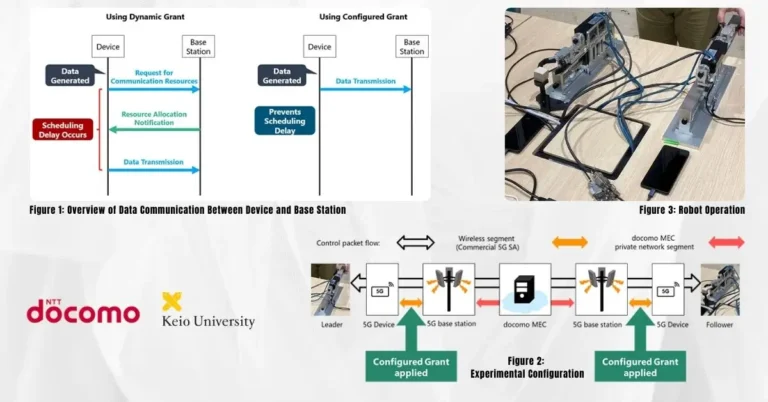
The trial combined 3GPP’s configured grant for uplink scheduling, a dedicated low-latency network slice, and MEC-hosted control to minimize delay and jitter end to end.
Configured Grant vs Dynamic Grant in 5G NR
Most devices use dynamic grant: they request uplink resources, wait for the scheduler to respond, and then transmit—adding variable “scheduling delay.” Configured grant flips the model by pre-allocating uplink transmission opportunities to specific devices or flows for defined intervals. This eliminates the request/response loop, cuts scheduling delay, and reduces variance when cells are busy.
In practical terms, configured grant provides a deterministic uplink “lane” aligned to the robot control loop. When paired with a low-latency slice that prioritizes the flow in the core and transport domain, the result is a steadier control stream—a prerequisite for precise force feedback and smooth motion.
Edge Architecture and the Haptic Control Loop
The setup ran on DOCOMO’s commercial 5G SA network, with control logic hosted on docomo MEC close to the RAN. A bilateral edge platform under development acted as the coordination point between the operator-side “leader” and the remote “follower,” enabling real-time bidirectional exchange of position, force, and velocity data required by Keio’s Real Haptics approach. Proximity to the radio reduced round-trip time and jitter accumulation across domains.
Testing Under Realistic 5G Traffic Conditions
To reflect real operations—where video feeds accompany control signals—the trial added 20 Mbps of background traffic alongside the haptic control channel. Configured grant was applied at the base station and device, and results were compared against a baseline using standard 5G SA without configured grant to isolate its impact under congestion.
Results: Stable Latency, Jitter, and Haptic Fidelity
The KPIs demonstrate material improvements in latency stability, force fidelity, and motion smoothness—indicators that the control loop is resilient enough for practical tasks.
Latency and Jitter Stability on Public 5G SA
Average latency and jitter were both lower with configured grant than with standard scheduling, meeting the envelope needed for realistic haptic teleoperation. The key outcome is not just a lower mean but reduced variance; fewer outliers and less drift keep the leader and follower synchronized, limiting over- or undershoot when applying force to delicate objects.
Force Fidelity and Motion Smoothness Improvements
Force reproduction accuracy improved by approximately 40% (a 24-point gain), meaning the remote robot more closely matched the operator’s applied force. Motion smoothness, measured by dimensionless jerk cost, improved by roughly 59%, translating into steadier, more predictable movements. For operators, these gains reduce cognitive load and the risk of damaging parts or tools—critical for monetizing teleoperation beyond controlled lab settings.
Strategic Implications for Operators and Enterprises
The demonstration provides a blueprint for offering deterministic mobile control as a differentiated service using public 5G SA, slicing, and edge.
Public 5G Slices as an Alternative to Private 5G
Enterprises that need national coverage and mobility can consider public 5G slices engineered for low latency as a viable option for teleoperation, especially where deploying private 5G is impractical. Configured grant offers a way to reserve uplink opportunities for control traffic while coexisting with eMBB users on the same cell.
RAN, Device, and Core Prerequisites for Haptics
Successful replication depends on device support for configured grant, RAN scheduler capabilities, and SA core readiness for QoS-aware slicing and MEC anchoring. Close integration with edge platforms and robotics stacks is essential to ensure the control loop timing, packetization, and retransmission policies are tuned for haptics rather than generic data.
Designing Tactile-Grade SLAs and Observability
Operators should define tactile-grade SLAs around end-to-end latency, jitter, and packet error rates, and expose real-time telemetry via APIs for enterprise observability. Mapping QoS flows (e.g., 5QI profiles), prioritizing uplink, and monitoring per-slice performance with analytics will be critical for trust and compliance in safety-related use cases.
Key Challenges to Scale 5G Teleoperation
Scaling from demo to production requires deterministic performance through mobility, interference, and multi-tenant contention while meeting safety and security requirements.
Mobility, Interference, and Uplink-Heavy Profiles
Handover consistency, interference management, and guaranteed uplink capacity are recurring pain points for time-critical applications. Validating configured grant behavior under fast mobility and cell-edge conditions, and ensuring resource isolation when multiple teleoperation sessions coexist, will be necessary for field deployments.
Cross-Domain Orchestration and APIs
End-to-end determinism spans RAN, transport, core, and edge. Automating slice lifecycle, integrating MEC placement, and using programmable exposure (e.g., GSMA-aligned APIs for QoS on demand) will help enterprises request, verify, and adapt performance in real time as workloads and locations change.
Safety, Security, and Certification for Teleoperation
Teleoperation introduces operational risk: fail-safe behaviors, authenticated control channels, and threat detection must be built in. Alignment with industrial safety standards and sector regulations, plus rigorous red-teaming of the control path and edge assets, will be prerequisite for mission-critical adoption.
What to Watch in 2026 for 5G Teleoperation
Standards, devices, and ecosystem moves this year will determine how quickly tactile-grade services become commercially repeatable.
5G-Advanced and Time-Sensitive Networking (TSN)
Enhancements coming with 5G-Advanced (Rel-18/19) target tighter latency bounds, improved scheduling, and better integration with deterministic Ethernet and TSN domains—key for bridging factory floors and public networks without breaking timing guarantees.
Device Ecosystem and Robotics Partnerships
Wider availability of UE modems and industrial CPE with configured grant support, plus vendor-certified reference stacks connecting robotics controllers to MEC, will accelerate adoption. Expect deeper collaborations among operators, RAN vendors, and haptics/robotics specialists.
Live Demo at MWC Barcelona 2026
DOCOMO and the NTT Group plan to exhibit the demo at MWC Barcelona 2026, offering a timely checkpoint for buyers and operators to assess maturity, device readiness, and integration pathways for pilot programs in H2 2026.