

Telecom Becomes an AI Vendor: AI & Automation Insights, August 2026
August 2026’s roundup: operators from SK Telecom to Ooredoo built or monetized AI infrastructure directly, AI-RAN validation reached the device

Multi-rail photonics are unlocking a new era of optical network scale, allowing hundreds of fully filled fiber pairs to operate in parallel. Paulina Gomez explores how RLS Hyper-Rail builds on Ciena's proven RLS foundation to deliver up to 32x greater density and the operational capabilities needed to make multi-rail practical at hyperscale. .
Read More →
Ciena’s scale-up and scale-out networking solutions are designed for the demanding connectivity requirements of AI factories and hyperscale data centers. By combining ultra-dense, power-efficient technologies with open, interoperable architectures, Ciena helps organizations connect growing XPU clusters at scale while reducing power, space, latency, and network complexity. .
Read More →
Explore how distributed AI training is driving a new “scale across” architecture that connects GPU clusters across campuses and regions. Learn how Ciena’s coherent optics and high-density photonic systems deliver the capacity, reliability, low latency, and efficiency required to scale AI infrastructure. .
Read More →
Neoscalers are scaling AI infrastructure at unprecedented speed, creating new demands for capacity, latency, power efficiency, and network reliability. This Ciena eBook explores how coherent optics, programmable photonics, intelligent software, and lifecycle services can help build and operate scalable, AI-ready networks.
Read More →
Ciena helps neoscalers build AI-ready networks designed for rapid growth, high capacity, and low latency. Its optical networking solutions combine coherent optics, photonic innovation, automation, and lifecycle services to improve performance, overcome power and space constraints, accelerate deployment, and support scalable AI infrastructure.
Read More →
Coherent optics has transformed how high-capacity data is transmitted over fiber by using advanced modulation, digital signal processing, and multiple signal dimensions. Ciena explains how the technology enables greater capacity, longer reach, improved spectral efficiency, and increasingly scalable connectivity for data centers, cloud infrastructure, and AI-driven networks.
Read More →
AI and cloud growth are driving unprecedented demand for high-capacity, low-latency connectivity. Ciena shows how scalable optical networking, data center interconnect, automation, and specialized services can help providers connect distributed infrastructure faster, simplify operations, and support the next generation of AI workloads.
Read More →
Neoscalers are emerging as a new class of AI infrastructure providers with rapidly growing demands for network capacity, simplicity, and speed. Ciena explores how advanced coherent optics, programmable photonics, and lifecycle services can help these providers build scalable, efficient optical networks for AI and cloud growth.
Read More →
AI infrastructure growth is creating major new connectivity demands, particularly for data center interconnect. Ciena explores how network operators can capitalize on this shift by delivering high-capacity, scalable optical connectivity for hyperscalers and distributed AI infrastructure.
Read More →
AI is driving new demands for compute, power, and high-capacity connectivity. Ciena explores how network operators can evolve their infrastructure, improve operational efficiency, and capitalize on growing AI traffic by delivering scalable connectivity for hyperscalers, data centers, and AI-driven applications.
Read More →
Vodafone and Ciena explore how AI is transforming telecom networks and business operations, from network planning and fault detection to customer service and security. The discussion also highlights Vodafone’s practical experience using AI to improve productivity and network performance.
Read More →
AI is creating unprecedented demands on data center and interconnect networks. Ciena explores how high-bandwidth, low-latency optical infrastructure will be critical to moving AI data efficiently across data centers, campuses, cloud environments, and the network edge.
Read More →
Explore how AI is reshaping network infrastructure, operations, and connectivity requirements. Ciena examines how scalable, high-performance networks and intelligent automation can support growing AI workloads while creating new opportunities for network operators.
Read More →August 2026’s roundup: operators from SK Telecom to Ooredoo built or monetized AI infrastructure directly, AI-RAN validation reached the device
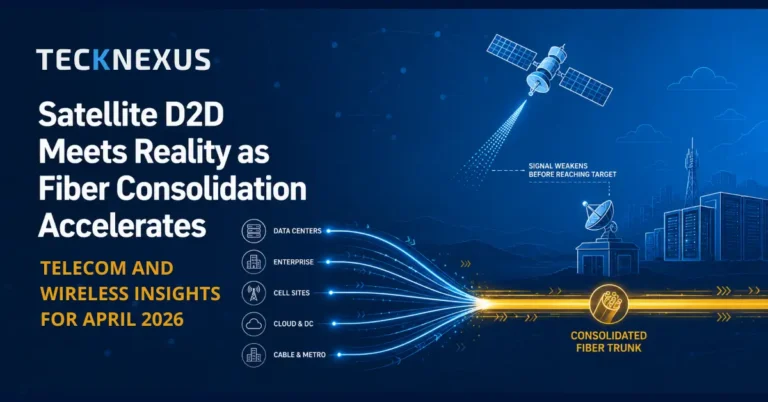
April 2026’s roundup: T-Mobile admits satellite direct-to-device usage is falling short of expectations, fiber consolidation accelerates through new JVs and

Runaway AI training demand is pushing data center fabrics past their limits, making optical networking the bottleneck to unlock GPU-scale

Across roughly 2,000 decision-makers in telecom, data center, and large enterprises, a strong majority doubts that existing infrastructure will keep

Nokia delivered a stronger-than-expected third quarter, with comparable operating profit reaching €435 million against consensus of about €342 million. Group

The telecom sector once hailed AI as a game-changer, but is it delivering? This article explores why many operators report

A new Ciena and Heavy Reading study signals that AI will become a primary source of metro and long-haul traffic

As networks grow more complex, traditional management models fall short. This article explores how AIOps (Artificial Intelligence for IT Operations)

Legacy broadband networks are struggling to meet today’s demands. Open architectures — modular, interoperable, and standards-based — are revolutionizing broadband

The telecommunications industry is undergoing a transformative shift driven by the synergy of fiber optic cables and Generative Artificial Intelligence






