Palo Alto Networks

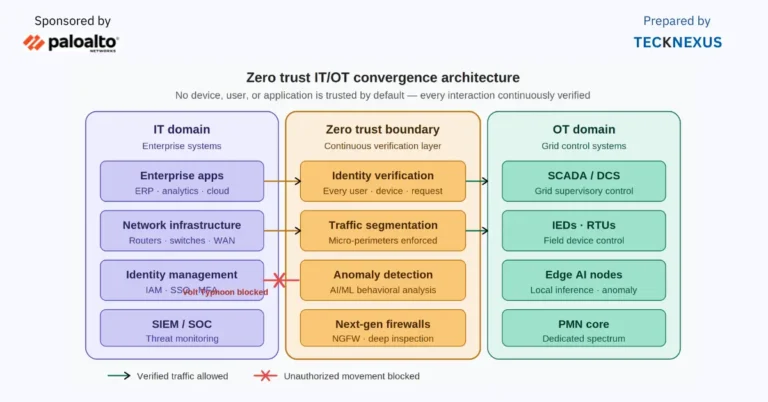
Volt Typhoon wasn't just a cyberattack - it was a strategic warning about the IT/OT boundary every utility now operates across. Zero trust is the only security model built for this threat environment, and private mobile networks are the foundation that makes it implementable. Here's what utilities need to know — and act on now.
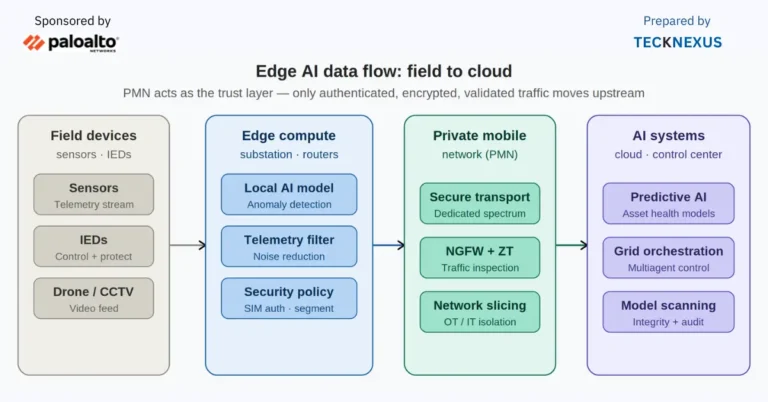
Edge AI is reshaping how utilities manage the grid — moving intelligence from the control room to the substation itself. Small language models, autonomous agents, and hardened edge routers are enabling faster fault detection, predictive maintenance, and real-time load optimization. But distributed intelligence demands distributed security. Here's what utilities need to build both.
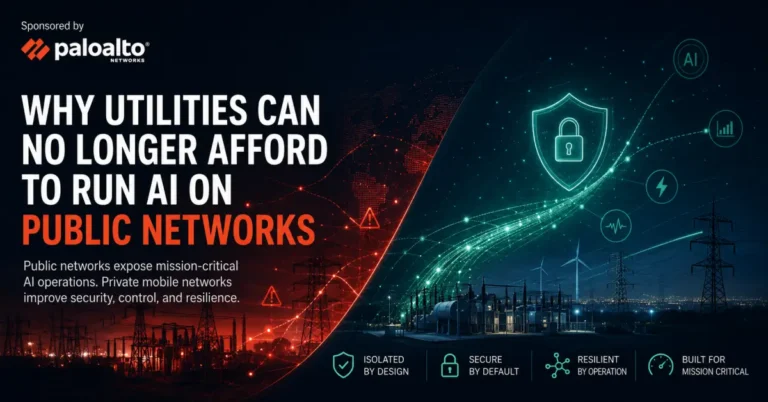
AI is reshaping utility operations, but many deployments still depend on public or legacy networks not designed for mission-critical OT, uplink-heavy telemetry, or cyber-resilient grid automation. This article explains why private mobile networks are becoming essential for secure AI-enabled utilities, reducing exposure to threats like Salt Typhoon and Volt Typhoon while supporting reliable, low-latency grid operations.
AI is moving from the data center to the substation — and the attack surface is expanding with it. Anterix, GE Vernova, and Palo Alto Networks lay out why private mobile networks are the only communications foundation that keeps pace with both the opportunity and the threat.
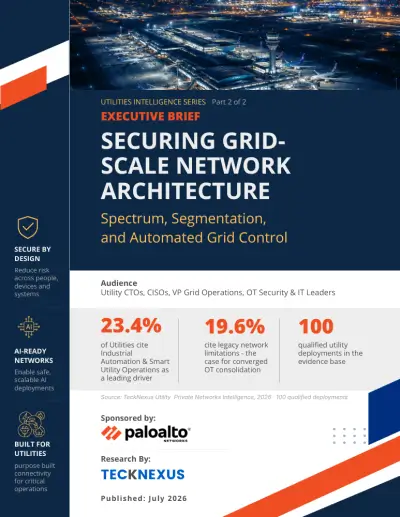
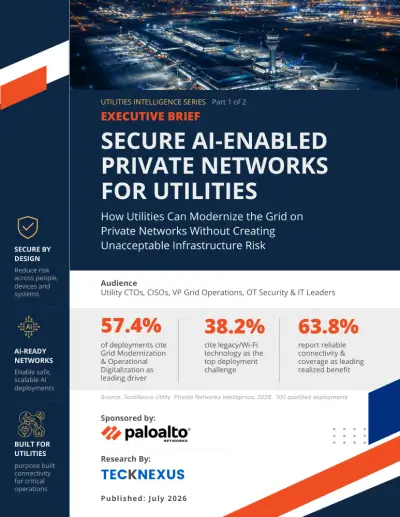
This whitepaper explains how utilities can use secure AI-enabled private mobile networks to modernize operations, support distributed intelligence, improve resilience, and strengthen cybersecurity across critical infrastructure. It covers AI applications, private network advantages, zero trust principles, multilayered security architecture, and governance considerations for AI-ready utility environments.
Private LTE, 5G, and CBRS networks are becoming the backbone of industrial operations. This article maps private network security vendors to a Four Pillars framework—Core Controls, Device Visibility, Detection & Response, and Orchestration—revealing where structural gaps emerge in real-world industrial deployments. From slice isolation and SIM lifecycle governance to OT micro-segmentation and SOC integration, it explains why layered enforcement—not vendor breadth—determines private 5G security resilience.
This edition of TeckNexus Private Network: Innovation & Ecosystem Solutions spotlights the platforms, partnerships, and deployment models accelerating private 5G, LTE, and CBRS at scale. Through feature stories, executive interviews, and award-winning case studies, it reveals how collaboration is turning private networks into secure, production-ready ecosystems.
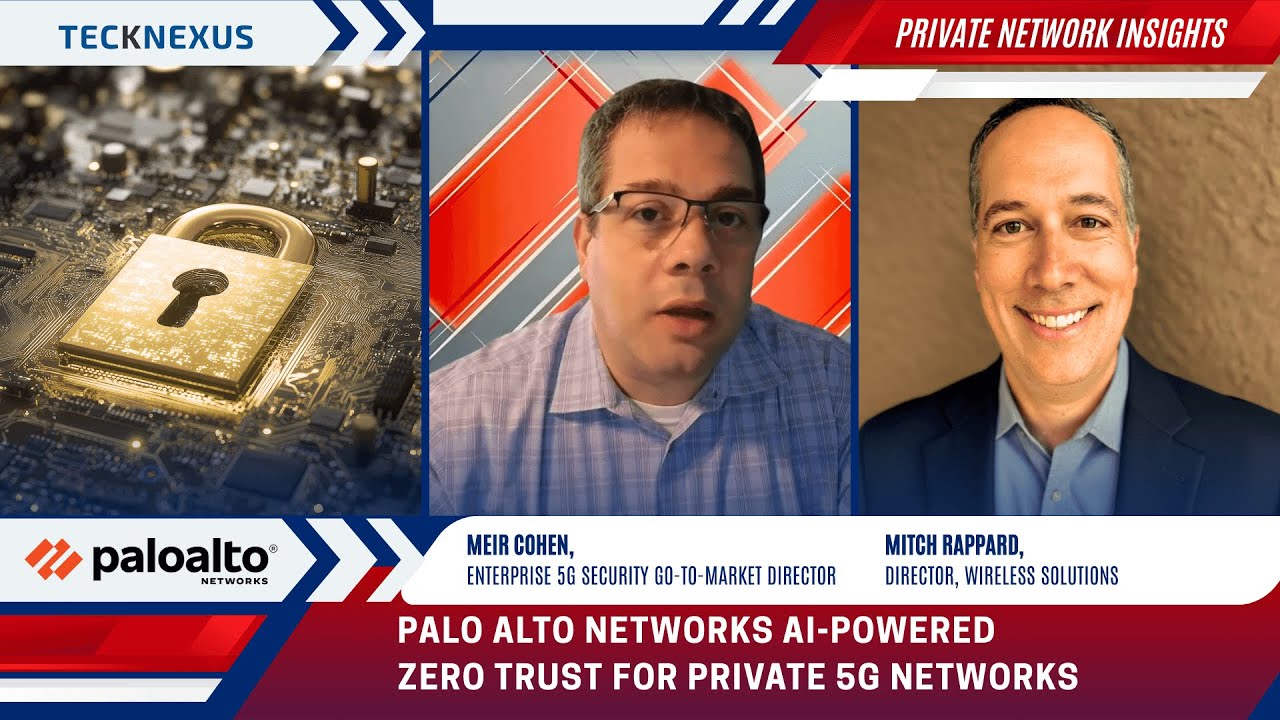
Palo Alto Networks wins “Excellence in Private Network Security” for its AI-powered Zero Trust platform securing private 4G and 5G networks. Built for mission-critical environments, the solution delivers end-to-end protection across core, edge, and cloud—enabling carriers, enterprises, and critical infrastructure operators to deploy private wireless networks securely, at scale, and with confidence.
Enterprises are moving fast to private 5G to digitize operations, but the payoff only materializes if security scales with the new connectivity footprint. Private 5G brings deterministic wireless to factories, hospitals, ports, and energy sites, connecting robots, AGVs, cameras, and critical control systems. Security must follow identities and workloads, not subnets. Adopt a Zero‑Trust approach aligned to NIST SP 800‑207 with a single source of truth for identity and policy. Shift from perimeter controls to context-driven segmentation. Build on open standards and APIs to avoid lock‑in and simplify operations. Security must be foundational, measurable, and auditable from day one.
Palo Alto Networks is buying Chronosphere to fuse cost-efficient, large-scale observability with AI-driven automation for modern cloud and AI data centers. Palo Alto Networks agreed to acquire Chronosphere for approximately $3.35 billion in a mix of cash and replacement equity, with closing expected in the second half of PANW’s fiscal 2026 (ending July 31). Chronosphere brings a next-generation observability architecture and telemetry pipeline built for scale and cost control. Together, they aim to turn observability from passive dashboards into autonomous, governed remediation that blends performance and security insights.
Amazon has moved its low Earth orbit broadband effort out of code-name mode and into a market-facing brand with strategic implications for telecom and enterprise buyers. Project Kuiper is now Amazon Leo, a direct reference to the low Earth orbit constellation underpinning the service. The rebrand signals a transition from R&D to commercial execution. Amazon reports more than 150 satellites in orbit today—roughly 153 by recent counts—following a string of successful launches and a completed prototype mission. The company says it will light up service as it adds coverage and capacity.

Your Brand. Our Intelligence Tools.

Capture leads at the point of evaluation. Talk to Us →

Sponsored by Palo Alto Networks
⚡ Utilities ⏱ 8 min ✓ Free
This tool is built and hosted by TeckNexus.
Launch Tool →
Whitepaper
This whitepaper explains how utilities can use secure AI-enabled private mobile networks to modernize operations, support distributed intelligence, improve resilience, and strengthen cybersecurity across critical infrastructure. It covers AI applications, private network advantages, zero trust principles, multilayered security architecture, and governance considerations for AI-ready utility environments....
Whitepaper
Non-terrestrial networks are rapidly evolving from experimental satellite systems into an increasingly important part of the global 5G connectivity landscape. This eBook, developed by Radisys in collaboration with TeckNexus, explores how 3GPP standardization, satellite architecture innovation, and software-driven network design are reshaping NTN deployment models. It examines the transition from...
Whitepaper
Private cellular networks are transforming industrial operations, but securing private 5G, LTE, and CBRS infrastructure requires more than legacy IT/OT tools. This whitepaper by TeckNexus and sponsored by OneLayer outlines a 4-pillar framework to protect critical systems, offering clear guidance for evaluating security vendors, deploying zero trust, and integrating IT,...
Scroll to Top

Map your security gaps to real threat scenarios – including Salt Typhoon, Volt Typhoon, AI data poisoning, rogue devices, and unencrypted OT traffic.

Take the free 8-minute assessment built for utility operators evaluating AI-enabled private mobile networks. Get a readiness score across five critical domains, see where your gaps are, and receive a prioritized action plan for what to fix first.

Free • 8 minutes • Built for private network security