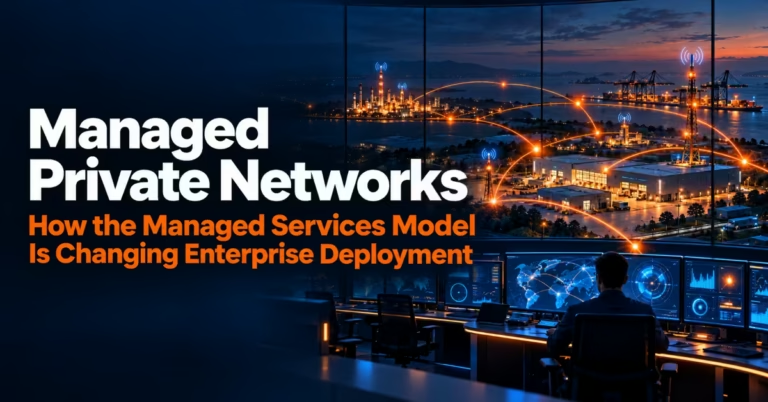


The control room has long been the nerve center of utility operations. Sensor data flows in from the field, operators analyze conditions and issue commands, and the grid responds – with latency measured in seconds or minutes at best. That model is being fundamentally disrupted, and the disruption is happening at the edge.

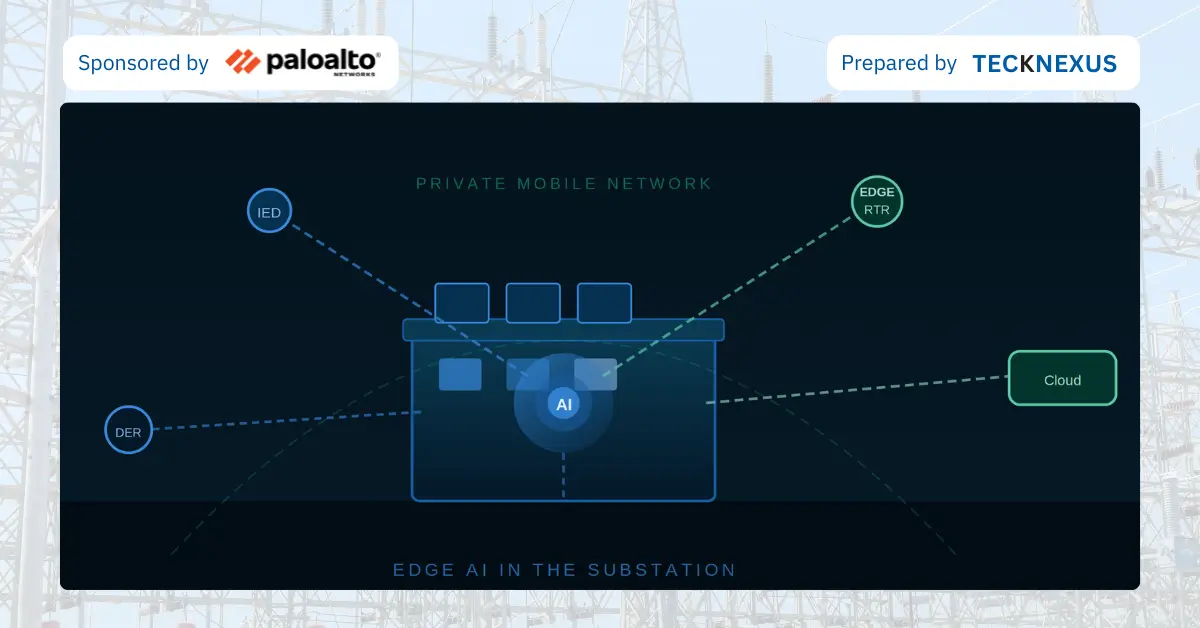
Forward-thinking utilities are now deploying AI-capable devices directly at substations, distributed energy resource sites, and field equipment gateways. Rather than routing all data back to a central control center for analysis, intelligence now lives where the equipment is. The implications for grid reliability, response speed, and operational efficiency are significant — but so are the security requirements this shift creates.

What Edge AI Actually Enables
Small language models (SLMs) are the key enabler for edge deployment. Unlike large language models that require substantial cloud compute resources, SLMs have recently emerged as more efficient, domain-specific, and concise than their large language model counterparts. They enable deployment on edge devices that are resource-constrained – in terms of compute, storage, and networking — and were previously off-limits. Utilities no longer have to run rigid, centralized models of grid operation and control on the public cloud; they can now place the power of AI at the edge, shifting their focus to more distributed and flexible models to meet the needs of a rapidly transforming and more dynamic grid.
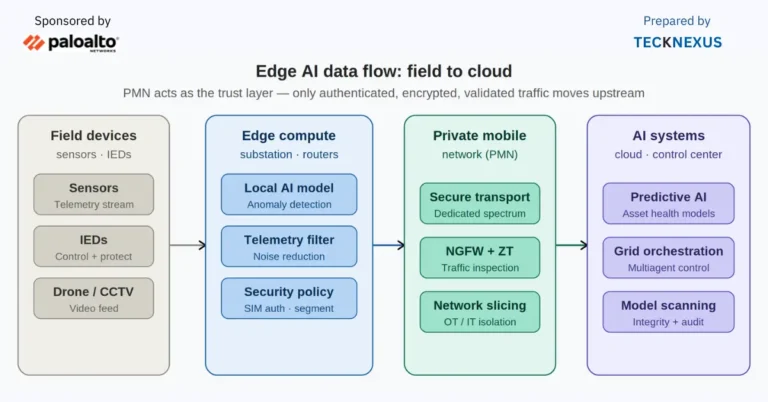
At the edge, AI workloads can filter noisy telemetry, detect anomalies close to the source, and reduce the volume of data that needs to be backhauled to the control center. For grid management applications, this means faster fault detection and isolation, real-time load optimization, and predictive health monitoring based on actual equipment conditions rather than maintenance schedules.
The shift from reactive to predictive operations is particularly significant for O&M economics. Traditional scheduled or reactive maintenance approaches can stress operations and maintenance budgets. With AI-powered intelligent analytics systems, however, utilities can move to predictive health monitoring systems that are asset-specific, data-driven, and condition-based, signaling for maintenance only when needed. Based on historical operations and near-real-time data feeds, these models empower utilities to avoid truck rolls based on usage or calendar cycles. These monitoring systems also incorporate AI-driven prescriptive elements that provide O&M action recommendations, give decision makers actionable intelligence, and deliver a holistic view of asset health.
Beyond predictive maintenance, edge AI unlocks a broader range of operational improvements. Autonomous agents can manage localized grid functions independently — managing distributed energy resources, reconfiguring network topology, and improving performance under changing load conditions. This distributed architecture with multiple control nodes enables utilities to divide their networks into autonomous zones so that, when a disruption occurs, each zone can protect itself to avoid cascading failures. Taking this further, multiagent systems allow for collaborative operations where information is shared, and agents collectively manage grid performance with visibility into neighboring zones and the larger network – transforming the grid into a dynamic, self-organizing system that can adapt in real time to internal and external forces.
The full scope of AI-enabled applications is expanding rapidly. Line fault classification, load balancing and voltage regulation, EV demand prediction, drone imagery analysis, OT/IT anomaly detection, and protection scheme augmentation with predictive decisioning are all active use cases — each delivering measurable improvements to reliability, efficiency, and cost.
The Security Requirements of Distributed Intelligence
Edge AI creates new dependencies that utilities must protect. While AI can bring added value, it also creates new challenges as more devices, assets, models, and data now populate and communicate across every level of the network. They can expose a vast new landscape of attack vectors, resulting in spoofed data, poisoned models, and fake asset statuses.
AI models rely on trusted, accurate sensor inputs – if that data is tampered with or spoofed, the model’s outputs are compromised. Edge devices process sensitive operational data in environments that are physically distributed and harder to physically secure than a central data center. Command outputs from edge AI systems demand secure execution in real time, with no tolerance for interception or manipulation.
Forward-thinking utilities are boosting efficiency and speed by deploying AI-capable devices at the network edge to process sensor data locally for real-time applications like grid management and predictive maintenance. The effectiveness of these systems hinges on trusted, accurate sensor data. But they are vulnerable to serious security threats like data tampering, spoofing, meddler-in-the-middle attacks, and AI model poisoning, which could lead to catastrophic failures.
This creates a specific challenge: the attack surface expands with every edge node added to the network. Each substation gateway, each field router hosting a local AI application, each sensor feeding data into an edge model is a potential entry point for adversaries seeking to corrupt the system’s operational intelligence.
Hardened Edge Routers as Dual-Purpose Infrastructure
The architecture that addresses this challenge treats edge routers not as passive infrastructure, but as active security enforcement points. Utilities must treat edge security as an enforcement zone, where policies are consistently applied regardless of the access medium. SIM-based authentication ensures that only authorized devices can connect, while segmentation policies isolate telemetry, control, and fault data streams.
Hardened edge routers, such as those deployed in substations and renewable energy sites, now serve a dual role: routing traffic while hosting local security functions and, increasingly, lightweight AI applications. These edge AI workloads filter noisy telemetry, detect anomalies close to the source, and reduce traffic backhaul to the control center – expanding both the intelligence and resilience of the private mobile network.
This co-location of intelligence and security enforcement means that anomaly detection happens close to the data source, not after data has traversed the full network to a centralized monitoring system. The response is faster, and the exposure window is narrower.
Continuous Monitoring Across a Hybrid Landscape
A utility’s communications environment typically spans cellular, narrowband, broadband power line communication, and Wi-Fi – each with its own telemetry, interference patterns, and attack surfaces. End-to-end visibility across this entire landscape is essential for secure edge AI operations.
AI and ML are particularly effective in this context. By correlating events across access technologies and transport domains, they can detect patterns that human operators might miss — examples include radio frequency interference suggesting a jamming attack, an unauthorized device joining over Wi-Fi, or an unexpected topology shift in the LTE domain.
The stakes of inadequate monitoring are not theoretical. Real-world campaigns like Volt Typhoon highlight what state-sponsored adversaries can do when they “live off the land,” blending malicious activity with normal traffic to avoid detection. Utilities can hope to identify such threats before they cascade into operational disruption only by embedding continuous, AI-driven monitoring into the private mobile network.
Edge intelligence and edge security are not competing priorities. They are two sides of the same deployment decision. Utilities must build a security framework on the foundation of private mobile networks to maintain grid reliability and resiliency. The substation of the future is smart and hardened, or it is neither.
Assess Your Utility’s Private Network Security
TeckNexus has developed a free Private Network Security Assessment for Utilities, co-created with Palo Alto Networks. The 5-section assessment maps your security gaps to real threat scenarios – including Salt Typhoon, Volt Typhoon, AI data poisoning, and unencrypted OT traffic — and delivers a prioritised action plan tailored to your environment. Launch the Free Private Network Security Assessment.
Related Tools
Haven’t yet determined which private network technology fits your utility environment? Start here. 17 questions, 8 minutes, free – Private Network Technology Selector.
Determine who should own your network infrastructure, where your data sits, and how to structure vendor engagement. 15 questions, 6 minutes, free – Private Network Architecture Selector.