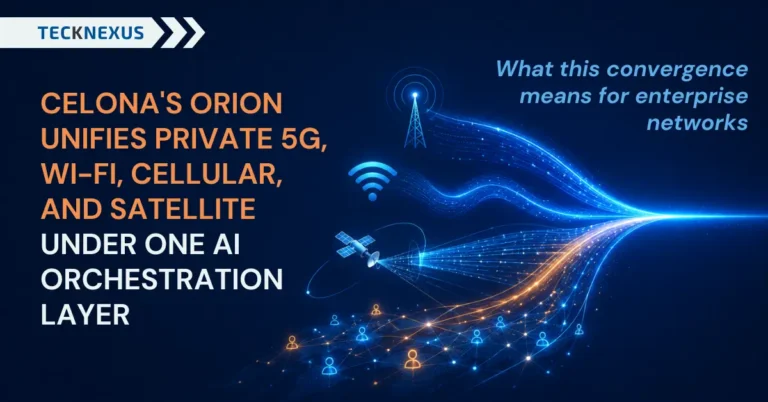
Celona’s launch of Orion this August is a useful window into where converged wireless architecture is heading. The platform unifies private 5G, Wi-Fi, public cellular, and satellite connectivity into what Celona describes as a single deterministic, secure fabric, adds an Orchestrator AI layer for managing operations across that combined network, and packages Wi-Fi 7 access points into a single subscription alongside the cellular components. For a buyer evaluating private network architecture, it’s worth understanding both what convergence across four connectivity technologies actually solves operationally, and what an AI orchestration layer spanning that convergence can add on top of it.

Why Multi-Technology Convergence Is a Meaningful Architectural Advance
Private 5G, enterprise Wi-Fi, public cellular roaming, and satellite backhaul have historically been managed as separate systems, each with its own management console, its own policy model, and its own operational team or vendor relationship, even within a single enterprise site. The practical pain this creates is well understood: policy inconsistency across technologies — a security or QoS rule enforced on the private 5G network but not mirrored on the Wi-Fi network covering the same physical space — operational overhead from managing multiple consoles, and handoff complexity when a device or application needs to move between connectivity types, such as a vehicle moving from cellular coverage into a satellite-backhauled remote area.
A unified management plane across all four technologies addresses that pain directly, and it’s a genuinely difficult architectural problem to solve well — bringing four historically distinct connectivity domains under one policy and orchestration model requires deep integration work across radio access, core network, and management layers that don’t share a common heritage. Celona‘s approach of building this from a single deterministic fabric, rather than layering a shared dashboard over otherwise separately managed systems, is the more technically ambitious path, and it’s worth enterprises understanding the distinction between the two approaches when comparing converged wireless options generally, since they deliver meaningfully different operational outcomes even when described in similar language.
The practical operational value of this kind of convergence shows up most clearly in sites with genuinely mixed connectivity needs across a single physical footprint — a large industrial campus, for instance, where fixed equipment and control systems run over private 5G, office and administrative areas run over Wi-Fi, field staff carry devices that need public cellular roaming when they leave the site, and remote monitoring equipment at the edge of the property relies on satellite backhaul where terrestrial coverage doesn’t reach. Managing security policy, device onboarding, and performance monitoring consistently across all four of those connectivity types today typically means stitching together separate systems and separate operational processes. A genuinely unified fabric collapses that into a single operational model, which is a meaningful simplification for network operations teams supporting exactly this kind of mixed-technology site.
What Orchestrator AI Adds Across a Converged Network
The AI orchestration layer, as described, is positioned to manage agentic operations across the combined network — automated policy enforcement, anomaly detection, and operational decision-making spanning all four connectivity types rather than being scoped to just the cellular portion of the network. That’s a substantial capability if it spans the full convergence Celona describes: a security policy applied on the cellular network propagating automatically to the Wi-Fi and satellite layers, for instance, removes a category of manual configuration work and policy-drift risk that has been a persistent operational burden for enterprises running multi-technology wireless estates. For any enterprise evaluating a converged platform, understanding how far an AI orchestration layer’s automation extends across the connectivity stack is a useful part of scoping the operational value it will deliver for a specific site’s mix of private 5G, Wi-Fi, cellular, and satellite requirements.
The Subscription Bundling Model Worth Understanding
Celona including Wi-Fi 7 access points within a single subscription alongside the cellular and orchestration components is a commercial packaging choice worth understanding on its own terms. Bundling connectivity hardware and the management and orchestration layer into one subscription simplifies procurement meaningfully — a single vendor relationship and a single commercial agreement rather than separate hardware and software line items, with the connectivity, orchestration, and hardware refresh cycle all coordinated by one provider rather than requiring the enterprise to manage integration across multiple vendor relationships itself. That consolidation is a real operational simplification, and it’s the kind of trade-off enterprises should weigh against their own preference for single-vendor versus multi-vendor architecture more broadly, a preference that varies reasonably by organisation and existing vendor relationships rather than having a universally correct answer.
Where This Fits Against the Broader Converged Connectivity Trend
Celona’s approach reflects where the broader converged wireless category is heading more generally. As enterprises increasingly operate a genuine mix of private 5G, enterprise Wi-Fi, public cellular for roaming or backup, and satellite for remote or maritime coverage, the market is responding with unified management approaches designed to reduce the operational complexity that mix has historically created. As more platforms move in this direction, the useful question for any enterprise to bring to its own evaluation is how deeply the convergence and orchestration spans each connectivity type for its specific site requirements, since that’s what determines how much of the operational simplification a converged platform is designed to deliver actually shows up in day-to-day network management for that particular deployment.
Wi-Fi 7 access points being included as part of Orion’s converged subscription is also worth noting on its own technical merits, separate from the bundling decision. Wi-Fi 7 brings meaningfully higher throughput and lower latency than previous Wi-Fi generations, along with multi-link operation that lets devices use multiple frequency bands simultaneously for improved reliability — capabilities that pair naturally with a converged fabric’s aim of delivering consistent performance characteristics regardless of which underlying connectivity technology a given device or application is actually using at a given moment. For enterprises planning a Wi-Fi refresh alongside a private 5G or converged wireless deployment, timing that refresh to align with the latest Wi-Fi generation is a sensible way to get full value from both the connectivity upgrade and the unified management layer sitting on top of it.
Explore the full TeckNexus Intelligence Platform — independent, buyer-neutral tools for private network and industrial AI decisions. https://tecknexus.com/intelligence/