

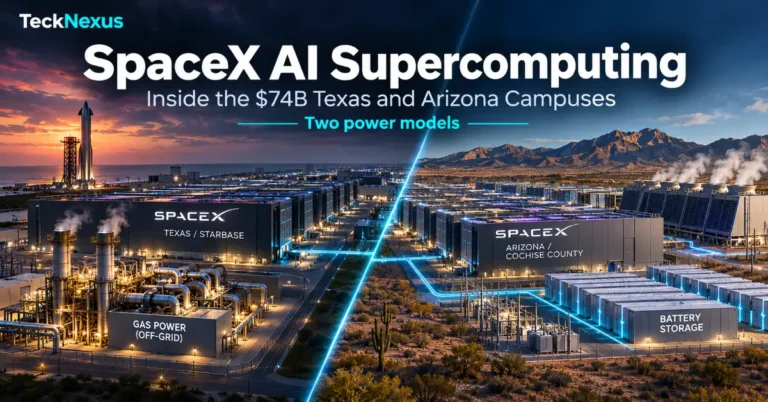
SpaceX has committed more than $74 billion to two AI supercomputing campuses: a site of roughly 444 acres at Starbase in Texas’ Rio Grande Valley, budgeted at over $24 billion, and a campus of about 747 acres in Cochise County, Arizona, at around $50 billion. The headline number is large, but the more instructive story sits in the engineering choices. The two campuses take almost opposite approaches to the problem every AI infrastructure builder now faces first: where the power comes from, and what the surrounding community gives up to supply it.

Read side by side, the projects work as a live experiment in two siting templates for gigawatt-class compute. One islands itself from the public grid. The other tries to make itself useful to the grid. Which template proves faster to permit, cheaper to run and easier to defend locally will influence AI campus design well beyond SpaceX.

Why SpaceX AI supercomputing has outgrown its current footprint
The scale of the new campuses only makes sense against how quickly the AI business has become the centre of gravity for the company. In the third quarter of 2026, SpaceX reported total revenue of about $14.6 billion, of which roughly $7.56 billion came from its AI unit, now branded Super Intelligence. That unit overtook the connectivity business, including Starlink, for the first time. Most of that revenue comes from leasing data centre capacity to AI developers rather than from SpaceX’s own models, which makes the unit behave more like a specialist cloud provider than an AI lab.
Spending is moving even faster. Third-quarter capital expenditure reached $19.6 billion, with around $16.4 billion going to AI, and the company guided to $35 billion to $40 billion of capex in the fourth quarter. Installed compute stood at 1.7 GW at the end of September, with management targeting about 3 GW by the end of the year. The company has also said that, at current pricing, new compute deployments pay back in under a year.
Here is the detail that reframes the announcement. The Cochise County land use application describes up to 6 GW of load. On its own, the Arizona campus could therefore represent roughly double the entire fleet SpaceX expects to be running by the end of 2026. This is not incremental capacity. It is a step change that requires a power strategy designed from the ground up.

SpaceX AI supercomputing campuses compared
The two sites differ on almost every infrastructure dimension that matters to regulators, utilities and neighbours.
| Dimension | Starbase, Texas | Cochise County, Arizona |
| Planned investment | Over $24 billion | About $50 billion |
| Site | About 444 acres near the Port of Brownsville | About 747 acres near Willcox Playa, nine buildings |
| Power model | Off-grid, on-site gas-fired plant (about 708 to 748 MW, depending on turbine option) | Grid-connected via local co-ops, 24 GWh battery, 90 MW gas backup, up to 6 GW load |
| Grid investment | Not grid-connected | $3.6 billion of transmission upgrades to be transferred to the regional co-op |
| Water approach | $220 million to add 20 million gallons per day to local water and wastewater capacity | Dry cooling, no cooling towers, about 7 to 10 acre-feet per year on site |
| Jobs | 3,000+ construction (already created), 500+ permanent | About 5,500 construction, about 1,000 permanent |
| Next decision point | City commission vote on tax abatement, 9 December | County planning and zoning hearing, 9 December |
Starbase: SpaceX AI supercomputing behind the meter
At Starbase, SpaceX plans to build, own and operate a gas-fired power plant on site rather than draw from the Texas grid. The state air registration describes two alternative configurations: 35 temporary turbines totalling about 748 MW, or eight GE Vernova 7E units totalling about 708 MW. The proposed nitrogen oxide limit of 248.86 tons per year sits just under the 250-ton federal major-source threshold, which keeps the plant within the state’s standard permit pathway for electric generating units. A proposed eight-mile pipeline would supply the fuel.
The logic of islanding is speed. Interconnection queues for large loads have become one of the longest lead-time items in data centre development, and a behind-the-meter plant removes that dependency. It also removes any argument that the campus is raising costs for other grid customers, a concern now central to data centre politics across the US.
The trade-off is that the regulatory risk moves rather than disappears. Texas paused grid-connection approvals for large loads in August and extended the pause to environmental permitting in September, and it remains unclear how that directive applies to standard permits for islanded facilities. The air registration was still pending as of the announcement. An incoming state administration in January has also signalled interest in a moratorium on data centre approvals pending new legislative protections. For an off-grid design, the permit for the power plant effectively becomes the permit for the campus.
Water is handled through a separate commitment: $220 million of private capital to expand Brownsville’s water and wastewater infrastructure by 20 million gallons per day, independently of the Rio Grande. Funding public capacity rather than simply consuming it is an increasingly common way for large campuses to secure local support, and here it is unusually explicit.
Cochise County: SpaceX AI supercomputing built with the grid
The Arizona campus inverts the Starbase model. Instead of separating from the grid, SpaceX proposes to work with local electric cooperatives, draw on existing renewable generation, and fund $3.6 billion of transmission upgrades that it says will be transferred to the regional generation co-op at no cost. A 24 GWh battery system and 90 MW of gas backup complete the power design.
The battery figure deserves attention. Against a full 6 GW load, 24 GWh equates to roughly four hours of storage. That is enough to shift consumption away from evening peaks, absorb surplus solar in the middle of the day and, in principle, support the wider network during stress events. This is the basis for the company’s claim that co-op members could see bills fall by up to 20%. No independent analysis of that figure has been published yet, and the local distribution co-op expects to file its next rate case in autumn 2027, which will be the first formal test of how the economics flow through to members.
Cooling is the other deliberate choice. In a desert county where groundwater is the most sensitive local issue, the campus is designed around dry cooling with no cooling towers and no planned industrial groundwater use, consuming an estimated 7 to 10 acre-feet per year on site after an initial fill of a few million gallons. Indirect water use from power generation cannot yet be estimated because the supply mix has not been disclosed. Dry cooling typically carries an energy penalty in hot climates, so the efficiency of the cooling design will matter as much as the water saving.
Community concerns are real and organised. Hundreds of residents attended a community meeting on 4 November to raise questions on water, power bills and wildlife, and a petition opposing the permit has gathered about 2,400 signatures.
What the SpaceX AI supercomputing build-out signals for digital infrastructure
Beyond the specifics of two sites, the announcement crystallises several shifts that will shape how large-scale AI infrastructure is planned over the next few years.
- Power strategy is now site selection. Both campuses were clearly located around an energy plan first and a network or customer plan second. The choice between islanded generation and grid partnership is becoming the defining architectural decision for gigawatt-class campuses.
- Water design is a licence to operate. One campus funds new public water capacity; the other engineers water out of the cooling loop. Either way, water has moved from an operational input to a precondition for approval.
- Community benefit is being engineered in, not bolted on. Transmission upgrades gifted to a co-op, a promised bill reduction and privately funded water infrastructure are all attempts to make the campus a net contributor to local systems.
- Equipment supply chains are the next bottleneck. Self-generation and grid expansion at this scale pull heavily on turbines, transformers, switchgear and high-voltage cable. SpaceX has said it will apply its own metal casting capability to turbine blades and vanes, a sign of how constrained that supply has become.
- Remote megasites raise the stakes for connectivity. Campuses of this size in the Rio Grande Valley and south-east Arizona will depend on high-capacity long-haul fibre and data centre interconnect to reach the AI developers renting the capacity. Starbase also sits beside the launch site that SpaceX sees as central to its longer-term ambition for orbital computing, linking terrestrial and space-based infrastructure planning in a way no other AI cloud provider can.
Key dates for the SpaceX AI supercomputing approvals
The coming weeks will determine whether both campuses proceed on the timelines the company has outlined.
- 9 December, afternoon (Arizona time): Cochise County Planning and Zoning Commission public hearing on the campus permit. Reporting differs on whether the commission’s decision is final or can be appealed to the Board of Supervisors.
- 9 December, evening (Central time): Starbase City Commission considers a property tax abatement and development agreement.
- 10 December: Texas grid officials aim to file audit reports linked to the pause on large-load approvals.
- 19 January: Change of administration in Texas, with a stated intention to pause data centre approvals until new protections are legislated.
The bigger picture
Strip away the dollar figures and the SpaceX announcement is a clear statement that AI compute is now an energy, water and land-use business as much as a technology business. The company has chosen to test both of the main answers to the power question at once, in two states with very different regulatory climates. The outcome of the December hearings, the Texas permitting pause and the eventual Arizona rate case will give the wider industry some of the first hard evidence on which model scales faster and earns local consent more reliably.
For a monthly view of how AI infrastructure, private networks and advanced connectivity are evolving, explore TeckNexus Monthly Insights. For deeper coverage of AI campuses, power strategy and data centre connectivity, visit the TeckNexus Data Centers and Digital Infrastructure hub.