

Most physical AI headlines focus on the brains: vision-language-action models, robot foundation models and the GPUs that train them. Far less attention goes to the moment a machine first touches the world, when streams from cameras, LiDAR, radar, force sensors and encoders arrive in different formats, at different rates and with different timing, and must be turned into something an AI model can act on safely.

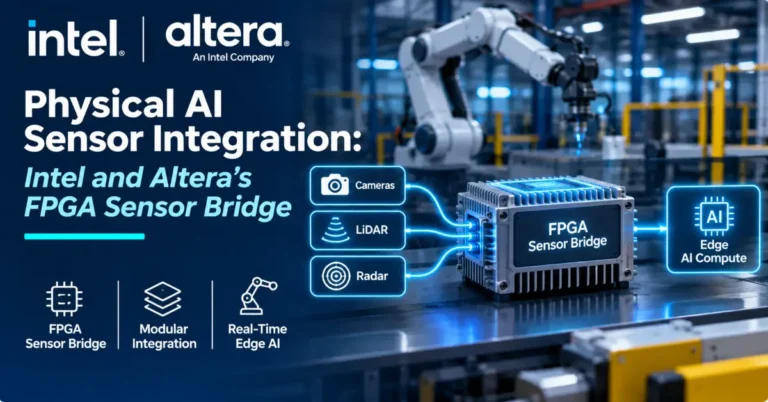
That first hop is where Intel and Altera have chosen to focus. On 10 November the two companies announced a collaboration to develop modular, real-time sensor-bridge reference solutions for edge and physical AI systems, combining Altera’s programmable FPGAs with Intel compute, connectivity and software. The announcement is modest in scope, with no product launch or availability date, but it says a great deal about where the engineering bottlenecks in physical AI now sit.

The physical AI sensor integration problem
A modern autonomous machine rarely relies on one sensor type. A mobile robot might combine several cameras, a LiDAR unit, short-range radar, inertial measurement and motor feedback. A surgical or imaging system can ingest high-resolution video alongside precise positional data. Each sensor speaks its own interface, from MIPI CSI-2 and SLVS-EC to GMSL and FPD-Link, and produces data at its own cadence.
For an AI system to perceive accurately, those streams need to be aggregated, synchronised to a common clock, pre-processed and passed to compute with predictable latency. For it to act safely, the control path needs deterministic timing, which general-purpose processors and GPUs are not designed to guarantee. Today, much of this work is solved with custom hardware for each product, which slows development and makes every new sensor or model change expensive.
What Intel and Altera are building for physical AI sensor integration
The collaboration aims to give equipment makers a reusable foundation instead. Altera FPGAs handle sensor connectivity, aggregation, pre-processing and deterministic control, while a host Intel processor runs the AI and application workloads. Software support spans Intel’s Open Edge Platform SDK, an Altera SDK and, for robotics, Intel’s robotics software stack.

Three initial domains are named:
- Healthcare: a jointly developed reference solution for advanced medical equipment with strict latency and real-time requirements.
- Aerospace and defence: reference designs for next-generation mission systems where size, weight and power constraints apply to converged AI and signal-processing workloads.
- Robotics: Intel compute, connectivity and robotics software paired with Altera FPGAs to address sensing, timing and real-time processing.
The central argument for FPGAs is adaptability. Because the logic can be reprogrammed after deployment, a design can support new sensor types, revised interfaces or updated AI models without a hardware respin. In a field where sensor suites and models are changing every product cycle, that flexibility shortens the path from prototype to production, which is the stated goal of both companies.
The wider physical AI sensor integration roadmap at Altera and Intel
The sensor bridge sits on top of a busy year for both companies. Altera, now operating as an independent company after Intel sold a majority stake to Silver Lake, unveiled its Agilex 2X portfolio in late October. It spans four families. Agilex 27 targets AI infrastructure, terabit networking, 6G and satellite networks; Agilex 25 is aimed at high-resolution video, drones and low-latency sensors; Agilex 23 combines real-time processing with functional safety for robotics, industrial automation and automotive; and Agilex 22 covers high-I/O control functions. Altera claims a 1.8 times performance-per-watt gain for Agilex 27 over Agilex 7, with samples planned for the second half of 2027. A new AI design companion, QuartusIQ, is intended to speed FPGA development.
Altera has also been working with Nvidia on a 100G FPGA-based Holoscan sensor bridge for medical physical AI, which shows the company positioning its FPGAs as a neutral sensor-to-compute layer that can sit in front of different processors.
Intel, for its part, has been building its edge physical AI stack from the compute side. Its Core Ultra Series 3 processors, the first products on the Intel 18A process, had more than 130 edge design engagements by mid-2026, and the company introduced OpenVINO Physical AI, an open-source robotics framework, alongside its Physical AI Studio tools. Intel’s pitch is consolidation: running real-time control and AI inference on a single system-on-chip rather than pairing a CPU with a separate accelerator. The FPGA sensor bridge extends that consolidation outward to the sensors themselves.
Where physical AI sensor integration fits in the full stack
It helps to see physical AI as a stack of distinct layers, each attracting its own investment and partnerships. Recent announcements from chipmakers and operators map neatly onto it.
| Layer | Role | Recent example |
| Sensor bridge | Aggregate, synchronise and pre-process sensor streams with deterministic timing | Intel and Altera sensor-bridge reference solutions |
| Edge compute | Run perception, AI inference and control on or near the machine | Intel Core Ultra Series 3 with OpenVINO Physical AI |
| Connectivity | Link machines, fleets and edge sites with reliable, low-latency networks | Private 5G, Wi-Fi and time-sensitive networking; Agilex 27 targeting 6G and satellite |
| Training and simulation | Develop and test models and digital twins before deployment | Deutsche Telekom‘s Industrial AI Cloud serving robotics and simulation users |
The sensor bridge is the least visible of these layers, but errors introduced there propagate everywhere else. A model trained on well-synchronised simulation data will underperform if the real sensor feed is misaligned by a few milliseconds. That is why deterministic, programmable front ends are drawing attention just as physical AI moves from pilots towards fleet deployment.
What physical AI sensor integration means for connected machines
For the connectivity industry, the collaboration is a reminder that physical AI is not only a compute story. Once sensor data is cleaned and time-aligned at the edge, decisions about what stays local and what travels over the network become clearer. Time-critical control loops remain on the machine, while aggregated perception data, fleet telemetry and model updates move over private 5G, Wi-Fi or wired industrial networks to edge servers and cloud training environments.
Several implications follow:
- Cleaner data at the source reduces network load. Pre-processing and fusion on the FPGA can shrink what needs to be transmitted, making fleet-scale deployments more practical over shared wireless networks.
- Timing becomes an end-to-end requirement. Deterministic behaviour at the sensor is only valuable if the network carrying coordination traffic can also deliver predictable latency, raising the profile of time-sensitive networking and 5G features designed for industrial control.
- The same silicon spans machine and network. With Agilex 27 aimed at 6G and satellite infrastructure and Agilex 23 at robotics, programmable logic is appearing at both ends of the physical AI connection.
- Reference designs speed ecosystem adoption. Equipment makers in healthcare, defence and robotics can start from validated building blocks, which should shorten the gap between connected prototypes and certified products.
The Intel and Altera collaboration does not yet come with availability dates or customer names, and its impact will depend on how quickly the reference solutions reach equipment makers. But the direction is clear. As physical AI matures, competition is spreading from training clusters and inference chips to the unglamorous layer where machines first sense the world, and that layer is becoming a platform in its own right.
For a monthly view of how physical AI, private networks and advanced connectivity are evolving, explore TeckNexus Monthly Insights. If your organisation is building in this space and wants to share its perspective with our audience while generating qualified leads, partner with TeckNexus.