





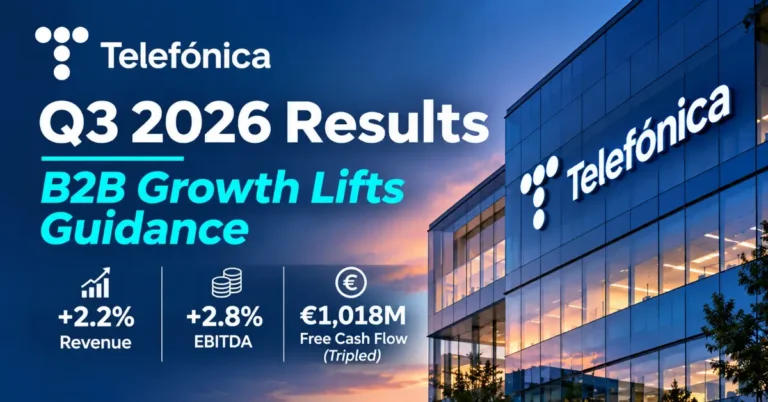
Telefónica’s third-quarter 2026 results mark a clear step forward in the operator’s Transform and Grow plan. Revenue reached €8.43 billion, up 2.2% at constant currency, the fourth consecutive quarter of growth in both constant and reported terms. Adjusted EBITDA rose 2.8% to €3.08 billion, with margin expanding by 0.8 points, and free cash flow climbed to €1,018 million, more than three times the figure a year earlier. For the first nine months, the group is back in profit at €464 million, compared with a loss of €1.08 billion in the same period of 2025.

On the strength of those numbers, Telefónica raised its full-year targets for adjusted EBITDA, operating cash flow after leases and free cash flow, while narrowing revenue guidance to reflect a softer handset market over the year. The combination is telling. Telefónica is growing the parts of the business it controls most directly, such as services, enterprise solutions and cost efficiency, and is less dependent on device sales to deliver results.

Telefónica Q3 2026 results at a glance
| Metric | Q3 2026 | Change |
| Revenue | €8.43bn | +2.2% constant currency |
| Service revenue | Growth accelerated | +1.8%, up 0.9 points on Q2 |
| Handset sales | Returned to growth | +7.4% in the quarter |
| Adjusted EBITDA | €3.08bn | +2.8%, margin up 0.8 points |
| Free cash flow | €1,018m | Up from €318m in Q3 2025 |
| B2B revenue | Strongest growth line | +5.6% in the quarter |
| Net financial debt | €25.2bn | Down €1.6bn since December 2025 |
| Leverage | 2.63x adjusted EBITDA | From 2.78x at end of 2025 |
Quarterly free cash flow benefited from a tax refund in Spain, but the underlying trend is also positive: nine-month free cash flow of almost €2 billion is up 10.7%, and operating cash flow after leases grew 7.2% in the quarter. Capital intensity held at around 12% of revenue, in line with the company’s plan.
How Telefónica Q3 guidance changed
The revision tells the story of the quarter in four lines. Every profitability and cash target moved up; only revenue, where handset volumes are outside the operator’s control, moved down.
| 2026 guidance metric | Previous target | Updated target |
| Revenue growth | 1.5% to 2.5% | 1% to 1.5% |
| Adjusted EBITDA growth | 1.5% to 2.5% | Slightly above 2.5% |
| Adjusted operating cash flow after leases | Over 3% | Over 3.5% |
| Free cash flow | About €3.0bn | About €3.1bn |
This is the second consecutive quarter in which Telefónica has raised its cash flow ambitions. The 2026 cash dividend of €0.15 per share, payable in June 2027, was reaffirmed.

Telefónica Q3 in context: the 2026 trend from Q1 to Q3
The nine-month totals in the Q3 release confirm the year’s direction but smooth over its shape. Setting the three quarters side by side shows a business that has strengthened steadily through 2026, with growth, cash generation and guidance all building quarter by quarter.
| Metric (constant currency) | Q1 2026 | Q2 2026 | Q3 2026 |
| Revenue growth | +0.8% | Flat | +2.2% |
| Service revenue growth | +1.1% | +0.9% | +1.8% |
| Adjusted EBITDA growth | +1.8% | +2.7% | +2.8% |
| Adjusted OpCFaL growth | +2.4% | +2.9% | +7.2% |
| B2B revenue growth | +5.7% | +6.7% | +5.6% |
| Free cash flow | €333m | €611m | €1,018m |
| Net financial debt | €25.34bn | €25.28bn | €25.19bn |
| Leverage (net debt / EBITDAaL) | 2.72x | 2.68x | 2.63x |
| Guidance action | Reaffirmed | OpCFaL raised to over 3% | EBITDA, OpCFaL and FCF raised; revenue lowered |
Several consistent patterns emerge from the year so far:
- Profitability building every quarter: adjusted EBITDA growth has stepped up from 1.8% to 2.8%, with margins expanding as restructuring savings in Spain and Germany flow through.
- Cash generation accelerating: free cash flow has risen each quarter, from €333 million to €1,018 million. Q3 includes a €334 million tax refund in Spain, but operating cash flow growth of 7.2% shows the underlying trend is also strengthening.
- Guidance moving in one direction: Telefónica reaffirmed its targets in Q1, made a single upgrade in Q2 and a broad upgrade in Q3. Every change to profitability and cash targets this year has been upward.
- B2B as a constant: enterprise revenue has grown between 5.6% and 6.7% in every quarter, around four times the pace of consumer revenue in Q1 and Q2, making it the most reliable growth line in the group. In Q3 consumer growth picked up to 3.9%, narrowing the gap, but B2B still led.
- Steady deleveraging: leverage has fallen in each quarter, from 2.78 times at the end of 2025 to 2.63 times, keeping the 2028 target of 2.5 times firmly in view.
The variations are just as instructive. Handsets explain the revenue revision: device sales fell almost 10% in Q2 before rebounding 7.4% in Q3, leaving the nine-month figure down 1.8%, which is why revenue guidance moved lower even as service revenue accelerated. Germany is the clearest turnaround story, with the revenue decline narrowing from double digits in Q2, when the 1&1 customer migration weighed most heavily, to around 3% in Q3. Brazil has been the most consistent performer, growing revenue above 7% in every quarter.
Telefónica Q3 performance across Spain, Brazil, Germany and the UK
Growth was led by the two markets where Telefónica holds its strongest positions, while Germany and the UK joint venture are in the middle of deliberate restructuring programmes.
- Spain: Revenue grew close to 3%, delivering the strongest nine-month growth in more than 15 years. ARPU rose 1.2%, convergent churn reached record lows, and the business has been reorganised into B2B, B2C and wholesale units, with the B2B unit combined with Telefónica Tech.
- Brazil (Vivo): Revenue grew 7.2% at constant currency, the fourth straight quarter above 7%, with adjusted EBITDA up 20.2% to €1,258 million at a 46% margin. Fibre additions continue at around 200,000 per quarter.
- Germany: Contract additions and fixed revenue continued to grow and around 1,100 new 4G and 5G sites were added in nine months, while EBITDA reflected roaming costs, marketing investment and the timing of savings. A voluntary exit programme has been completed, with management targeting a return to profitable growth in 2027.
- UK (Virgin Media O2): The non-consolidated joint venture is executing a transformation programme targeting around £800 million in run-rate operating and capital savings by 2029, alongside extending 2 Gig broadband across its cable footprint.
Why B2B is the engine of Telefónica Q3 growth
Enterprise is now the fastest growing part of Telefónica’s business. B2B revenue rose 6.0% at constant currency over nine months to €5.95 billion, against 2.2% for consumer, and grew 5.6% in the third quarter. Digital services are driving that performance: cloud and cybersecurity revenues are growing at double-digit rates in Brazil, Spain has launched round-the-clock managed detection and response for small and medium businesses, Vivo has partnered with Palo Alto Networks, and the UK business added satellite connectivity for enterprise customers.
The reorganisation in Spain is significant here. Combining the B2B unit with Telefónica Tech gives enterprise customers a single route to connectivity, cloud, cybersecurity and IT services, which is how large organisations increasingly want to buy. It also positions Telefónica for the strategic, sovereignty-driven contracts appearing across Europe. In recent months the company has been selected with Indra to build communications and security infrastructure for a future digital euro, is part of a consortium whose AI Gigafactory bid won European Commission approval, and has been expanding its defence 5G work with NATO and allied ministries.
These are long-cycle, high-trust engagements that sit well beyond traditional telecom services. They reward operators that combine national network scale with security credentials and a credible technology partner ecosystem, and Telefónica’s results suggest that mix is beginning to show up in the numbers.
AI and simplification behind Telefónica Q3 margins
Margin expansion owes a great deal to a simpler, more automated operating model. Telefónica is applying AI across customer care and network operations in its main markets:
- Customer care automation: in Germany, more than 80% of in-care customer interactions are now supported by AI.
- Personalised sales: Vivo uses AI to tailor product information to customers in Brazil.
- Network operations: early automation of network operations is under way in Germany.
Paired with organisational redesign in Spain, Germany and the UK, these programmes underpin the higher EBITDA guidance. They also show how AI is moving from pilot to measurable operating impact inside large operators, a theme that will shape telecom cost structures across Europe over the next several years.
Balance sheet strength supports the Telefónica Q3 outlook
Deleveraging remains a central priority. Net financial debt fell by €1.6 billion over nine months to €25.2 billion, helped by free cash flow and net financial divestments, and leverage improved to 2.63 times adjusted EBITDA against a target of 2.5 times by 2028. About half of the debt carries fixed coupons, average interest cost has fallen to 2.85% from 3.05%, average debt life is more than 11 years, and liquidity stands at €17.5 billion.
That financial headroom matters strategically. It gives Telefónica room to keep investing in fibre and 5G, where fibre premises passed have reached 77.6 million and 5G covers 83% of the population in its core markets, while continuing to fund the B2B, AI and sovereign technology initiatives that are now driving growth.
What to watch after Telefónica Q3 2026
Three signals will define the next few quarters. The first is whether Germany delivers the EBITDA recovery management expects as service revenue improves and savings take full effect in 2027. The second is how quickly B2B and Telefónica Tech can scale sovereign cloud, cybersecurity, AI infrastructure and defence work into recurring revenue. The third is the pace of deleveraging towards the 2028 target as the portfolio is simplified further.
On the evidence of this quarter, Telefónica is becoming a leaner, more enterprise-focused and more cash-generative operator, with a growing role in Europe’s digital sovereignty agenda.
For more insights, read the latest TeckNexus Monthly Insights newsletters at https://tecknexus.com/contenttype/newsletters/. Want to share your perspective with the TeckNexus community and generate qualified leads? Partner with TeckNexus at https://tecknexus.com/intelligence-programs/.