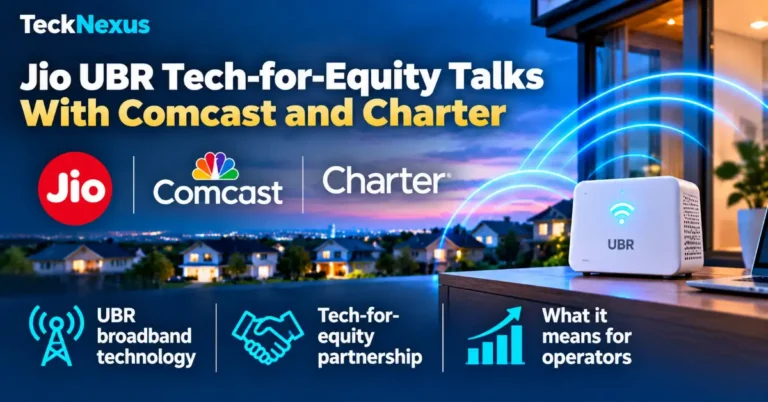
Jio Platforms has held talks with several companies, including US cable operators Comcast and Charter Communications, about licensing its wireless home broadband technology in exchange for potential equity stakes, according to a Reuters report published on 3 November 2026 that cites people familiar with the matter. Discussions with South Africa’s MTN Group were also held but did not progress, reportedly over valuation and licensing terms. The sources said there is no timetable for a deal with any party, and none of the companies has confirmed the talks.

The report follows Jio’s own statement, made in the week of its record $3.2 billion listing in Mumbai, that it is targeting 10 to 15 sizeable international partners for the platform. The technology at the centre of the talks is Jio‘s unlicensed band radio, or UBR, which delivers home broadband over Wi-Fi frequencies from transmitters on nearby towers or rooftops to receivers on customers’ buildings, with no cable to the home.
Read quickly, this is a story about an Indian operator looking for growth abroad after a big IPO. Read in context, it says something more interesting about how the telecom industry is changing. An operator that built its own network technology at enormous scale for its home market now wants to sell that technology to some of the largest broadband providers in the world, and to be paid partly in ownership. That is a different business model from the one operators have traditionally followed, and it could become a recurring pattern.
Jio’s Tech-for-Equity Talks at a Glance
| Item | Detail |
| Status | Reported exploratory talks; not confirmed by the companies; no timetable |
| Technology | Jio unlicensed band radio (UBR) home broadband, delivered over unlicensed Wi-Fi spectrum |
| Proposed model | Licensing Jio’s technology in exchange for potential equity stakes in partner businesses |
| Companies named | Comcast and Charter Communications (talks reported); MTN Group (talks did not progress) |
| Jio’s target | 10 to 15 sizeable international partnerships, across developed and developing markets |
| Scope of offer | UBR home broadband, plus Jio’s operational and business support systems (OSS/BSS) stack |
| Jio’s UBR scale | About 6.5 million customers on UBR-based connectivity in India |
| International leadership | Expansion co-led by Dan Bailey, a former Deutsche Bank technology, media and telecom executive, and Mathew Oommen |
| Context | Jio Platforms listed in Mumbai in late October 2026 after a record $3.2 billion IPO |
What Jio UBR Technology Is and Why It Can Travel
Jio built UBR to solve a problem every broadband provider faces: the last connection to the home is the most expensive part of the network. Fibre delivers excellent performance but requires civil works for every street and building. Fixed wireless access over licensed 5G spectrum avoids the digging but consumes capacity that operators also need for smartphones. UBR takes a third route, using shared unlicensed spectrum in the 5 GHz band to link network sites to homes.
| Last-mile option | How it reaches the home | Main strengths | Main considerations |
| Fibre to the home | Cable laid to each building | Highest capacity and long asset life | Cost and time of civil works per premises |
| Licensed 5G FWA | Mobile network radios to an indoor or outdoor receiver | Uses existing mobile sites; fast to activate | Shares licensed spectrum with mobile users |
| Unlicensed band radio (UBR) | Wi-Fi-band transmitters on towers or rooftops to receivers on buildings | No spectrum licence costs; no cable to the home; frees licensed spectrum for mobile | Shared spectrum, line-of-sight planning and local rules for unlicensed bands |
Two features make UBR more exportable than most operator-built technology. First, unlicensed spectrum is available in many countries without an auction, so a partner does not need new licences to deploy it. Second, Jio has already run the system at national scale, through several generations of its home broadband technology, and has the operating software to manage it. Industry analysts have pointed to rural markets in Africa, Southeast Asia and Australia as natural fits, subject to local regulation and line-of-sight conditions.
Jio’s leadership describes UBR as two and a half to three years ahead of the nearest alternatives and says senior executives from other operators have visited India to see it in operation.
Why US Cable Operators Could See Value in Jio UBR
At first glance, licensing a wireless home broadband technology might seem an unusual move for companies whose businesses are built on wired networks. Comcast had about 28.3 million residential broadband customers at the end of September 2026, and Charter had around 29.4 million internet customers in June. But the US home broadband market has become much more competitive, with fibre builders expanding and mobile operators signing up millions of fixed wireless customers. Several possible attractions stand out for cable:
- Extending reach beyond the cable plant. A wireless last mile can bring service to homes and communities where extending coaxial or fibre lines is uneconomic, using existing network sites as launch points.
- Responding to fixed wireless competition. Mobile operators’ FWA services have been among the fastest-growing sources of US broadband additions. A wireless option of cable’s own would let it compete on similar terms without relying on licensed mobile spectrum.
- Using the US’s generous unlicensed spectrum. The FCC opened 1,200 MHz of the 6 GHz band for unlicensed use in 2020, in addition to the long-established 5 GHz band. That is a substantial resource for any technology designed to deliver broadband over unlicensed frequencies.
- Easing pressure on licensed capacity. Akash Ambani has noted that in the US, around 3% of FWA customers consume about 65% of 5G FWA capacity. Moving heavy home broadband users onto unlicensed spectrum is precisely the problem UBR was designed to address.
Both cable operators also run mobile businesses and hold licensed CBRS spectrum, so they already think about wireless as a complement to their wired networks. A proven unlicensed home broadband platform would add another tool to that mix.
The Jio UBR Tech-for-Equity Model: The Operator as Technology Exporter
The most distinctive part of the story is the commercial model. Jio has said it intends to grow overseas as a technology-led business, preferring partnerships and joint ventures to acquiring operators or building networks itself. Licensing technology in exchange for equity fits that approach. The partner gains a proven platform without a large upfront payment, and Jio shares in the value its technology helps create.
Operators that build their own technology and then sell it to others are no longer unusual. Jio already owns Radisys, which supplies network software and systems to operators internationally. Japan‘s Rakuten created Rakuten Symphony to commercialise the cloud-native mobile platform it built for its own network. What is new in Jio’s case is the scale of the ambition and the willingness to take ownership stakes, which aligns Jio’s returns with the long-term success of each deployment.
Jio is also offering its OSS/BSS stack, the operating and billing software that runs a telecom business. Its executives have acknowledged that these discussions are more complex than those around UBR, because the software sits at the heart of an operator’s day-to-day operations. Taken together, UBR and OSS/BSS amount to an offer of a ready-made home broadband business rather than a single product.
What Has to Come Together for Jio UBR Partnerships Abroad
The reported talks are at an early stage, and the companies have given no timetable. For any international partnership, several elements will shape how quickly a deal moves from discussion to deployment:
- Commercial terms. Agreement on valuation and licensing structure, the areas where the MTN talks reportedly did not converge.
- Local spectrum rules. Power limits and conditions for unlicensed bands differ by country and affect range and capacity.
- Deployment conditions. Line-of-sight planning, rooftop access and site availability determine how widely the technology can be used in each market.
- Integration. Fitting a new access technology into an existing operator’s network, support processes and customer equipment.
- Local adaptation. Tailoring a system proven in Indian conditions to different housing types, usage patterns and customer expectations.
The Bigger Picture for Jio UBR and Global Broadband
Whether or not the talks with Comcast and Charter lead to agreements, they mark a notable moment for the telecom industry. For decades, technology flowed from equipment vendors to operators. Jio’s push suggests a growing role for operators that innovate at home and then export what they have built, with emerging-market scale and cost discipline as their advantage.
For the global broadband market, the story also highlights how much attention is shifting to the last mile. Fibre, licensed fixed wireless and unlicensed wireless are increasingly seen as complementary tools rather than rivals, and operators that can combine them flexibly will be best placed to reach every home economically.
The details to watch are which partners Jio signs first, whether they come from developed or developing markets, and how the tech-for-equity structure is applied in practice. Each will show how far an operator-built technology can travel.
For more analysis of broadband, fixed wireless and the operators reshaping connectivity, read TeckNexus Monthly Insights. Have a perspective on home broadband or wireless access technology to share? Partner with TeckNexus to put your insight in front of decision-makers and generate leads.