
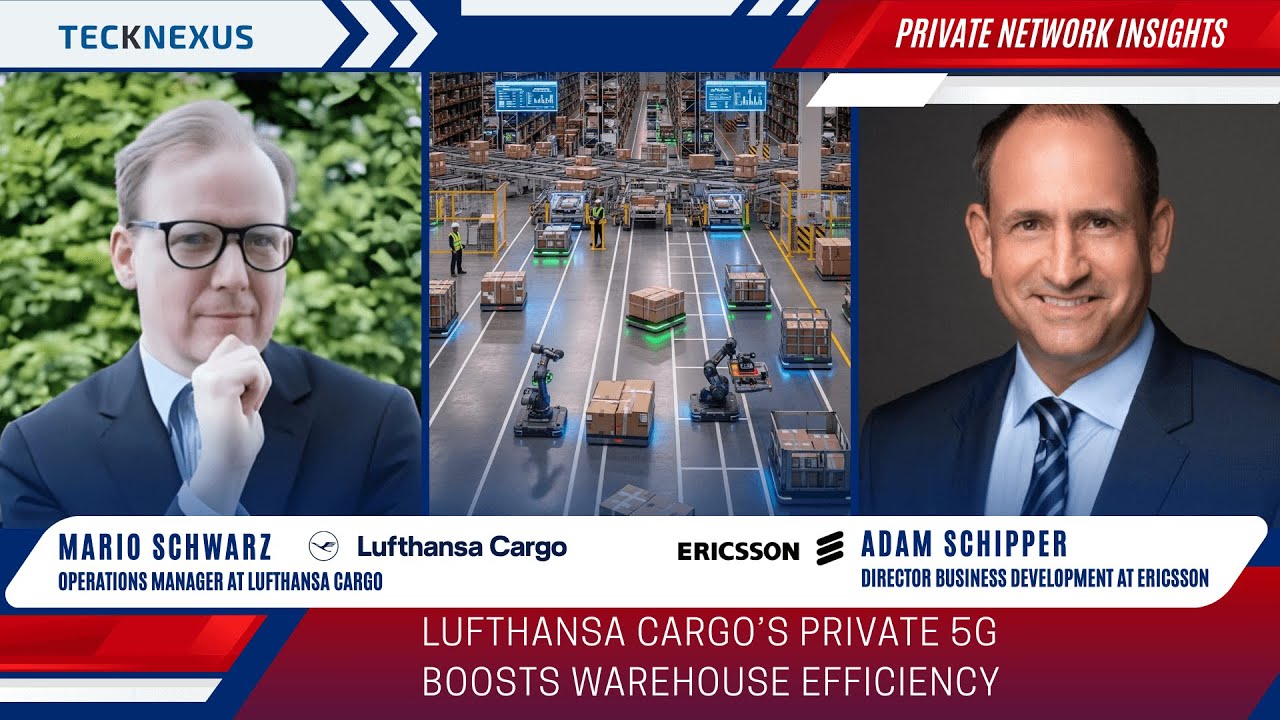
Why Lufthansa Cargo Chose Private Cellular: Ericsson Perspective
Lufthansa Cargo’s decision to deploy a private cellular network originated from persistent connectivity challenges at its warehouse locations. To understand the root cause, the company brought in Lufthansa Industry Solutions to conduct a comparative study. The assessment evaluated Wi-Fi performance, public cellular connectivity, and the potential of a private cellular network.

The results were conclusive. Connectivity under a private cellular architecture significantly outperformed both Wi-Fi and public mobile networks—particularly in coverage consistency, reliability, and mobility across the warehouse environment.
Armed with this data, Lufthansa Cargo initiated a one-year private 5G trial to validate performance under real operational conditions. The trial success demonstrated that private cellular could eliminate roaming issues, reduce device disruptions, and deliver the deterministic performance needed for high-speed cargo operations.
Shifting Use Cases and the Limitations of Legacy Connectivity
According to Adam Schipper, the shift toward private cellular is driven by evolving operational needs. Warehousing use cases today are dramatically different from 10–15 years ago. Wi-Fi and public cellular networks were never designed for the level of mobility, automation, and digitalization now required on warehouse floors. Applications such as mobile scanning, live tracking, computer vision, and robotics demand seamless mobility. Workers and devices are constantly in motion, and any interruption in connectivity—even a momentary handoff delay—disrupts workflows and undermines productivity.
In these environments, being disconnected is simply not an option.
Dynamic Warehousing Requires More Flexibility
Warehouse operations are inherently dynamic. Layouts shift, equipment moves, and workflows evolve based on cargo mix and flight schedules. Schipper emphasized that private cellular offers the flexibility needed to adapt the network quickly without redesigning access-point architectures or re-tuning Wi-Fi zones. Private 5G provides consistent performance regardless of warehouse reconfiguration—an essential capability for high-turnover logistics environments.
Predictable Low Latency & Enhanced Security
Predictive latency is another decisive advantage. Time-critical applications require deterministic response times without jitter, lag, or unexpected interference. Private cellular networks excel in delivering stable, predictable latency. Security is equally important. With cyberattacks on the rise, private cellular’s SIM-based authentication and isolated architecture provide a higher level of control and resilience than traditional enterprise networks.
Key Drivers Behind the Move to Private Cellular
Schipper summarizes the top drivers as:
- Seamless mobility across large, dynamic spaces
- Flexibility to support evolving workflows
- Predictable, low-latency performance
- Enhanced security through SIM-based access control
This perspective provides valuable context for understanding why Lufthansa Cargo embraced private 5G as a foundational layer for digital transformation.
Reinventing Daily Operations with Private 5G
For Lufthansa Cargo, private 5G is more than a network upgrade—it’s a fundamental shift in how warehouse operations are executed. At its LAX warehouse, the deployment of private 5G has reshaped workflows, increased efficiency, and removed longstanding barriers tied to unreliable connectivity.
While digitalization has been a strategic priority for years, connectivity was the missing link. Despite multiple initiatives aimed at digitizing workflows, the warehouse team consistently hit a wall when moving between Wi-Fi zones and losing secure connections.
The Cost of Connectivity Gaps in a High-Speed Operation
The scale of Lufthansa Cargo’s LAX warehouse operations is significant. Covering 60,000 square feet—plus an additional apron area totaling more than 100,000 square feet—the facility must support high-throughput processes. During aircraft turnarounds, the team handles nearly 300 metric tons of freight in just 120 minutes.
This pace depends heavily on real-time data and mobile devices. Yet, legacy Wi-Fi systems often fell short.
Roaming between access points caused critical disruptions. Devices dropped connections when transitioning, forcing workers to reauthenticate due to stringent security protocols. This wasn’t a minor issue—it introduced tangible delays during time-sensitive operations, particularly for tasks like tracking freight via handheld scanners while on the move.
Wi-Fi Reauthentication Led to Frequent Delays
As Mario Schwarz, Operations Manager at Lufthansa Cargo, explains, “When roaming takes more than a few hundred milliseconds, you lose connectivity and must reestablish it.”
Every time a device lost connection, workers had to re-enter credentials. That meant stopping forklifts mid-route, manually reconnecting, and restarting tasks. These moments added up quickly, undermining productivity across the warehouse floor.
Private 5G Resolves Key Limitations
The shift to private 5G transformed the operating environment. The new network architecture uses a single, wide-area cellular cell, eliminating the need for roaming altogether. The benefits were immediate and far-reaching:
- Continuous coverage across 100,000+ square feet
- No dropped connections or handover delays
- No need for reauthentication
- Stable, secure performance across all mobile devices
This reliable connectivity became the backbone of day-to-day operations, providing the consistency needed for all critical workflows.
Immediate Impact on Worker Experience
One of the most notable outcomes of the deployment was how quickly it earned user trust. Shop floor employees—often hesitant to rely on mobile devices due to Wi-Fi frustrations—immediately embraced the improved system.
The network’s reliability enabled them to stop relying on paper-based workarounds. Tablets, handheld scanners, and other devices became dependable tools rather than liabilities. This seamless transition reduced resistance and improved productivity within days of implementation.
Up to 80% Faster Processes
Lufthansa Cargo didn’t just notice improvements anecdotally—they measured the results. Mario Schwarz shared that performance metrics were tracked closely before and after deployment. Thanks to the elimination of reauthentications, paper-based fallback steps, and time-consuming data entry, the company saw process time improvements of up to 80%. These gains weren’t limited to faster scanning. They covered the full end-to-end workflow:
- Fewer manual data entries
- Reduced time spent walking to fixed terminals
- No more rekeying handwritten notes into systems
By streamlining these tasks, the team could focus on higher-value activities and maintain tighter schedules during critical operations.
From Resistance to Readiness
Adoption of digital tools had been a challenge under the Wi-Fi system. Workers often preferred manual processes simply because they were more reliable. Convincing staff to use tablets and scanners required constant effort.
That changed with private 5G. With no disruptions or connection failures, the team no longer had a reason to avoid digital workflows. The benefits were obvious, and the technology became an enabler rather than an obstacle. As Schwarz explained, “Our shop floor workers are not technical people—they’re focused on doing their jobs efficiently. They’re not interested in technical specifications or how fancy the system is. What matters to them is simple: it works.”
Additional Private 5G Use Cases Beyond Lufthansa Cargo
While Lufthansa Cargo initially focused on improving handheld scanning and mobile workflows, many additional use cases across warehousing and logistics are now being enabled by private 5G.
- Real-Time Data Collection: Private 5G ensures continuous, high-quality data flow from sensors, scanners, and mobile devices—supporting faster decisions and eliminating data gaps that slow operations.
- Computer Vision, Video Analytics & AI: AI-enabled cameras can detect anomalies, measure cargo, and verify processes instantly. These applications need low latency and consistent bandwidth that Wi-Fi cannot guarantee.
- Robotics & Automated Picking: AGVs and inventory robots rely on deterministic connectivity for navigation and task execution. Private 5G provides uninterrupted mobility across large warehouse spaces.
- Predictive Maintenance: Continuous data from forklifts, conveyors, and IoT equipment enables early detection of issues, reducing downtime and improving asset health.
- Predictive Logistics & Real-Time Analytics: Real-time analytics help optimize freight flow, resource allocation, and SLA compliance, especially during high-volume or time-critical operations.
Expanding Private 5G to Other U.S. Sites
Following the success at LAX, Lufthansa Cargo is exploring a broader rollout of private 5G in the U.S., with potential deployments in major hubs such as JFK, Atlanta, and Chicago.
In the U.S., the availability of the CBRS spectrum makes private 5G deployment more accessible. While not entirely free, CBRS spectrum is available at a significantly lower cost than in other regions like Europe, where spectrum licenses must be purchased.
The productive environment at LAX has now been live for over a year, and Lufthansa Cargo is actively evaluating the business case for its next deployment phase, starting with its JFK facility.
A Foundation for Digital Transformation and Sustainability
Beyond immediate operational gains, private 5G plays a central role in Lufthansa Cargo’s broader digital transformation and sustainability strategies.
The network provides the connectivity layer required for a variety of future use cases, including:
- AGVs (Automated Guided Vehicles)
- CCTV with AR (Augmented Reality) overlays
- AI for automated freight dimensioning and anomaly detection
These applications depend on secure, low-latency connectivity. Without a reliable network foundation, their value would be limited. Private 5G enables these advanced tools to operate at full capacity, helping Lufthansa Cargo move closer to its sustainability and operational goals.