
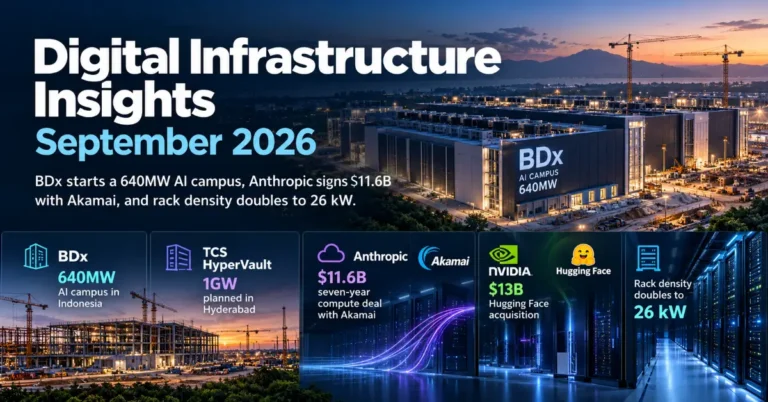
Digital Infrastructure Insights September 2026: AI data centre capacity broke ground across Asia-Pacific and the Gulf, compute moved into long-term contracts and fresh financing, silicon and platform ownership consolidated, rack density doubled, interconnect and subsea capacity kept pace, and governments and operators built sovereign compute stacks.

At a glance – Digital Infrastructure Insights September 2026
- AI campuses broke ground across Asia-Pacific and the Gulf: BDx Data Centers began building a 640MW AI campus in West Java, HyperVault secured 264 acres for a 1GW campus in Hyderabad, and Microsoft will deploy more than $10B across four Gulf states by 2030.
- Compute moved into long-term contracts: Anthropic signed an $11.6B, seven-year CPU compute deal with Akamai, and Nscale signed an initial $3.5B commitment with Figure while raising $3.4B in pre-IPO notes.
- Silicon and platform ownership consolidated: Nvidia confirmed its $13B acquisition of Hugging Face, AMD agreed to acquire World Labs for about $8.2B, and Fujitsu will start global sales of its Monaka CPU in November.
- Density and power set the pace: average rack loads doubled from 12 kW in 2024 to 26 kW by 2026, with some designs targeting up to 1 MW per rack, and South Korea’s Honam semiconductor cluster stalled on power and water capacity.
- Interconnect kept pace: Telxius opened a Cancún landing gateway for the Tikal cable, slated for H1 2027 with an initial 380 Tbps trunk, and Equinix launched Fabric One and a distributed AI Inference Exchange.
- Sovereign compute stacks grew: NTT DATA committed $1.5B to AI-ready sovereign data centres in India, Swisscom deployed NVIDIA DGX SuperPOD clusters for its CHF 100m Swiss AI Platform, and SK Telecom put Rebellions NPUs into production.
1. AI data centre campuses break ground across Asia-Pacific and the Gulf
New AI capacity this month was concentrated in Southeast Asia, India, Australia and the Gulf, ranging from campuses under construction to national plans.

- BDx Data Centers (Indonesia): broke ground on a 640MW AI-focused data centre campus in West Java (under construction).
- HyperVault (India): Tata Consultancy Services’ subsidiary secured 264 acres in Hyderabad for a phased 1GW AI data centre campus, budgeting up to INR700 billion ($7.4B), built in line with customer demand (plan).
- Iren (Australia): proposed a $10 billion AI compute data centre in Bundey, South Australia, intended largely to supply US technology companies (proposed).
- Microsoft (Gulf): will deploy more than $10B through 2030 to expand Azure cloud, regional data centres and AI infrastructure across the UAE, Saudi Arabia, Qatar and Kuwait, combining new and previously announced funding, with a focus on service resiliency.
- Uztelecom (Uzbekistan): commissioned two Tier III design-certified data centres in Bukhara and Kokand, expanding its UzCloud platform with AI computing and GPU-as-a-Service (live).
- Government of the Philippines: launched a $34B national AI plan targeting a 30-fold increase in AI data centre capacity alongside nationwide broadband improvements (plan); Indosat Ooredoo is co-developing the Zankore AI compute and neocloud platform in Indonesia, covered in TeckNexus’s “When Your Connectivity Provider Becomes Your Compute Provider”.
Why it matters for buyers: this month’s capacity spans every stage from live Tier III halls to national plans, so buyers comparing regions should separate what is energised from what is announced and over what time frame. Gigawatt campuses are typically built in phases tied to demand.
2. Compute moves into long-term contracts and fresh financing
AI developers and infrastructure providers locked in multi-year compute and raised capital against it this month.
- Anthropic & Akamai: Anthropic agreed an $11.6 billion, seven-year contract for CPU-based computing capacity from Akamai to support its AI services, including a warrant to buy Akamai Series B shares at $111.33 per share.
- Nscale: signed a multi-year partnership to be Figure’s preferred compute provider, with an initial $3.5 billion commitment, potential expansion beyond $6 billion and possible deployment of up to 100,000 NVIDIA GPUs from 2027; Nscale separately raised $3.4 billion in pre-IPO convertible notes led by Third Point, with Nvidia, Apollo, Citadel, Hudson Bay Capital, Abu Dhabi Investment Council and 8090 Industries, as it prepares for a US listing.
- Meta & Firmus: Meta signed an agreement to use Firmus’ GPU computing power in Southeast Asia for AI research and model training.
- Nvidia & MediaTek: Nvidia brought MediaTek into its data centre ecosystem and committed to buy $3.5 billion of MediaTek-issued bonds.
- Andreessen Horowitz: launched a $1.1 billion Machine Age Fund for the physical infrastructure needed to scale AI workloads, citing physics, computer science and legacy supply chains as bottlenecks.
- Charter Communications: activated its Spectrum Edge Compute Infrastructure on NVIDIA platforms, with new collaborations with Cast AI and HP for edge AI workloads.
Why it matters for buyers: a seven-year CPU contract and a GPU commitment that could reach 100,000 units show AI developers securing compute years ahead, often through financing structures that tie supplier, investor and customer together. Buyers should read the term, flexibility and exit provisions as closely as the price. → Score contract length, lock-in and supplier financing risk with the TeckNexus RFP Scorecard Generator.

3. Silicon and platform ownership consolidates
Chip makers bought further up the AI stack while new processors and rack-scale designs widened the choice of silicon.
- Nvidia: confirmed a $13 billion acquisition of Hugging Face, which reports more than 18 million users sharing over 3 million models, 500,000 datasets and about 1 million applications, following the reported $12.9B deal covered in August.
- AMD: agreed to acquire AI research firm World Labs for about $8.2 billion in stock, adding spatial intelligence models and robotic learning technologies.
- Fujitsu: will start global sales of its Fujitsu-Monaka CPU in November for cloud and data centre operators and server vendors, with a Monaka Server for AI inference and sovereign AI available first in Japan and Europe.
- d-Matrix: will integrate its Raptor XPUs with NVIDIA infrastructure using NVLink Fusion for scale-up within MGX racks, with Spectrum-X Ethernet for scale-out, liquid cooling and interoperability alongside Vera Rubin NVL72 systems for disaggregated inference.
- Qualcomm & Amazon: are developing customised silicon for AWS AI infrastructure with optical connectivity up to 1.6 Tbit/s.
- Outlook: Nvidia CEO Jensen Huang said at a UK event that Nvidia expects chip sales to double in 2027 (projection, reported by Bloomberg); VAST Data previewed DataEnclave for confidential AI on NVIDIA Confidential Computing, with general availability targeted for Q1 2027 through partners including Cisco and Supermicro.
Why it matters for buyers: with chip suppliers acquiring model platforms and research firms, the line between hardware vendor and AI platform is narrowing. Buyers planning multi-year infrastructure should check how open each stack stays to other silicon, models and networking. → Compare silicon and platform options against your own workloads with the TeckNexus Technology Selector.
4. Density, power and supply constraints set the pace
Power delivery, cooling and supply chains, not floor space, emerged as the limits on how fast AI capacity can be built.
- Rack density: ETDatacenters reports average data centre rack loads doubled from 12 kW in 2024 to 26 kW by 2026, driven by AI, with some designs targeting up to 1 MW per rack, requiring redesigned high-amp redundant power, wider liquid cooling (direct-to-chip, rear-door heat exchangers, immersion) and structural upgrades for floor loads.
- Mitsubishi Electric: unveiled a chip-to-grid blueprint for NVIDIA-powered AI factories that brings together electrical systems, cooling, automation and energy management.
- South Korea: the government-backed 800-trillion-won semiconductor cluster in Honam faces delays from power and water capacity constraints and labour-relations uncertainty; the government granted a feasibility exemption for water infrastructure and is seeking one for power.
- Supply chains: networking vendors warned of supply bottlenecks affecting AI data centre builds and telecom network upgrades in the US market.
Why it matters for buyers: doubling rack density in two years changes power, cooling and structural design more than it changes floor space, and Honam shows power and water can stall even the best-funded projects. Buyers should confirm power and cooling capacity at the rack level, not just the facility level, and plan for equipment lead times. → Size power, cooling and capacity scenarios with the TeckNexus Network Planning tools.
5. Interconnect, optics and subsea capacity keep pace
Landing stations, interconnection platforms and national fibre programmes added capacity to carry AI traffic between sites and markets.
- Telxius (Mexico): deployed a carrier-neutral landing gateway and Tier III edge data centre in Cancún as Mexico’s landing point for the Tikal submarine cable, with N+1/2N power and cooling redundancy; Tikal is slated for H1 2027 with an initial 380 Tbps trunk, giving a diverse route to the United States.
- Equinix: launched Fabric One, a managed service automating connectivity between enterprise sites, clouds and AI environments, and Inference Exchange, a distributed AI inference programme developed with NVIDIA and Together AI across Equinix data centres.
- STL Networks (India): approved a wholly owned subsidiary to build and own digital infrastructure, obtain telecom licences and deliver data centre connectivity for hyperscalers, data centre operators and enterprises.
- Philippines: PLDT, Globe Telecom and Converge ICT have allocated more than $2.2 billion in 2026 capital spending for network expansion, wider fibre deployment and the National Fiber Backbone.
- TeckNexus analysis: “How AI Infrastructure Is Reshaping Optical Networking” examines why AI clusters need far more optical interconnect per unit of compute, the move from 800G to 1.6T transceivers, early co-packaged optics and the laser supply constraint.
Why it matters for buyers: inference spread across many sites makes interconnect part of the compute decision, as Equinix’s Inference Exchange and Telxius’s landing gateway show. Buyers should plan route diversity and transceiver supply alongside GPUs. → Plan interconnect and fibre capacity with the TeckNexus Network Planning tools.
6. Sovereign compute and the chip supply chain
Operators, IT services firms and governments built compute that stays in-country and added to local chip supply chains.
- NTT DATA (India): committed $1.5 billion to AI-ready data centres in India focused on sovereign compute and data residency, with on-site edge inference and private 5G, and work with Ericsson combining private 5G and edge platforms with edge AI services.
- Swisscom: deployed NVIDIA DGX SuperPOD clusters as part of a CHF 100m Swiss AI Platform programme, adding on-premises GPU capacity in Switzerland.
- SK Telecom: put Rebellions NPUs into production to run four in-house AI services, scaling on-premise inference in South Korea.
- Confidential and sovereign platforms: Fujitsu’s Monaka Server targets sovereign AI infrastructure in Japan and Europe, and VAST Data’s DataEnclave supports connected or fully air-gapped deployments with customer-controlled keys.
- India’s chip supply chain: Fujifilm plans about ₹800 crore for a greenfield semiconductor materials plant under ISM 2.0, breaking ground in FY2026 with commercial production targeted for FY2028; HCLTech opened a semiconductor lab in Bengaluru as part of a ₹185 crore investment.
Why it matters for buyers: sovereign compute is now offered by operators and IT services firms, not only governments, and often bundled with domestic chips, private 5G or air-gapped options. Buyers with data-residency rules should compare where data, keys and models physically sit. → Evaluate sovereign and in-country infrastructure options with the TeckNexus Technology Selector.
What Digital Infrastructure Insights for September 2026 means if you’re planning AI infrastructure investment
September’s throughline is commitment: gigawatt campuses breaking ground, seven-year compute contracts, chip makers buying platforms, and governments and operators building compute that stays at home. Six moves follow directly from the month:
- Separate live, under-construction and planned capacity — this month spans live Tier III halls in Uzbekistan, a 640MW campus under construction in Indonesia and national plans in the Philippines.
- Read compute contracts for term and exit, not just price — Anthropic’s seven-year Akamai deal and Nscale’s Figure commitment show how long compute is now being locked in.
- Check how open each AI stack stays — Nvidia’s Hugging Face acquisition and AMD’s World Labs deal bring chip suppliers into the platform layer.
- Plan power and cooling at rack level — average density has doubled to 26 kW, with some designs targeting 1 MW per rack.
- Treat interconnect and transceiver supply as part of the compute plan — distributed inference and 1.6T optics make it a first-order requirement.
- Map sovereign options early if data residency applies — NTT DATA, Swisscom and SK Telecom all built in-country compute this month.
For operators’ AI services and agents, see the companion AI & Automation Insights, September 2026; for 5G, satellite and spectrum, see Advanced Connectivity Insights, September 2026.
Catching up? Last month’s signal is here: The Capital Behind the Compute: Digital Infrastructure Insights, August 2026 →
This analysis is drawn from TeckNexus’s full curated Digital Infrastructure Monthly Insights for September 2026. See every deployment, product, and partnership update →