Amazon

Google has unveiled next‑generation TPU accelerators with up to a 4x performance boost and secured a multiyear Anthropic commitment reportedly worth billions, signaling a new phase in AI infrastructure competition. Google introduced new Tensor Processing Units that deliver roughly four times the performance of prior generations for training and inference of large models. Beyond speed, the design targets better performance-per-watt, a critical lever as AI energy costs surge. Anthropic has secured access to Google Cloud TPU capacity at massive scale, with reports citing availability up to one million TPU chips over the term of the agreement.
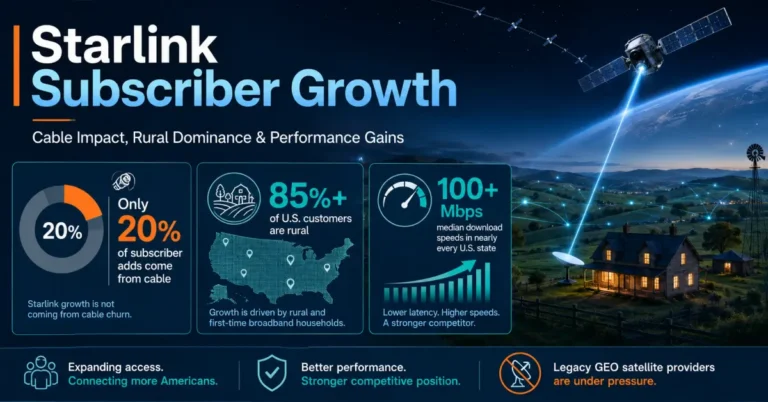
BT Group and its consumer brand EE plan to offer a Starlink-powered home broadband product focused on underserved locations where fixed-line build is constrained by terrain, sparsity, or cost. The service targets “ultrafast” downlink performance, with Starlink capable of delivering up to roughly 280 Mbps and latency in the low tens of milliseconds. Commercial availability is slated for the second half of 2026, giving BT time to industrialise ordering, installation, support, and integration into its existing product catalogue and systems. LEO fills the last 1–5% gap where full fibre is slow or uneconomic to reach.
Apple is reportedly nearing a deal to license Google’s Gemini for Siri, a move that would reshape assistant architectures and near-term AI roadmaps across devices and networks. Multiple reports indicate Apple is close to licensing a custom version of Google’s Gemini model, reportedly at a scale of around 1.2 trillion parameters, for roughly $1 billion per year. The model would power a major Siri upgrade while Apple continues building its own foundation models. The objective is clear: boost Siri’s reasoning and task execution in the near term without ceding control over Apple’s system-level integrations or search defaults.
LG Uplus is working with AWS on agentic AI that automates installation of cloud‑native network software, with early claims of up to 80% faster turn‑ups versus manual methods. LG Uplus and AWS partnered to develop an AI-driven approach that installs complex network software stacks without human intervention. The system uses Amazon Bedrock alongside AWS’s Strands-Agents SDK to orchestrate multiple cooperating AI agents. These agents are pre-trained on network design and implementation documents so they can execute the full workflow – provisioning cloud infrastructure, collecting device and network parameters, generating configurations, performing installation, and troubleshooting.
OpenAI has signed a multi‑year, $38 billion capacity agreement with Amazon Web Services (AWS) to run and scale its core AI workloads on NVIDIA‑based infrastructure, signaling a decisive shift toward a multi‑cloud strategy and intensifying the hyperscaler battle for frontier AI. The agreement makes OpenAI a direct AWS customer for large‑scale compute, starting immediately on existing AWS data centers and expanding as new infrastructure comes online. AWS and OpenAI target the bulk of new capacity to be deployed by the end of 2026, with headroom to extend into 2027 and beyond.
At SK AI Summit 2025, CEO Jung Jaihun outlined plans to expand the Ulsan artificial intelligence data center (AIDC) to 1GW-class capacity, stand up a nationwide trio of hubs (Gasan in the Seoul metro, Ulsan in the south, and a new southwest site), and take the model into Southeast Asia starting with Vietnam. The operator is also deepening technology collaborations with Amazon Web Services (AWS) on Edge AI and with NVIDIA on AI-RAN and a Manufacturing AI Cloud; it intends to buy more than 2,000 NVIDIA RTX PRO 6000 Blackwell GPUs and scale Korea’s largest GPU cluster, Haein, as core compute for industrial AI workloads.
According to the latest Speedtest Intelligence findings from Ookla, the share of states where at least 60% of tested fixed-broadband users achieve the FCC’s 100 Mbps down/20 Mbps up benchmark rose sharply between late 2024 and the first half of 2025. That count climbed from 22 states (plus Washington, D.C.) to 38 states (plus D.C.), signaling faster last‑mile networks and better in-home performance for a sizable portion of U.S. households. Progress on equity also accelerated. In the first half of 2025, 33 states reduced the performance gap between urban and rural users—while 17 saw the gap widen versus the second half of 2024.
Amazon is piloting AI-enabled smart glasses for delivery associates to streamline last‑mile workflows, adding a hands‑free heads‑up display that blends navigation, scanning, and proof‑of‑delivery into the driver’s field of view. The company is testing delivery‑specific smart glasses that use on‑device computer vision and AI to identify packages, surface hazards, and guide walking routes from the vehicle to the doorstep without requiring a phone in hand. When a van is parked, the device activates and shows the next task: find the right parcel in the vehicle, traverse complex environments like multi‑unit buildings, and confirm delivery with visual capture.
AWS experienced a major outage centered on its US-EAST-1 region in Northern Virginia, triggering cascading failures across dozens of cloud services and dependent applications worldwide. The incident began in the early hours of Monday and was initially mitigated within a few hours, though residual errors and recovery backlogs persisted through the morning in US-EAST-1. Engineering updates point to a DNS resolution problem affecting a key database endpoint (DynamoDB) alongside internal network and gateway errors in EC2, which then propagated across dependent services such as SQS and Amazon Connect. When a foundational component like DNS or an internal networking fabric falters, service discovery and API calls fail in bulk.
India is poised to greenlight commercial satellite communication services once TRAI issues final pricing for satellite spectrum use and associated charges. The communications minister indicated the policy and licensing groundwork for satellite broadband is largely complete, with two GMPCS licenses issued and one additional letter of intent granted. The final trigger is the Telecom Regulatory Authority of India’s decision on spectrum pricing and usage fees for satcom bands. After that, operators can commence rollouts—initially for enterprise and backhaul, then for consumer broadband in selected markets. Bharti-backed Eutelsat OneWeb and Reliance Jio’s satellite unit are positioned to move early, with constellation capacity and gateways progressing.
ChatGPT users in the U.S. can now buy from Etsy sellers without leaving the conversation, with more than a million Shopify merchants “coming soon.” The feature, called Instant Checkout, is available to logged-in Free, Plus, and Pro users. It supports Apple Pay, Google Pay, Stripe, and credit cards. The flow is simple: ask for ideas, get curated products with images, prices, and reviews, tap Buy, confirm shipping and payment, and the merchant fulfills the order using its existing systems. Brands like Glossier, Skims, Spanx, and Vuori are expected to be part of the broader Shopify rollout.
New analysis from Bain & Company puts a stark number on AI’s economics: by 2030 the industry may face an $800 billion annual revenue shortfall against what it needs to fund compute growth. Bain estimates AI providers will require roughly $2 trillion in yearly revenue by 2030 to sustain data center capex, energy, and supply chain costs, yet current monetization trajectories leave a large gap. The report projects global incremental AI compute demand could reach 200 GW by 2030, colliding with grid interconnect queues, multiyear lead times for transformers, and rising energy prices.

TeckNexus Newsletters

I acknowledge and agree to receive TeckNexus communications in line with the T&C and privacy policy

Tech News & Insight
Enterprises adopting private 5G, LTE, or CBRS networks need more than encryption to stay secure. This article explains the 4 pillars of private network security: core controls, device visibility, real-time threat detection, and orchestration. Learn how to protect SIM and device identities, isolate traffic, secure OT and IoT, and choose...

Sponsored by: OneLayer

     
Whitepaper
Telecom networks are facing unprecedented complexity with 5G, IoT, and cloud services. Traditional service assurance methods are becoming obsolete, making AI-driven, real-time analytics essential for competitive advantage. This independent industry whitepaper explores how DPUs, GPUs, and Generative AI (GenAI) are enabling predictive automation, reducing operational costs, and improving service quality....
Whitepaper
Explore how Generative AI is transforming telecom infrastructure by solving critical industry challenges like massive data management, network optimization, and personalized customer experiences. This whitepaper offers in-depth insights into AI and Gen AI's role in boosting operational efficiency while ensuring security and regulatory compliance. Telecom operators can harness these AI-driven...
Supermicro and Nvidia Logo
Scroll to Top

Feature Your Brand in Private Network Magazines

With Award-Winning Deployments & Industry Leaders
Sponsorship placements open until Nov 10, 2025