OpenAI AI Devices: Roadmap, Rationale, and Impact
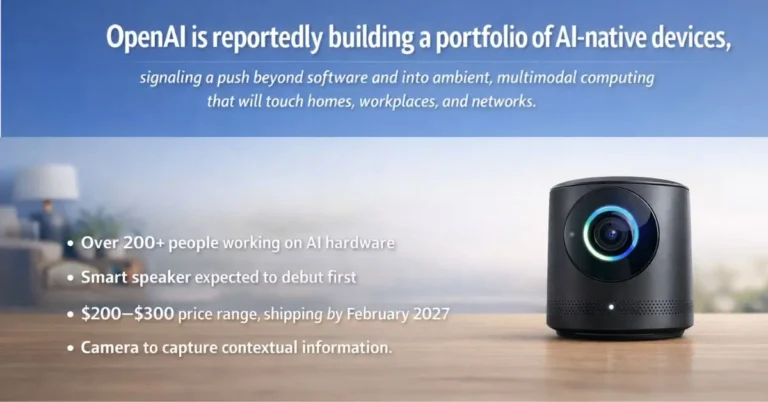
OpenAI is reportedly building a portfolio of AI-native devices, signaling a push beyond software and into ambient, multimodal computing that will touch homes, workplaces, and networks.

Smart speaker, glasses, lamp: timeline, pricing, and specs
Multiple reports indicate OpenAI has over 200 people developing a family of AI-enabled hardware, with a smart speaker expected to debut first. Early guidance points to a price in the $200–$300 range and a ship window no earlier than February 2027. The device is said to include a camera to capture contextual information about users and surroundings—an explicit bet on multimodal AI that fuses voice, vision, and environment for richer interactions. Additional concepts in the pipeline include smart glasses, which are unlikely to reach mass production before 2028, and a smart lamp aimed at always-available, spatially aware assistance in living rooms, offices, and classrooms.

Jony Ive design and strategy for ambient multimodal AI
OpenAI accelerated its hardware trajectory with a multibillion-dollar acquisition of Jony Ive’s “io Products” startup in 2025, fusing industrial design, human–computer interaction, and AI systems engineering under one roof. The strategic logic is straightforward: move AI from a screen-and-app model to a hands-free, environment-aware, assistant model; diversify revenue beyond API and enterprise software; and reduce dependency on third-party platforms. Hardware becomes a gateway to persistent engagement, proprietary data signals, and recurring subscription attachment for advanced AI services.
Multimodal use cases across home, work, and accessibility
A camera-equipped smart speaker at this price point targets mainstream adoption while enabling multimodal use cases—contextual reminders, object recognition, home automation with vision, accessibility support, and richer household agent workflows. Smart glasses extend this into true “heads-up” assistance for consumers and frontline workers—think task guidance, translations, inventory scanning, and remote expert scenarios—competing with emerging offerings across the consumer and enterprise AR/AI spectrum.
Competitive landscape and OpenAI’s differentiators
OpenAI will enter a crowded field, but it brings a leading AI stack and design-led approach that could reshape expectations for ambient AI experiences.
Competitors: Meta Ray‑Ban, Apple, Google, Amazon ecosystems
Meta’s Ray-Ban smart glasses have established consumer momentum with camera-forward, AI-assisted experiences. Apple and Google continue to advance mixed reality and glasses initiatives. Incumbent smart speaker ecosystems from Amazon and Google remain entrenched in the home. OpenAI’s challenge is to cut through this with distinctly better multimodal performance, developer extensibility, and privacy-by-design.
Differentiators: generative models, agentic workflows, tight integration
The company can leverage best-in-class generative models, conversational memory, and agentic workflows tuned for real-world context. Expect tight hardware–software integration, fast on-device wake word and ASR/TTS pipelines, and seamless handoff to the cloud for heavy multimodal inference. Industrial design pedigree from the Ive-led team could deliver wearability, thermals, and ergonomics that are table stakes for glasses success. A coherent device family—speaker, lamp, glasses—creates a mesh of sensors and microphones for robust spatial understanding and multi-room continuity.
Risks: privacy (GDPR/CCPA), supply chain, battery life, go‑to‑market
Always-listening microphones and always-looking cameras bring regulatory and trust challenges in markets governed by GDPR, CCPA, and emerging AI safety rules. Supply-chain execution, silicon selection, and battery life will make or break glasses viability. Go-to-market is nontrivial: distribution, carrier partnerships, and retail presence will shape adoption, while competition for developer attention will hinge on SDK quality, privacy guarantees, and revenue-sharing terms.
Telecom impact: Wi‑Fi 7, 5G/RedCap, edge inference, MEC
AI-native devices shift workloads between device, edge, and cloud, creating new angles for connectivity, latency, and service differentiation.
Connectivity: Wi‑Fi 7, BLE Audio, 5G RedCap; hybrid inference
These devices will lean on Wi‑Fi 7 (802.11be) for high-throughput home experiences and Bluetooth LE Audio for low-power accessories; smart glasses could add 5G for mobility, potentially via RedCap profiles as 3GPP Release 18/19 mature. Far-field voice and continuous vision amplify uplink demands and jitter sensitivity. Expect hybrid inference: on-device NPUs handle wake and short prompts; heavier multimodal reasoning offloads to cloud or MEC nodes. Operators with dense edge footprints and traffic steering can shave latency and improve conversational responsiveness.
Operator opportunities: bundles, Open Gateway APIs, Matter/Thread
Fixed and converged operators can bundle AI devices with premium broadband tiers, Wi‑Fi 7 gateways, and managed security. Mobile operators can offer connectivity-plus-subscription bundles that package ChatGPT-style services with prioritized 5G slices or QoS. Exposure of network capabilities via GSMA Open Gateway APIs—location, device status, QoS on demand—can enhance agent behaviors and enterprise workflows. For smart home integration, support for Thread and Matter will be pivotal; operators can position themselves as trusted installers for ambient AI in homes, retail, and SMB venues.
Enterprise scenarios: retail, hospitality, healthcare; private 5G/MEC
In retail, hospitality, and healthcare, a camera-enabled speaker or lamp becomes a front-desk agent for check-in, triage, or Q&A, with privacy zones enforced at the edge. In industrial settings, glasses paired with private 5G or Wi‑Fi 6/7 deliver line-of-sight instructions and remote expert support. ETSI MEC-aligned deployments can localize PII processing and meet data residency mandates while preserving performance.
What to watch: silicon, OS/SDK, Matter/Thread, channels, enterprise
Execution details over the next 12–24 months will reveal OpenAI’s ability to convert AI leadership into sustained hardware adoption.
Key signals: silicon partners, device OS, SDKs, distribution, certifications
Follow silicon choices for on-device inference—custom ASIC versus partnerships with Qualcomm, MediaTek, or others—as this dictates latency, battery life, and BOM. Look for the device OS strategy, SDK availability, and whether OpenAI supports Matter/Thread to play nicely with existing smart homes. Distribution will matter: direct-to-consumer versus retail and carrier channels. Finally, watch for enterprise SKUs, policy controls, and certifications that determine suitability for regulated sectors.
Action plan: operator bundles, edge capacity, governance
Prepare portfolios, networks, and procurement to capitalize on ambient AI while managing risk and compliance.
For operators: Wi‑Fi 7 CPE, edge GPU/NPU, Open Gateway, co‑marketing
Prioritize Wi‑Fi 7 CPE roadmaps, edge GPU/NPU capacity planning, and Open Gateway integration to expose network intelligence to AI agents. Develop co-marketing bundles pairing broadband or 5G with AI device subscriptions and managed privacy controls. Build field services offers for installation, calibration, and SLAs in small business and premium residential segments.
For enterprises: pilots, governance, PoE/VLAN/MEC readiness
Pilot ambient AI in front-of-house and frontline workflows with clear data governance: on-device redaction, opt-in camera policies, and role-based access. Align facilities and IT for PoE, VLAN isolation, and MEC offload where applicable. Demand auditability, content filters, and model update controls before scaling.
Bottom line: package connectivity, edge, and trust to scale ambient AI
If OpenAI executes, AI-first devices could reset expectations for how people interact with services at home and at work. For telecom and enterprise leaders, the upside lies in packaging connectivity, edge, and trust into turnkey experiences that make ambient AI practical, private, and performant.