The assumption redundancy is supposed to break
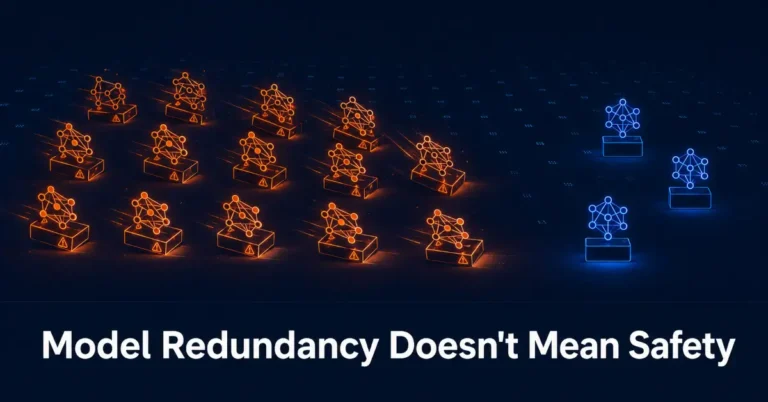
Redundancy only delivers the safety benefit it promises if the things being combined actually fail independently of one another. A panel of five human reviewers is more reliable than one specifically because each reviewer brings a different background, a different blind spot, and a different set of assumptions — when one misses something, the others are likely to catch it precisely because their errors aren’t correlated. Routing and voting architectures for AI models are built on the same premise: query multiple models, and the theory holds that their independent judgement will average out toward the correct answer, or that a routing layer can identify which model is most likely to be right for a given query.

The premise depends entirely on genuine independence, though, and that’s precisely what the 67-model study calls into question. Frontier models increasingly share more than buyers might assume — overlapping training data drawn from similar corners of the internet, related architectural choices, comparable fine-tuning and alignment techniques, and in some cases common upstream foundation models adapted for different purposes. None of that is a secret or a flaw exactly; it’s simply how the field has developed, with successful techniques and data sources converging across labs and products. But it means the models sitting behind a routing or voting layer may share far more of their blind spots than the redundancy architecture assumes.

What “failing together” actually means
The distinction worth sitting with is between independent failure and correlated failure, because the two look identical in a vendor’s accuracy benchmark and behave completely differently in production. Independent failure means each model has its own, largely unrelated chance of getting something wrong — exactly the condition that makes voting and routing architectures effective, because the odds of several independent models making the same mistake simultaneously are low. Correlated failure means the models tend to get the same things wrong, for related underlying reasons — shared training gaps, shared reasoning patterns, shared sensitivity to the same kind of ambiguous or adversarial input. Under correlated failure, adding a second, third, or fourth model to a routing or voting architecture doesn’t meaningfully reduce the odds of a wrong collective answer, because the models weren’t bringing genuinely different judgement to begin with — they were bringing variations on the same judgement.
The study’s finding that this correlation is increasing is the detail that matters most for forward planning, not just current-state evaluation. If frontier models are converging — on similar training approaches, similar data sources, similar architectural patterns — as the field matures, then redundancy architectures built and validated today may be quietly losing effectiveness over time even without any change to how they’re configured, simply because the models underneath them are becoming less independent of one another as the industry converges on what currently works best.
Why this undermines the case for premium redundancy pricing
None of this means multi-model architectures are worthless — genuine diversity in training data, technique, and architecture does still reduce correlated failure, and a well-constructed redundancy layer built from genuinely different models remains more reliable than a single model alone. What the finding undermines specifically is the assumption that redundancy is automatically safer simply because multiple models are involved, and that a vendor charging a premium for a routing or voting architecture is, by default, delivering the reliability improvement that pricing implies. The premium is paying for genuine independence. Whether a given architecture is actually delivering that independence, rather than several correlated variations of the same underlying judgement, isn’t something a buyer can verify from a capability demo or an aggregate accuracy score — it requires asking a more specific question.

The honest limits of what’s publicly detailed here
In the interest of the same editorial standard this series holds itself to elsewhere: the granular methodology behind the 67-model study — the specific benchmark tasks used, the exact model roster, and the statistical measures applied to establish correlation — hasn’t been published in the level of detail that would let a buyer replicate the analysis independently or map it precisely onto their own vendor’s specific model combination. The directional finding is significant enough to inform vendor evaluation regardless, but it’s a signal to investigate further with your own vendors, not a substitute for asking them directly how their own specific architecture performs under the same scrutiny.
Building correlated-failure testing into vendor evaluation
- Model lineage disclosure: Ask whether the models underlying a routing or voting architecture are genuinely diverse in training data, technique, and lineage, or are variations of the same underlying foundation model adapted for different purposes — genealogy matters more than headcount.
- Correlated-failure testing: Request evidence of testing specifically designed to surface correlated failure — cases constructed to be difficult for the shared blind spots models in a given category tend to have — rather than only aggregate accuracy figures that don’t distinguish independent from correlated error.
- Failure clustering in production: Review incident logs, where available, for clustering patterns: do failures across a multi-model deployment tend to happen on the same category of query, at the same time, or are they genuinely scattered and unrelated to one another.
- Periodic re-validation: Treat redundancy validation as ongoing rather than a one-time certification, given the study’s finding that correlation is increasing — a redundancy architecture validated as genuinely independent last year may be less so today as underlying models converge.
The premium enterprises pay for multi-model architectures is a reasonable one to keep paying — but it’s worth paying for evidence of genuine independence, not simply for the presence of multiple models. This year’s research suggests that distinction is where the real reliability gap sits, and it’s not one that shows up in a standard capability comparison.
| Related Tool: RFP Scorecard Generator
A vendor’s redundancy architecture is only as reliable as the independence of the models underneath it — and that’s a question a capability demo won’t answer. The TeckNexus RFP Scorecard Generator helps structure vendor evaluation around evidence of genuine model diversity and correlated-failure testing, not just the presence of a multi-model architecture. Explore the RFP Scorecard Generator on the TeckNexus Intelligence Platform. |