Open almost any telecom industry publication this year and you’ll find an “AI agent” announcement — a new virtual assistant, a network that “heals itself,” a customer service bot that promises to change everything. What’s much harder to find is a straight answer to a simple question: how much of this is actually running, at what level of independence, and how do we know it’s true?
That’s the gap TeckNexus Intelligence built this tracker to close. Instead of summarizing press coverage, we independently verify every AI agent deployment against named sources — operator earnings calls, analyst reports, and on-the-record documentation — and score each one on how autonomous it really is and how strong the evidence behind it actually is. Claims that can’t be independently corroborated don’t get softened and included anyway. They get left out. Here’s what that discipline found across 50 operators, spanning every major region in the world.
AI Agent Autonomy in Telecom: Real, But Still Human-Supervised Everywhere
The single most important finding in this entire research program is also the simplest to state: not one of the 50 operators we track has removed a human from the loop. Every operator, at every autonomy level we measured — including the most advanced tier, where AI agents independently handle routine and repetitive work — still keeps a person positioned to review exceptions and non-routine decisions before they execute.
That’s worth sitting with, because it cuts against a lot of the “autonomous network” marketing language circulating in the industry right now. It’s not that the technology can’t go further. It’s that telecom operators, almost universally, are choosing not to remove human oversight yet — a reasonable posture given what’s actually on the line when an AI agent makes a mistake in this industry: a customer’s bill, a family’s connectivity, a company’s compliance obligations.
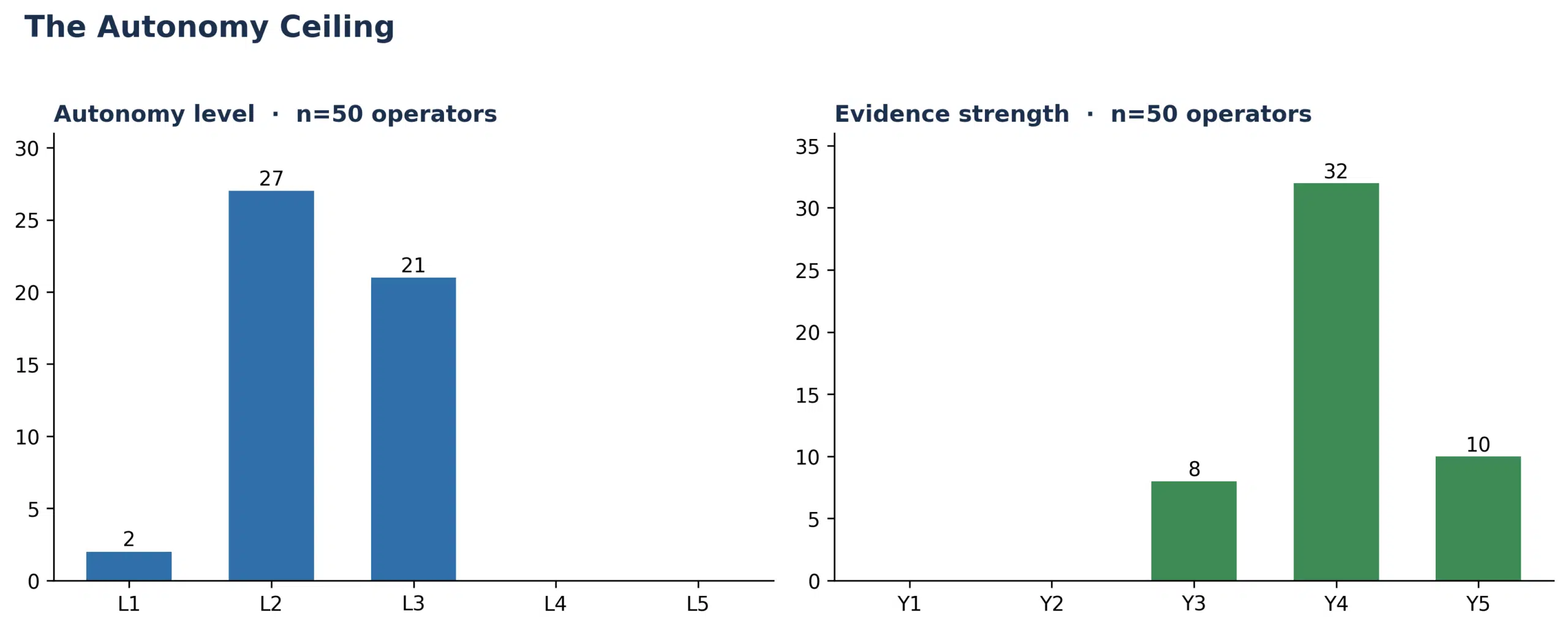
The chart below shows where the 50 operators we track actually sit on two separate measures: how autonomous their AI agents are (the “Autonomy Ceiling”), and how strong the independent evidence behind each claim is. Most tracked operators (54%) still have a human execute every action an AI agent recommends. A substantial second group — 42% — has crossed into genuine independence, where the AI agent completes routine work on its own and a human steps in only for exceptions. Only one operator has independently verified autonomy beyond that.
→ Want the full autonomy-tier breakdown, and what specifically separates one tier from the next? Upgrade to Maturity Benchmark — see details below.
Which Telecom Companies Are Actually Leading in AI Agent Deployment
Curious where your company stands in the broader telecom AI agent ecosystem? Benchmark your company’s AI agent position against network equipment vendors, OSS/BSS providers, system integrators, and operators.
Two different operators can legitimately claim “AI agent leadership,” depending on what you’re measuring — and conflating the two is where a lot of industry coverage goes wrong.
Deutsche Telekom has the most complete AI agent program of any operator we track. It’s the only operator with genuine, evidenced AI agent activity across all four areas that matter — customer experience, network operations, radio access network (RAN) automation, and back-office/IT — rather than a strong showing in just one or two. Most other highly ranked operators lead in one or two of these areas, not all four, which makes Deutsche Telekom’s program a useful reference point for what a fully built-out telecom AI agent strategy actually looks like today.
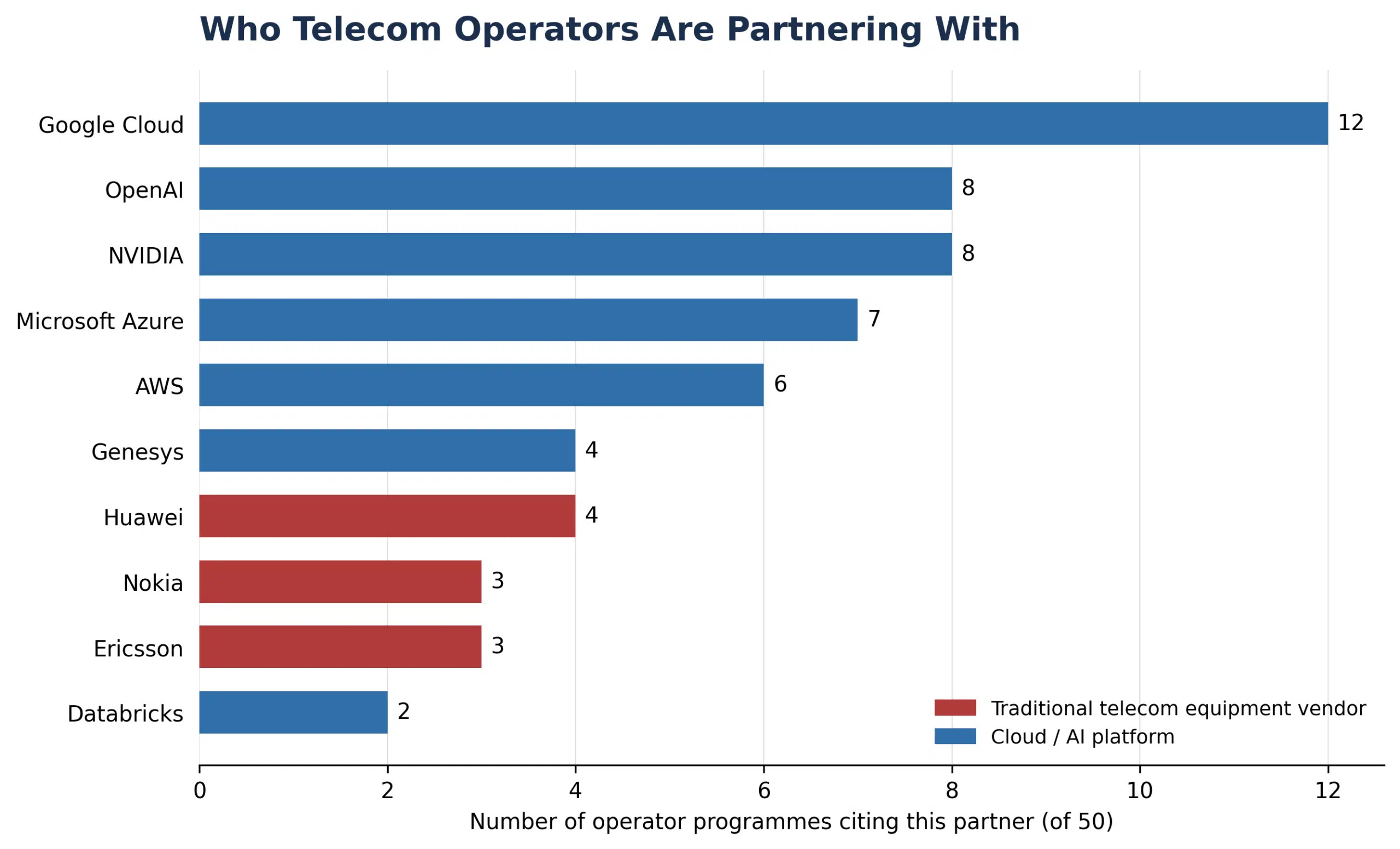
On the technology side, there’s a genuinely surprising result: Google Cloud is the most frequently named AI partner across all 50 operators’ publicly documented programs — ahead of OpenAI, NVIDIA, and Microsoft, and ahead of the traditional telecom equipment vendors (Nokia, Ericsson, Huawei) that a lot of industry narrative assumes are running the show in network-side AI specifically. For any operator currently deciding whether to build AI capability in-house or partner for it, that’s a data point worth knowing about before the decision gets made, not after.
Showing the 50 highest-scoring operators that we are tracking. Want to see more details on all 50 operators AI agents? Upgrade to Market Radar — see details below.
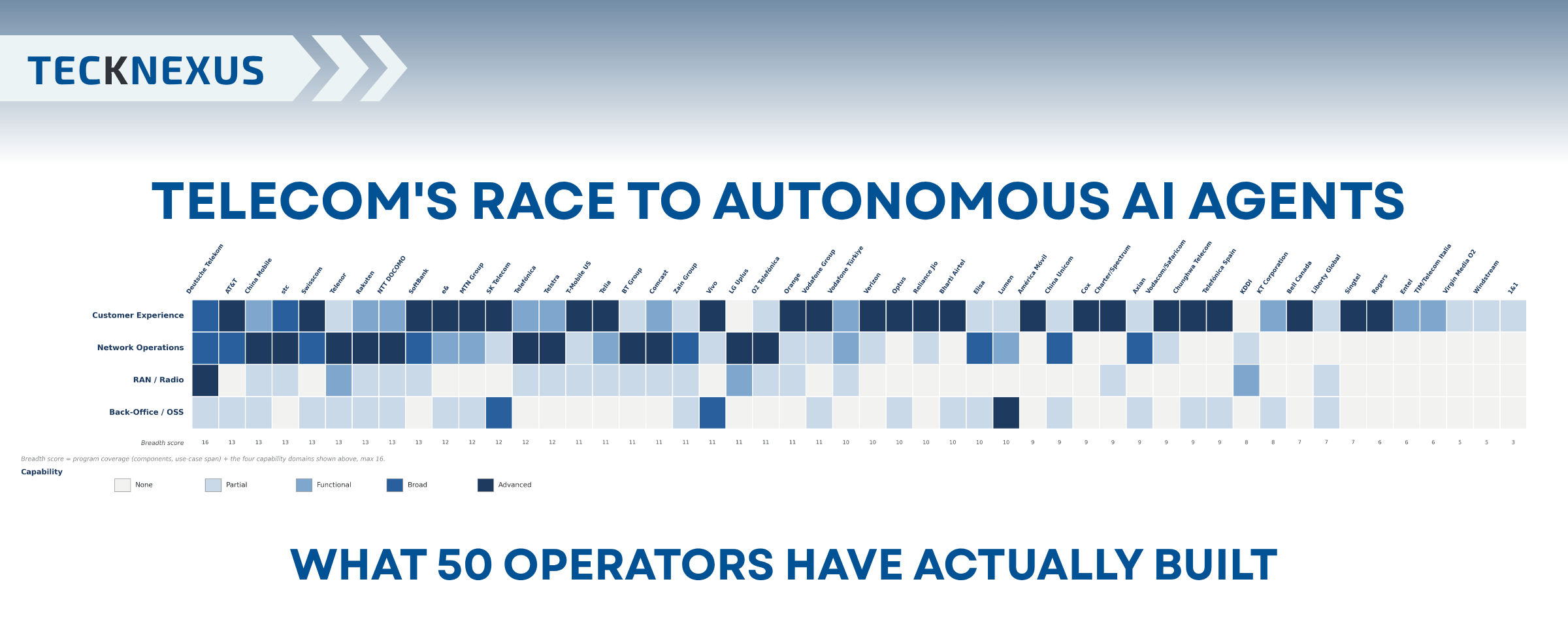
Showing the 10 highest-scoring operators out of the 50 we track — see the full ranking of all 50 operators in the Market Radar.
Where Telecom AI Agents Are Being Deployed Today
Not all AI agent use cases in telecom are created equal, and one of the clearest patterns in this research is how unevenly adoption spreads across different parts of an operator’s business.
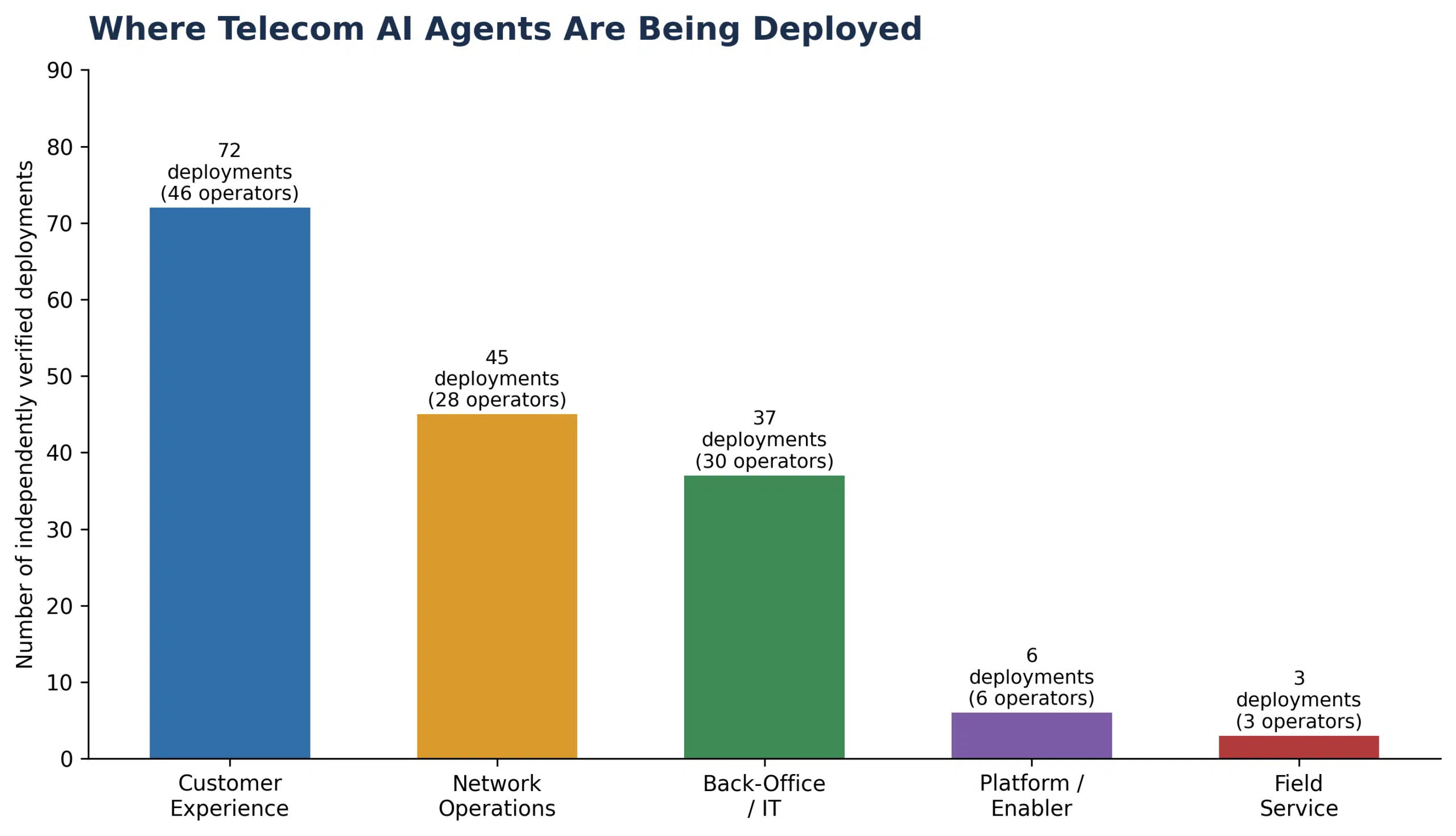
Customer service is by far the most common place to find an AI agent. We identified 72 separate, independently evidenced customer-experience AI initiatives spanning 46 of the 50 operators we track — 92% of the entire dataset has at least one real, verified customer-facing AI agent running today. But adoption isn’t the same as independence: more than 80% of those customer-service AI agents sit at the two most conservative autonomy levels, meaning a human is closely supervising most of what they do. Only a single operator — e&, whose “EASE” concept has run a fully autonomous, unstaffed retail store since 2023 — has reached full autonomy in a customer-facing setting anywhere in our dataset.
Network operations agents tell a different story. Rather than one standout operator, we found six separate AI agent programs — at China Mobile, Deutsche Telekom, Liberty Global, stc, and Vodafone Türkiye — tied for the strongest combination of autonomy and evidence anywhere in this category, spread across Asia, Europe, and the Middle East. It’s tempting to assume network-side AI agents should be allowed more independence than customer-facing ones, since a network mistake is usually more contained and reversible than a billing mistake reaching a customer. Our data partly supports that: network operations agents do run at a somewhat higher baseline autonomy level than customer-service agents. But the ceiling doesn’t move — no network operations AI agent in our tracker has reached full autonomy either.
→ Want all 72 customer-experience AI deployments, operator by operator? Upgrade to Customer Experience AI — see details below.
The most surprising find in this whole research program, though, sits in a category most industry coverage barely mentions at all: back-office and IT AI agents — the systems quietly handling fraud detection, regulatory compliance, and internal employee support behind the scenes. Looking only at each operator’s single, primary AI initiative, this category looked almost invisible — just a handful of examples in our entire 50-operator dataset. But once we looked past each operator’s flagship, most-publicized AI program and counted every individual AI agent initiative they’ve actually launched, a completely different picture emerged: 37 separate back-office AI agent deployments across 30 different operators — a footprint just as broad as network operations, hiding in plain sight because it never gets the press coverage customer-facing launches do.
→ Want the full network-operations picture, including what the six leading programs actually built? Upgrade to Network Operations AI — see details below.
The best example in this category also happens to be one of the most genuinely inventive AI agent deployments in telecom today. Virgin Media O2 built an AI voice agent named “Daisy” with one job: waste scammers’ time. Daisy poses as an elderly, easily confused phone user, and — independently verified by CBS News — has kept real scam callers on the line in conversations running past 40 minutes, all without a human ever picking up. It’s the single most autonomous, best-evidenced AI agent anywhere in our back-office category, and it’s a genuinely good example of what’s possible once telecom operators get creative with agentic AI outside the obvious customer-service use case.
→ Want all 37 back-office and fraud/compliance deployments, including Daisy’s full story? Upgrade to Fraud, Compliance & Back-Office AI — see details below.
How Telecom AI Agent Strategy Differs by Region
Telecom AI agent deployment isn’t a single global story — it splits along genuinely different regional strategies, and understanding which region you’re comparing against matters more than most global benchmarks let on.
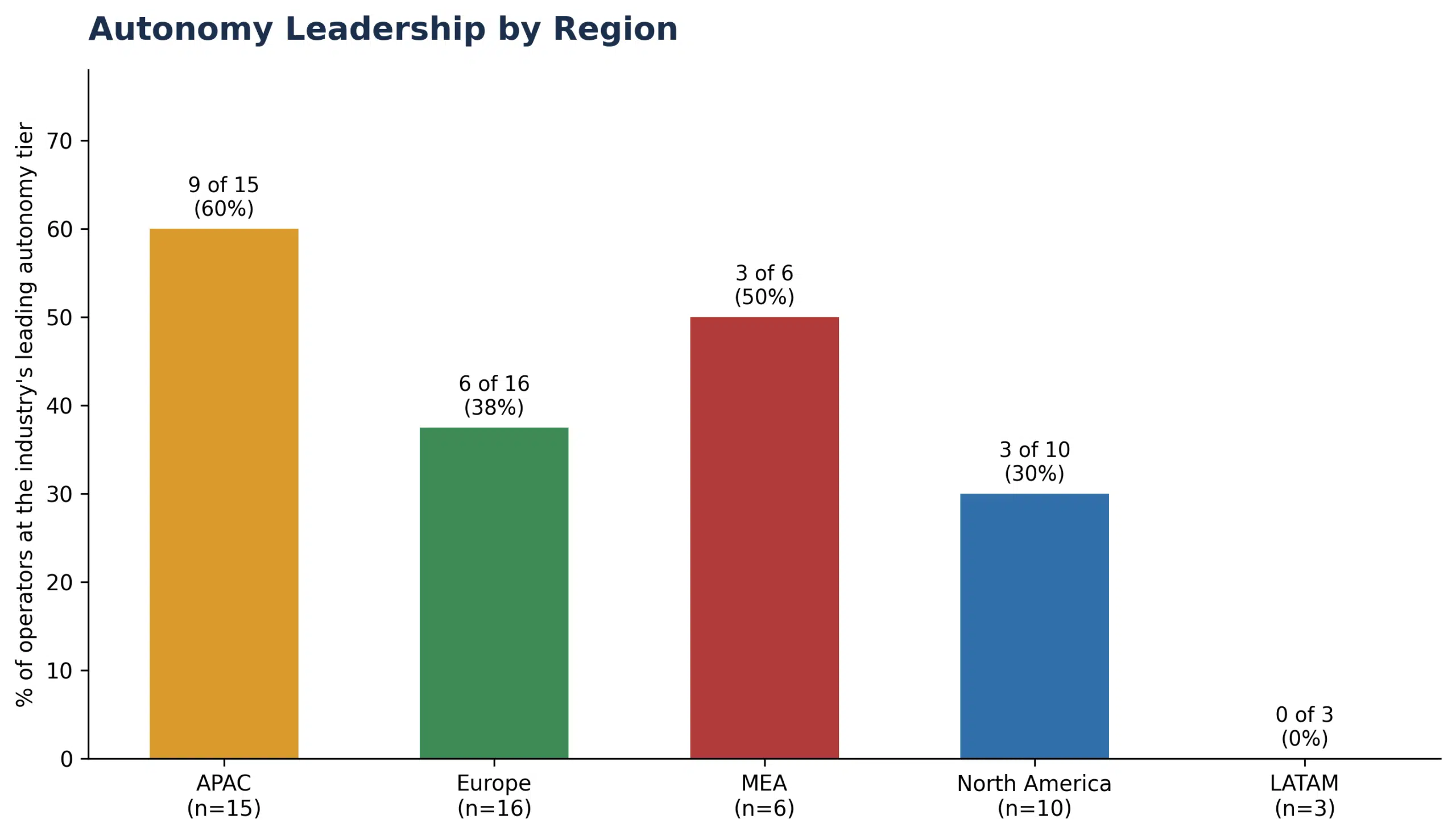
Asia-Pacific operators lead the world on the share of AI agents reaching advanced autonomy — 60% of the APAC operators we track have gotten there, led by large, strategically coordinated programs at operators like China Mobile, China Unicom, SoftBank, and SK Telecom. Europe leads on sheer depth instead: it has more individual operators running advanced AI agents than any region except APAC, spread across a much larger and more diverse group of 16 different national markets. North America has moved decisively into full production with its AI agents but has concentrated almost all of that investment in customer-facing tools, leaving network-side AI agent adoption well behind the global average.
→ Want the full regional breakdowns? Upgrade to APAC Benchmark, Europe Benchmark, or North America Benchmark — see details below.
The sharpest regional contrast in our entire dataset sits between two regions often lumped together as “emerging markets.” Not a single Middle East/Africa operator we track leads with a consumer-facing AI strategy — the region is built almost entirely around network operations and enterprise use cases. Every single Latin American operator we track does the exact opposite, leading entirely with consumer-facing deployments. Same market-maturity tier, completely opposite strategic bets — and each region’s clearest next opportunity is, not coincidentally, exactly the strategy the other region has already committed to.
→ Want the full MEA and LATAM comparison, operator by operator? Upgrade to MEA & LATAM Benchmark — see details below.
Our Methodology: Why You Can Trust These AI Agent Findings
Every operator and every individual AI agent initiative in this tracker is scored on three independent measures: autonomy — how much of a task the AI agent completes without a human signing off, mapped against TM Forum’s industry-standard Autonomous Network levels; evidence strength — how rigorously the underlying claim is sourced and independently corroborated, not just asserted; and capability breadth — how many distinct parts of an operator’s business, from customer service to the network core, its AI agent programs actually touch.
Claims that can’t be independently corroborated are excluded from this research entirely — not included with a caveat attached. No telecom operator or technology vendor pays TeckNexus Intelligence for a rating, ranking, or mention anywhere in this research.
AI Agent Market Radar & Maturity Benchmark🔒 Upgrade
Benchmark your AI agent program against 50 telecom operators worldwide. See where you stand on autonomy, capability, and evidence of deployment; identify the operators and markets worth benchmarking; and understand the concrete steps that separate your current maturity level from the next. Use the combined market radar and maturity benchmark to prioritize the next stage of your AI agent strategy.
AI Agent Deployment Benchmark🔒 Upgrade
Customer Experience · Network Operations · Fraud · Compliance · Back Office
See where telecom AI agents are actually being deployed — and where they are producing meaningful results. Compare customer-experience programs across 46 operators, examine leading network-operations deployments and automation outcomes, and explore how 30 operators are applying agents to fraud, compliance, and back-office processes. Separate pilots from scaled programs and identify deployment patterns relevant to your own roadmap.
Global & Regional AI Agent Benchmark🔒 Upgrade
North America · Europe · APAC · MEA · Latin America
Understand how telecom AI strategies and maturity differ across regions. Compare North America’s customer-experience focus, Europe’s depth of deployment, APAC’s leadership in higher-autonomy programs, and the distinct opportunities emerging across MEA and Latin America. Identify the operators setting the benchmark in each market and the regional approaches most relevant to your own strategy.