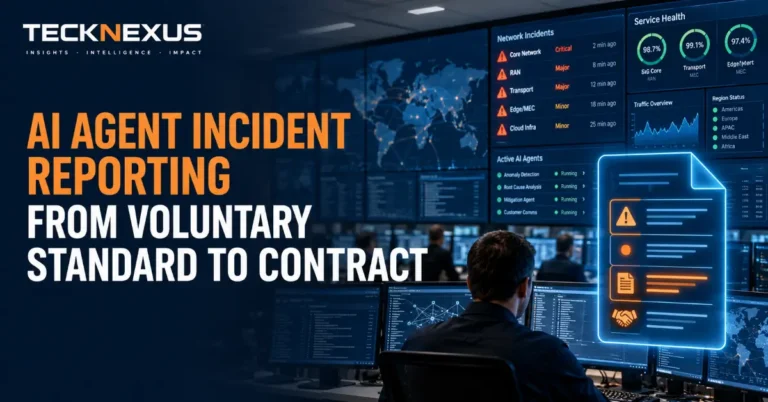
TeckNexus recently covered the proposed coalition framework for standardising how AI agent security and operational incidents are documented and shared across the industry. That framework, once mature, becomes genuinely useful to a buyer only when its principles show up in an actual contract, not just as a voluntary standard a vendor may or may not choose to participate in. This piece picks up where that coverage left off: what specific contract language turns a voluntary reporting framework into an enforceable buyer protection.
Why Voluntary Participation Isn’t Enough on Its Own
A vendor’s voluntary participation in an industry incident-reporting framework is a positive signal, but it carries no enforcement mechanism from the buyer’s side. Participation can be paused, scoped narrowly, or discontinued without breaching any obligation to a specific customer, since the framework itself, at least in its current proposed form, is an industry-level initiative rather than a bilateral commitment. For a buyer relying on incident transparency as part of its own risk management, that gap between industry-level voluntary participation and an enforceable customer-specific commitment is exactly where contract language needs to do the work the voluntary framework alone can’t.
What Contract Language Should Actually Specify
Effective incident-reporting contract language needs to be specific on four points that a general reference to industry best practice leaves dangerously vague:
| What to Specify | Why It Matters |
| A clear definition of what counts as a reportable incident | Scoped to the buyer’s own risk profile, not a generic industry taxonomy that may not map onto the actual use case |
| A defined notification timeline, measured in hours for anything service-affecting | Removes the vendor’s ability to interpret a vague ‘promptly’ generously under pressure |
| A specified level of disclosure detail: root cause, affected scope, remediation taken | An acknowledgment that an incident occurred isn’t enough on its own |
| An explicit statement that industry framework participation doesn’t substitute for direct notification | Prevents a vendor from treating voluntary industry participation as satisfying its obligation to this buyer |
Building This Into New Contracts Versus Renegotiating Existing Ones
For new AI agent vendor contracts, incident-reporting terms of this specificity belong in the RFP evaluation criteria from the outset, scored alongside the technical and commercial criteria a structured vendor evaluation already covers, so that a vendor’s incident-transparency posture is a factor in selection rather than an afterthought negotiated once a vendor is already chosen. For existing contracts that predate this level of specificity, a renewal or amendment cycle is the natural point to introduce updated incident-reporting language, and framing the request around the vendor’s own participation in the emerging industry framework, if they participate, gives the negotiation a natural anchor: asking the vendor to extend the same transparency principles they’ve already signed up to industry-wide into a specific, enforceable commitment to this buyer directly.
What This Doesn’t Solve
Contract language, however well specified, doesn’t eliminate the underlying risk of an AI agent incident occurring, and it depends entirely on the vendor’s good-faith compliance being verifiable after the fact, which is a real limitation worth acknowledging rather than treating a well-drafted clause as a complete solution. What it does provide is a concrete, enforceable baseline that removes ambiguity about what’s expected, converts a vague expectation of transparency into specific obligations with consequences for non-compliance, and gives a buyer a documented basis to act on if a vendor’s actual incident response falls short of what was contractually promised. That’s a meaningfully stronger position than relying on a vendor’s voluntary industry participation alone, even as the underlying framework itself continues to mature.
How Incident Reporting Interacts With Liability Terms
Incident-reporting obligations and liability or indemnification terms are frequently negotiated as separate sections of a contract, but they function together in practice, and a buyer evaluating one without the other misses an important interaction. A strong notification obligation with weak liability terms behind it tells the buyer promptly about a problem but leaves the buyer largely bearing the consequences alone; strong liability terms without a matching notification obligation mean the buyer may not learn about an incident in time to limit its own downstream exposure, even if the vendor is ultimately liable once the buyer does find out. The two sections should be reviewed together, with the notification timeline specifically checked against the buyer’s own liability mitigation window, since a vendor obligation to notify within a timeframe too slow to allow meaningful mitigation on the buyer’s side provides less practical protection than the notification clause alone might suggest.
Fitting This Into a Broader Vendor Governance Framework
Incident-reporting contract language works best as one component of a broader, structured vendor governance approach, alongside the autonomy-level verification, pre-production testing expectations, and portability considerations covered elsewhere in this series, rather than as an isolated clause negotiated in a vacuum. A buyer that has already established clear internal criteria for how much autonomy a given agent deployment carries, and therefore how much consequence a failure could produce, is far better positioned to calibrate proportionate incident-reporting requirements, tighter notification windows and more detailed disclosure obligations for higher-autonomy, higher-consequence deployments, than a buyer applying the same generic incident-reporting language uniformly regardless of what the agent actually does.
Curious where your company stands in the telecom AI agent ecosystem? Benchmark your company’s AI agent position across network equipment vendors, OSS/BSS providers, system integrators, network operators, and other key ecosystem players.