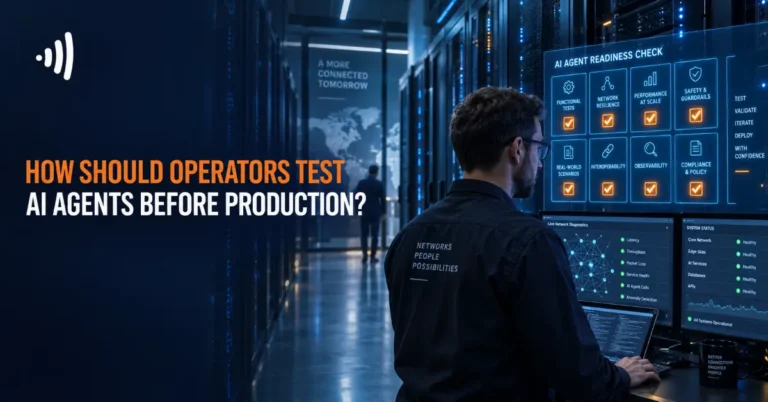
An AI agent that performs well on a benchmark or a demo is not the same thing as an AI agent that’s ready for production in a live telecom environment, and the gap between the two is exactly where testing needs to focus. A single successful run, however impressive, says little about how the agent behaves across the range of conditions a production environment will actually throw at it. Building a genuine pre-production test plan means testing for repeatability, exception handling, rollback capability, and the practical mechanics of human override, not just capability on a favourable test case.
Repeatability: Testing the Same Scenario Multiple Times, Not Once
A single successful test run of a given scenario tells you the agent can succeed under those specific conditions once. It doesn’t tell you whether the agent will succeed consistently, since many AI systems, particularly those involving language model reasoning, produce different outputs across repeated runs of a functionally identical scenario. A genuine pre-production test plan runs each priority scenario multiple times, ideally with minor, realistic variation in the input conditions each time, and tracks the consistency of the outcome, not just whether any single run succeeded. Operators evaluating a vendor’s agent should ask directly what repeated-run testing the vendor has done, and at what consistency rate, rather than accepting a single demonstrated success as sufficient evidence.

Exception Handling: What Happens Outside the Expected Path
Production environments generate scenarios that don’t match any training example or predefined playbook, and how an agent behaves when it encounters a genuinely novel or ambiguous situation is one of the more important things to test deliberately, rather than discovering only when it happens live. A well-designed test plan includes deliberately constructed edge cases and ambiguous scenarios specifically to observe whether the agent recognises the limits of its own competence and escalates appropriately, or whether it proceeds confidently with an answer or action that isn’t actually well-supported by the situation. An agent that fails visibly, flagging uncertainty and escalating, is meaningfully safer in production than one that fails silently, producing a confident but incorrect action with no signal that anything went wrong.
Rollback: Confirming the Undo Path Actually Works
Any agent with real execution authority over network configuration, customer accounts, or operational systems needs a tested rollback path, not just a theoretical one described in vendor documentation. Testing rollback means actually triggering the agent’s error-correction or reversal mechanism under realistic conditions and confirming it restores the correct prior state, rather than assuming the capability exists because it’s listed as a feature. This is particularly important for any action with a time-sensitive or cascading effect, where a delayed or incomplete rollback can leave a system in a worse intermediate state than either the original condition or the intended new one.
Human Override: Testing the Mechanism, Not Just Its Existence
A human override capability that exists in principle but is slow, unclear, or requires specialist knowledge to invoke in the moment isn’t a meaningful safety control in a live incident. Testing human override means confirming that the specific engineer or operator who will actually be on shift when the agent is live can identify that intervention is needed, locate the override mechanism, and successfully halt or redirect the agent’s action within a timeframe that matters for the situation, under realistic time pressure rather than in a calm training exercise. This is as much a test of the operational interface and the team’s familiarity with it as it is a test of the agent’s own technical override capability.

Building These Four Tests Into a Standard Pre-Production Gate
None of these four testing dimensions is optional for an agent that will have real execution authority over anything service-affecting:
| Dimension | What to Test | Why It Matters |
| Repeatability | Run the same scenario multiple times, with minor realistic variation | A single success doesn’t prove consistent behaviour |
| Exception handling | Deliberately constructed novel or ambiguous scenarios | Reveals whether the agent escalates visibly or fails silently |
| Rollback | Actually trigger the reversal mechanism under realistic conditions | Confirms the undo path works, not just that it’s documented |
| Human override | Have the actual on-shift operator invoke it under time pressure | Confirms the mechanism is usable in a real incident, not just in principle |
Treating all four as a standard gate every agent must pass before production deployment, rather than testing capability alone, is the practical discipline that closes the gap between a demo that looks impressive and a system that’s actually safe to run live. TeckNexus’s own research into the underlying causes of AI agent reliability gaps, including where confident-but-wrong failures tend to originate, is available in detail through the Intelligence Platform for operators building out this kind of test programme.
Documenting the Test Programme, Not Just Running It
A test programme that’s run informally, without a documented record of what was tested, under what conditions, and with what outcome, produces far less lasting value than one where the results are captured in a form that can be referenced later, whether for an internal audit, a regulatory inquiry, or simply to establish whether a subsequent model or configuration update has regressed a capability that previously passed. A documented test record for each of the four dimensions, specific scenarios tested, number of repeated runs, exception cases exercised, rollback trigger conditions validated, override response times measured, gives an operator a defensible basis for having deployed the agent responsibly, and gives a clear baseline to test against again after any material change to the agent’s configuration, underlying model, or the systems it interacts with.
Testing Doesn’t Stop at the Production Gate
A pre-production test programme establishes a baseline of confidence at a single point in time, but an agent’s behaviour, and the environment it operates in, both continue to change after deployment: the underlying model may be updated by the vendor, the systems the agent interacts with may change, and the range of real-world scenarios the agent encounters in production will inevitably exceed what any pre-production test plan anticipated. Treating the four-dimension test framework as a one-time gate rather than a recurring discipline, revisited after any material change and periodically even without one, is a common and consequential gap between organisations that maintain genuine confidence in their production agents over time and those whose initial testing rigour quietly erodes as the system runs unexamined in the background.
TeckNexus’s full evaluation-gap research on AI agent reliability is available through the Intelligence Platform — https://tecknexus.com/ai-agent-reliability-industrial-operations-evaluation-gap/