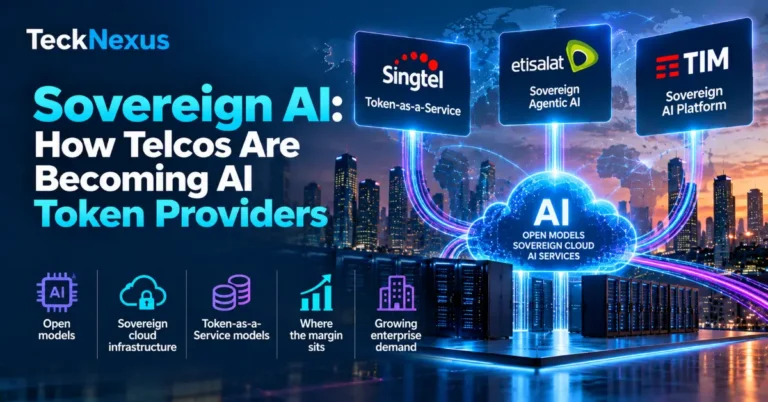
Telecom operators have spent the past two years as some of the most enthusiastic buyers of artificial intelligence, applying it to network operations, customer care and internal productivity. October 2026 showed a growing number of them turning that experience into products. Singtel’s RE:AI launched a Token-as-a-Service offering hosted in Singapore. Etisalat UAE expanded a multi-year partnership with DataRobot to scale sovereign agentic AI. TIM announced a sovereign AI platform in Italy spanning its cloud and edge network. And in NVIDIA’s latest telecom survey, 89% of respondents said open source models and software are important to their AI strategy.

Together these moves describe a new role for operators: not just consumers of AI, but providers of it, selling access to models, compute and governed AI services to enterprises and governments that want them delivered locally. The trend that our August AI & Automation Insights framed as telecom becoming an AI vendor is now taking on a defined commercial shape.
Why Open Models Underpin Sovereign AI Services
Open-weight models are central to this shift because they give operators control that closed models cannot. Operators can fine-tune them on their own data, run them inside national borders, inspect more of how they behave, and switch between them as performance and pricing change. The gap in capability between open and proprietary models has also narrowed for many reasoning, coding and agentic tasks.
Several reasons come up repeatedly when operators explain their preference:
- Cost control: routing routine tasks to smaller open models reduces token spending as workloads grow.
- Customisation: fine-tuning on telecom data improves accuracy on network and customer workflows.
- Governance: open weights and training methods support compliance reviews and explainability.
- Deployment flexibility: the same model can run in public cloud, private data centres or at the network edge.
- Local language and regulation: models can be adapted to national languages, data rules and sector requirements.
SoftBank is building its Large Telecom Model on open foundations for network operations and design. AT&T describes its strategy as matching each workload to the right model rather than relying on one, with open models central to that approach. Its internal platform already sends routine queries to open source models, which handle around 40% of requests against a target of 60% to 70%, and model routing has cut its AI coding costs by 56%. Indosat Ooredoo Hutchison uses its Sahabat-AI family of open models to reflect Indonesian language and culture. NVIDIA, for its part, has released a 30-billion-parameter Nemotron telco model fine-tuned on open telecom datasets, along with recipes for operators to adapt it further.
Telcos Package Sovereign AI as a Service
The commercial offers emerging from this foundation vary, but they share a common logic: combine local infrastructure, model choice and governance into a managed service that enterprises can consume without building it themselves.
| Operator | Offer | Model approach | Sovereignty angle |
| Singtel RE:AI | AI Token-as-a-Service | Open-weight models plus selected frontier models; bring your own | Hosted on sovereign infrastructure in Singapore |
| Etisalat UAE | Sovereign agentic AI at scale with DataRobot | DataRobot platform under a multi-year agreement | National data residency requirements |
| TIM Enterprise | Sovereign AI platform across cloud and edge with NVIDIA | Nemotron models with NeMo Guardrails | Data localisation and edge cloud nodes across Italy |
| Indosat Ooredoo Hutchison | Sahabat-AI open model family | Open source models adapted locally | Indonesian language and culture |
| Econet Wireless Zimbabwe | EcoAI Tokens and AI services with Cassava AI | Access to leading models on NVIDIA computing | Local AI access and services |
Singtel’s service is the clearest example of the token model in action. Customers buy token volumes through flexible subscriptions, choose from open-weight models including Qwen, Mistral, GLM, Kimi and MiniMax, add selected frontier models when needed, or bring their own. Intelligent routing matches each workload to the most suitable model, and everything runs on Singtel’s sovereign AI cloud, data centres and connectivity. The service targets three enterprise pain points at once: rising token costs, concern about sending sensitive data to models hosted overseas, and the complexity of managing many models as agentic AI spreads.
Some operators are going further down the stack. In August, Ooredoo Group and Indosat launched the Zankore GPU-as-a-Service platform with NVIDIA and Nokia, targeting 1 GW of AI capacity in Indonesia over three years, with an initial 200 MW planned for the first half of 2027. At the other end, operator AI is reaching consumers directly: Jio has partnered with Google‘s Gemini on a no-cost voice AI service for transcription and summarisation across 12 Indian languages, showing how local language support can become a distribution advantage.
Governments are reinforcing demand. Germany is preparing a cooperation agreement with NVIDIA built around its sovereign open source foundation model initiative, and NVIDIA has committed close to $10 billion across Europe‘s AI ecosystem, with operators including Bouygues Telecom developing enterprise AI agents on its platforms. Similar sovereign platforms appeared earlier in the year in India, as covered in our September AI & Automation Insights.
Where the Margin Sits for Sovereign AI Providers
Selling AI is not automatically profitable. Raw compute and commodity model access are likely to face intense price pressure, from hyperscalers and from falling token prices. The operators best placed to earn sustainable returns will differentiate on the layers around the model:
- Orchestration and routing: choosing the right model for each task and managing many models on a customer’s behalf.
- Verified sovereignty: demonstrable control over where data and models reside and who can access them, backed by compliance commitments.
- Local and domain models: language, regulatory and sector adaptations that global providers may not prioritise.
- Bundling with the network: combining AI with connectivity, edge compute and security in a single managed contract.
- Utilisation: keeping GPU capacity busy across enterprise, public sector and the operator’s own workloads.
There are risks to manage as well. Heavy dependence on a single technology stack can concentrate supplier risk, GPU investments carry utilisation risk if demand develops more slowly than expected, and enterprises will expect clear service levels for model performance and availability, not just for connectivity.
What Sovereign AI Services Mean for Enterprise Buyers
For enterprises, particularly in regulated sectors and the public sector, operator-delivered AI adds a credible new option alongside hyperscalers and specialist AI clouds. The appeal is strongest where data residency, local language support or integration with private networks and edge sites matter. Buyers evaluating these services should look at the range of models available, how routing decisions are made, what governance and audit capabilities are included, and how pricing scales as agentic workloads multiply token usage. Contract terms matter too: whether data used for fine-tuning stays isolated, whether customised models can be moved if the customer switches provider, and how quickly new open models are added to the catalogue.
The Outlook for Telcos as AI Token Providers
The pieces are now in place for operators to compete in AI services: open models that rival proprietary ones on many tasks, sovereign infrastructure that governments and regulated industries want, and pricing models that turn AI into a consumable utility. Whether this becomes a meaningful revenue line will depend on execution in the layers above compute, and on how quickly enterprise AI usage moves from pilots to the large agent fleets now appearing inside operators themselves. The early signals from Singapore, the UAE, Italy and Indonesia suggest the market is real, and that local trust may prove to be the operator’s most valuable asset.
For more insights on advanced connectivity, explore the TeckNexus Monthly Insights, and to share your perspective with our audience and generate qualified leads, partner with TeckNexus through an Intelligence Program.