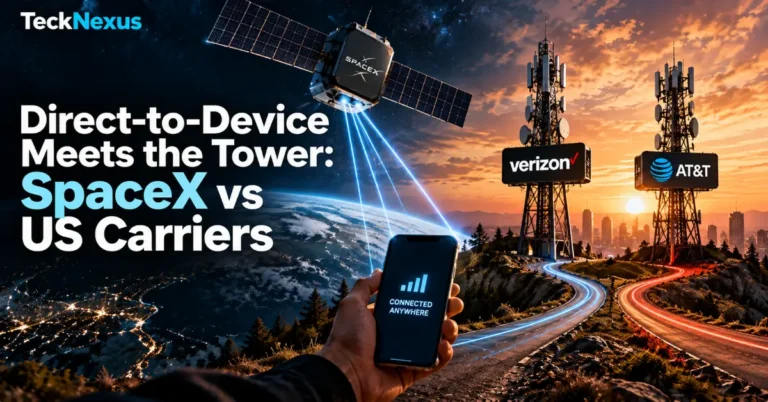
For most of the past three years, direct-to-device satellite connectivity was framed as a gap-filler: text messages from a mountain trail, emergency coverage where no tower reaches. That framing has shifted quickly this autumn. SpaceX has acquired low-band terrestrial spectrum, reportedly explored access to around 80,000 US cell sites, and signalled an ambition for Starlink Mobile to become a major mobile carrier in its own right. Shares in the three national operators fell sharply on the spectrum news earlier in October, and the third quarter earnings season turned into a public conversation about what a hybrid space and ground network would really take to build.

The most detailed answer came from Verizon CEO Dan Schulman. His assessment, and the contrasting timeline offered by SpaceX‘s leadership, frame the strategic questions that will shape US mobile competition over the rest of the decade.

Why direct-to-device alone is not the competitive question
The physics of satellite-to-phone links are well understood. Signals travel hundreds of kilometres to reach a standard handset, cell sizes are vast, and capacity per square kilometre is a fraction of what a dense terrestrial grid can deliver. That makes satellite coverage valuable in remote and rural areas, but far harder to scale where most subscribers actually live. Verizon puts the share of its revenue generated in urban and suburban markets at about 98%, which is precisely where terrestrial density matters most.
SpaceX’s recent moves suggest it reads the market the same way. Pairing satellites with ground-based radios and its own terrestrial spectrum would let it serve dense areas from towers while using its constellation for coverage everywhere else. In other words, the competitive challenge to incumbents is not direct-to-device on its own. It is direct-to-device combined with a terrestrial network, and that changes the economics entirely.
What a terrestrial network behind direct-to-device requires
Schulman set out a detailed inventory of what a competitive nationwide network would need: somewhere between 65,000 and 80,000 macro sites, backhaul over fibre or satellite, radio access equipment, power, significant additional spectrum, and the retail, customer service and back-office systems that turn a network into a carrier. By his estimate, a full build would take at least four to six years and cost between $300 billion and $500 billion over seven to eight years. SpaceX’s leadership has publicly suggested a shorter timeframe of two to three years.
Both views can be informative at once. Incumbent estimates reflect decades of experience in site acquisition, permitting and operations. A new entrant with an existing constellation, vertical integration and a willingness to lease rather than build may be able to compress parts of the timeline. The gap between the two estimates is where the strategic uncertainty sits, and it is why investors reacted as strongly as they did.
The building blocks compare as follows:
| Competitive lever | National incumbents today | Hybrid satellite and terrestrial entrant |
| Macro sites | Established nationwide grids built over decades | Leasing access to tens of thousands of existing towers |
| Spectrum | Deep low, mid and high-band portfolios | Recently acquired low-band plus satellite allocations |
| Backhaul | Extensive owned and leased fibre | Combination of fibre and satellite links |
| Rural coverage | Gaps remain in the most remote areas | Constellation reaches almost anywhere with sky view |
| Distribution and care | Retail, customer service and billing at scale | Must be built or partnered |
| Satellite strategy | Joint D2D venture and selective partnerships | Vertically integrated constellation |
The spectrum battle behind direct-to-device
The most immediate front is regulatory. The FCC is due to vote on Thursday 29 October on a proposal to open an additional 482 MHz across more than a dozen bands for Supplemental Coverage from Space, the framework that governs satellite-to-phone service in terrestrial spectrum, and to harmonise those rules with Mobile Satellite Service.
Ahead of that vote, CTIA and the three national operators asked the Commission to exclude the 2.5 GHz and 3.45 GHz bands. Their argument is technical: both are time-division duplex bands, while satellite direct-to-device has been designed around paired frequency-division duplex spectrum. T-Mobile, whose capacity layer is built on 2.5 GHz, has filed modelling suggesting that satellite transmissions overlapping a cell site could severely degrade uplink coverage and speeds. The operators want the Commission to focus satellite use on FDD bands instead.
However the vote lands, it will set the boundaries of how much terrestrial spectrum satellite operators can use for direct-to-device, and therefore how far a hybrid network can lean on spectrum it does not own outright.
How incumbents are positioning against direct-to-device competition
The incumbents’ responses share a common thread: compete on density and integration, and engage with satellite on their own terms. Verizon has said it is open to satellite partnerships for complementary coverage, either directly or through the joint direct-to-device venture it is pursuing with AT&T and T-Mobile. Where it draws a firm line is wholesale access. Schulman ruled out extending an MVNO arrangement to any satellite provider and said existing MVNO agreements offer no indirect route onto Verizon’s network.
AT&T CEO John Stankey took a similarly measured stance a week earlier, cautioning against overreacting to a single holder of low-band spectrum. Both operators are pointing to the same strengths: established terrestrial grids, multi-band spectrum depth, and continued investment in capacity. For Verizon, that includes putting its mmWave holdings to work for gigabit fixed wireless, preparing for 6G, and adding AI-enabled services, while reporting its strongest postpaid phone growth in five years.
The strategic posture is notable. Rather than dismissing the new entrant, incumbents are openly planning on the assumption that it will execute. That is a healthier starting point than the industry has sometimes adopted when facing disruptive competitors, and it puts the emphasis on cost structure and customer experience rather than complacency.
Direct-to-device signals to watch through 2028
Several developments will show how quickly the hybrid model takes shape:
- The 29 October vote. The FCC’s decision on the 482 MHz proposal, and whether TDD bands are carved out, will define the satellite spectrum envelope.
- Tower lease deals. Signed agreements with major tower companies would turn reported talks into a measurable terrestrial footprint.
- Additional spectrum transactions. Further low-band or mid-band acquisitions by satellite operators would indicate how quickly terrestrial capacity is being assembled.
- The incumbents’ D2D joint venture. The launch, scope and pricing of the national operators’ joint direct-to-device venture will show how incumbents package satellite coverage.
- Distribution and operations. Retail, customer care and device certification announcements are often the slowest parts of a carrier build and a reliable signal of readiness.
- Service launch timing. Starlink Mobile’s commercial launch, expected around early 2028, will be the first real test of hybrid network performance in dense markets.
The TeckNexus view on direct-to-device competition
The arrival of a well-capitalised hybrid entrant is pushing US mobile competition into a new phase. Satellite is no longer a separate category alongside cellular. It is becoming one layer in an integrated network design, and the players that combine orbital reach, terrestrial density and spectrum depth most efficiently will set the pace. For incumbents, the response is already visible in sharper segmentation, disciplined spectrum use and selective satellite partnerships. For the new entrant, the next two years are about converting announcements into sites, spectrum and service. Either way, the outcome will reshape how coverage, capacity and competition are defined well beyond the US market.
For more analysis on 5G, satellite connectivity and advanced networks, subscribe to TeckNexus Monthly Insights .
If you would like to share your perspective with our audience and generate qualified leads, partner with TeckNexus through our Intelligence Programs.