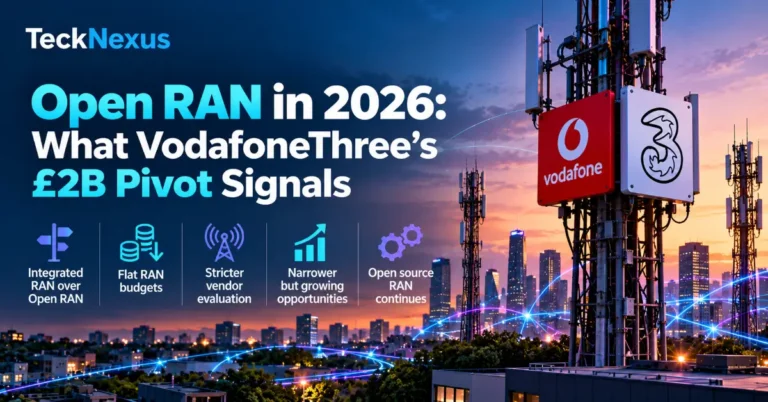
For much of the past decade, Open RAN was framed as the force that would break up the radio access market. October 2026 offered a more nuanced picture. VodafoneThree laid out why its UK network will be built on integrated radio equipment from Ericsson and Nokia, Deutsche Telekom signalled that its RAN budget will not grow to accommodate AI, and Cellnex Poland chose Ericsson as one of several suppliers for a large modernisation programme. At the same time, open source RAN software kept maturing, and several large operators kept expanding open deployments elsewhere.

Read together, these moves do not signal the end of Open RAN. They show operators applying a much stricter test to every RAN decision: can it be delivered on time, at a lower total cost, with clear accountability when something goes wrong?

Why VodafoneThree Stepped Back from Open RAN in the UK
Before the merger, Vodafone had planned to use Open RAN at about 2,500 UK sites that currently run Huawei equipment, which must be removed by the end of 2027. The plan centred on Samsung software with general-purpose servers from Dell and Intel. VodafoneThree has since moved to a £2 billion programme with Ericsson and Nokia, and at its October investor update the company explained the reasoning: the Open RAN roadmap available at the time did not fit the strict site and spectrum deadlines attached to the merger approval, and the incumbent vendors developed radios tailored to its specific spectrum holdings.
The financial frame is equally telling. VodafoneThree now targets about £1 billion in annual cost savings by fiscal 2032, up from an earlier £700 million goal, alongside 99% population coverage with 5G Standalone by 2030. Capital spending peaks next year. When a merged operator is consolidating around 37,000 sites down to roughly 26,000, delivery certainty becomes the dominant requirement. The company also described the UK choice as one made for now, and Vodafone Group continues to introduce Samsung Open RAN in Germany and other European markets.
Open RAN Is Narrowing, Not Disappearing
The wider October picture shows Open RAN finding its level rather than fading away. The same operators that make integrated choices in one market are deploying open architectures in another, and the decisive factor is usually local: the incumbent vendor being replaced, the deadline, and the spectrum mix.

| Operator | Market | RAN direction | Main driver |
| VodafoneThree | UK | Integrated RAN from Ericsson and Nokia (£2B) | Merger deadlines and spectrum-specific radios |
| Vodafone Group | Germany and other European markets | Introducing Samsung Open RAN | Market-by-market vendor strategy |
| Deutsche Telekom | Germany | Nokia Open RAN replacing Huawei at 3,000 sites by 2027; RAN budget held flat | Vendor swap on its own timetable; capex discipline |
| NTT Docomo | Japan | Commercial O-RAN-compliant multivendor base stations from Nokia | Programmability and multivendor flexibility |
| Cellnex Poland | Poland | Ericsson among several suppliers for RAN, microwave and site energy | Energy efficiency and site footprint |
NTT Docomo began commercial deployment of O-RAN-compliant multivendor base stations in September, and Nokia and Ericsson are both building programmability into their portfolios through different routes, with Nokia backing the O-RAN E3 interface and real-time dApps while Ericsson prioritises rApps for automation. These details were covered in our September Advanced Connectivity Insights. Openness is increasingly delivered as interfaces and software inside large vendor contracts, rather than as a wholesale switch to many smaller suppliers.
The New Capex Discipline Behind Open RAN Decisions
Budget pressure sharpens every one of these choices. Ericsson has said it expects the global RAN market to remain flat in 2026, extending a multi-year plateau, and its third quarter results reinforced that view. Deutsche Telekom told investors it does not expect AI-driven uplink traffic to raise its capital intensity after 2027, keeping uplink upgrades inside existing RAN modernisation plans. With no new revenue wave to fund experimentation, operators are optimising for a narrow set of outcomes.
Five priorities now shape most RAN awards:
- Delivery certainty: meeting regulatory, merger and vendor-swap deadlines without slippage.
- Spectrum fit: radios engineered for an operator’s specific band combinations, increasingly in multi-band units.
- Total cost of ownership: energy use, site footprint and tower load, not just equipment price. Cellnex Poland’s award, for example, combines radios, microwave links and integrated site energy systems.
- Accountability: one party responsible for performance, integration and fault resolution.
- Programmability: open interfaces and automation that let operators add intelligence without re-architecting the network.
Open RAN competes strongly on the last of these and can win on cost in the right conditions. Where it has struggled is the first, because multivendor integration adds testing and coordination time that hard deadlines do not always allow.
Open Source RAN Keeps Advancing in the Background
While large operators make pragmatic procurement calls, the open ecosystem is building capability. The OCUDU Ecosystem Foundation, hosted by the Linux Foundation, released version 26.10 of its open source CU/DU software in October. It adds 3GPP Release 17 non-terrestrial network support for satellite connectivity, O-RAN Split 7.2b for more flexible distribution of radio processing, 8T8R MIMO with enhanced beamforming, native 5G positioning, and security hardening through continuous fuzz testing and encrypted signalling.
None of this changes a national operator’s next tender. It does matter for the longer arc of the market. Open source baseband software lowers the barrier for research networks, government programmes and specialised deployments, and it keeps competitive pressure on proprietary roadmaps. It also positions open architectures for 6G, where the evolutionary path most operators favour will reward networks that can absorb new capabilities through software.
What the Open RAN Shift Means for Private and Enterprise Networks
Enterprise and private network buyers face a different calculation from national operators. Deployments are smaller, deadlines are usually set by the business rather than a regulator, and many sites need features such as precise positioning, satellite backhaul or tight integration with industrial systems. Those are precisely the areas where open interfaces and open source CU/DU software are advancing fastest.
The lesson from October is less about choosing open or integrated and more about the criteria. The questions national operators are now asking apply equally to a port, mine or factory: who is accountable for end-to-end performance, how the network will evolve towards 5G-Advanced and 6G through software, and what the total cost looks like over the full life of the deployment, including energy and operations.
The Outlook for Open RAN in 2027
Open RAN’s role is being redefined rather than ended. Expect integrated vendors to win where deadlines, spectrum complexity and accountability dominate, and open architectures to keep gaining ground where operators replace incumbent equipment on their own timetable, where open source lowers costs, and where programmability is the main goal. Vodafone’s own description of its UK decision as one made for now is a reminder that RAN strategies are being set market by market, and revisited as the technology and the economics change.
For more insights on advanced connectivity, explore the TeckNexus Monthly Insights, and to share your perspective with our audience and generate qualified leads, partner with TeckNexus through an Intelligence Program.