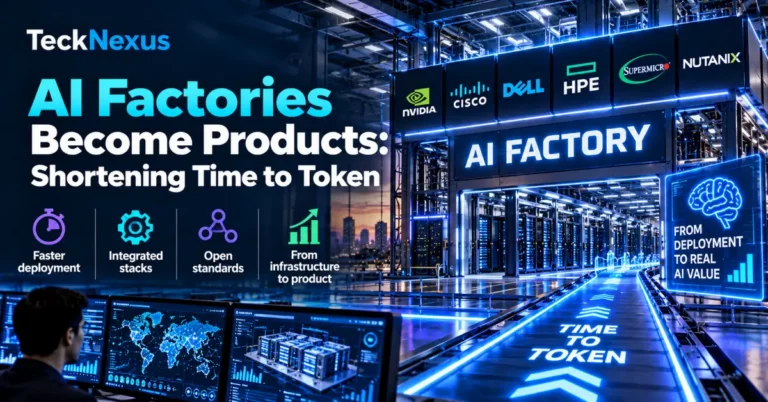
Not long ago, building an AI cluster meant a long custom engineering project: choosing accelerators, designing networks, specifying power and cooling, then integrating and testing everything on site. October 2026 showed how far that model has shifted. NVIDIA introduced DSX POD, a factory-built, containerised reference design for Vera Rubin systems. Cisco and Supermicro expanded a rack-scale Secure AI Factory offering with NVIDIA. Dell extended its AI Factory from deskside systems to the data centre, HPE launched Private Cloud AI, and Nutanix partnered with NVIDIA, Supermicro and Netris on a packaged AI infrastructure stack.

The common thread is that AI factories, the facilities that turn power, data and compute into tokens, are being sold as products with defined configurations, delivery times and support models. The metric that ties them together is time to token: how quickly a new investment produces useful AI output. That metric is reshaping product design, standards and where AI capacity can be deployed.

How AI Factories Became Products
The productisation of AI factories is happening at several layers at once. At the bottom are rack-scale systems that ship as integrated units rather than collections of servers. Above them sit pre-integrated pods and containers that include cabling, power distribution and liquid cooling. At the top are full-stack offerings that bundle compute, networking, storage, security, observability and software, and increasingly the facility management software that runs the whole site.
| Product layer | What it includes | October examples |
| Rack-scale system | Integrated accelerators, interconnect, rack power and liquid cooling | NVIDIA Vera Rubin MGX racks up to 250 kW; AMD Helios racks via HPE |
| Pre-integrated pod | Factory-assembled compute, cabling, power and cooling in containerised units | NVIDIA DSX POD, from early 2027 |
| Full-stack AI factory | Compute, networking, storage, security, observability and software | Cisco Secure AI Factory with Supermicro; Dell AI Factory; HPE Private Cloud AI; Nutanix with NVIDIA, Supermicro and Netris |
| Facility and operations software | Power control, grid coordination, digital twins and lifecycle automation | NVIDIA DSX AI Factory Platform, DSX OS and Minerva |
Each layer removes integration work from the customer and moves it into the factory or the vendor’s validated design. For buyers, that means fewer decisions and faster deployment. For vendors, it means competing on the completeness and reliability of the package rather than on individual components.
Why Time to Token Defines the AI Factory Product
The case for productised AI factories rests on speed. NVIDIA says its DSX POD design can reduce deployment from around six months to as little as 14 days, because compute, networking, cabling, rack power and liquid cooling are assembled and validated before shipping, then connected on site to prepared power, water and networking. A global partner ecosystem is due to begin manufacturing and delivering units in early 2027.

Speed matters because AI capacity starts earning only when it produces output. Jensen Huang has estimated that a three-month delay in bringing an AI data centre online can forgo around $10 billion in revenue for large deployments. Even at smaller scale, every month between capital spending and first token weighs on returns. Productised designs also reduce the risk of on-site integration errors, which can delay commissioning further, and make it easier to add capacity in steps that track demand.
Open Standards and Integrated Stacks in AI Factories
As AI factories become products, the question of whose specifications they follow becomes strategic. The October OCP Global Summit showed significant movement towards shared standards. NVIDIA contributed its Vera Rubin rack and compute tray designs through its open MGX architecture, supporting racks of up to 250 kW with liquid cooling and standardised interfaces. It joined AMD, Google and Meta to publish version 0.7 of the Open Data Center Specification, and with Google, Meta and Microsoft released an OCP Grid Resilience Specification targeting recovery from grid events in under two seconds. NVIDIA and Cisco also introduced the USFP optical standard, targeting 400 Gbps per lane.
Other voices are emphasising heterogeneity. HPE has argued that the shift from centralised training to distributed inference and agentic AI calls for open standards, interoperable software and a mix of accelerators across edge, cloud and sovereign environments. SK hynix has made a similar case from the memory side, arguing that AI performance now depends on co-designing compute, memory, storage, networking, power and cooling at rack and facility scale, with early ecosystem collaboration and shared standards. AMD’s Helios racks, which HPE will supply to Vultr under a $1.2 billion agreement, show rack-scale products emerging across multiple accelerator ecosystems. In China, Huawei‘s SuperClusters and UnifiedBus interconnect and Alibaba‘s Zhenwu V900 processor point to a parallel domestic stack.
In practice, integrated stacks and open specifications are converging. Vendors are contributing designs to open bodies while offering validated end-to-end products on top, giving buyers a choice between the speed of a complete package and the flexibility of mixing components.
Enterprise AI Factories Move On-Premises
Productisation is also bringing AI factories within reach of enterprises that will never build a hyperscale campus. Dell’s expanded AI Factory with NVIDIA spans deskside workstations to data centre infrastructure, aimed at running agentic and generative AI on-premises. HPE’s Private Cloud AI combines NVIDIA compute, networking and software with HPE infrastructure as an on-premises private cloud. Cisco’s Secure AI Factory with Supermicro integrates NVIDIA NVL72, HGX and MGX systems with Cisco networking, distributed security and Splunk observability, in both liquid- and air-cooled configurations for enterprises, neoclouds and sovereign clouds. Nutanix is combining its platform with NVIDIA Spectrum-X Ethernet, Supermicro hardware and Netris networking software.
Agentic AI is shaping these designs. NVIDIA introduced a Vera CPU rack for AI agent workloads, reflecting the fact that agents spend much of their time on orchestration, tool calls and data handling rather than pure accelerator work. Enterprise AI factories are increasingly configured for steady inference and agent workloads, not just periodic training.
The Facility Becomes Part of the AI Factory Product
The boundary between IT equipment and the building is dissolving. Average rack loads rose from about 12 kW in 2024 to around 26 kW in 2026, with some designs targeting up to 1 MW per rack, as noted in our September Digital Infrastructure Insights. At those densities, power and cooling cannot be designed separately from compute.
NVIDIA’s DSX AI Factory Platform, introduced for Europe in October, illustrates the shift. It combines closed-loop liquid cooling and dry coolers for near-zero facility cooling water, DSX Flex to coordinate workload power with grid conditions, SimReady digital twin models for power and cooling published on Hugging Face, and DSX OS, released as open source, to automate the infrastructure lifecycle. Industrial partners including ABB, Eaton, GE Vernova, Schneider Electric, Siemens Energy and Vertiv are part of the ecosystem. The AI factory product now includes the electrical and thermal systems, and the software that operates them.
What AI Factories as Products Mean for Telcos and Edge Sites
Containerised units that arrive ready to connect to power, water and networking open new options for where AI capacity can live. Telecom operators hold real estate, power connections and fibre at central offices, regional data centres and edge sites. Pre-integrated AI factory units could let them add inference capacity at these locations in weeks, closer to enterprise customers and with local data residency.
Several operators are already building in this direction. TIM is deploying edge cloud nodes with NVIDIA GPUs across Italy as part of its sovereign AI platform, Jio is among the early users of NVIDIA’s Minerva AI factory monitoring platform, and Lumen is combining Eminence Grey’s sovereign AI platform with its programmable network to connect edge and cloud AI environments. As AI factories become standard products, the operator’s advantage shifts towards sites, power, connectivity and the ability to operate distributed capacity.
AI Factory Buying Checklist
For enterprises, operators and neoclouds evaluating productised AI factories, the key questions are:
- Time to first token: how long from order to production output, including site preparation and commissioning.
- Facility requirements: power density, liquid cooling, water use and grid connection needs, and whether existing sites can meet them.
- Standards alignment: how closely the design follows open specifications, and how easily components can be upgraded or replaced.
- Workload fit: the balance of training, inference and agentic workloads the configuration is optimised for.
- Operations and observability: the software included to monitor yield, manage power and automate the infrastructure lifecycle.
- Scaling path: how capacity can be added in modular steps as demand grows.
The Outlook for AI Factories
The AI factory is following the path of other maturing technologies, from custom engineering to standard products delivered at scale. Over the next two years, the competition will centre on how quickly a vendor can deliver working capacity, how well its products follow shared standards, and how completely they integrate power, cooling and operations. For buyers, that means more choice and faster deployment. For telcos and edge operators, it creates an opening to host AI capacity close to where it is used.
For more insights on advanced connectivity, explore the TeckNexus Monthly Insights, and to share your perspective with our audience and generate qualified leads, partner with TeckNexus through an Intelligence Program.