Digital Twin

A digital twin is a live virtual model of a physical asset, network, or environment, continuously updated with real data so it can be monitored, simulated, and optimized. In telecom, operators use network digital twins to plan deployments, test changes, and run “what-if” scenarios before touching live infrastructure; in enterprise settings, twins model factories, ports, and facilities that private networks connect. Combined with AI, digital twins support predictive maintenance, automated optimization, and safer experimentation across complex systems. For operators and enterprises, the appeal is reducing risk and cost by testing in simulation rather than production. This channel tracks digital twin technology across networks and connected industries — planning, simulation, and operations — with analysis of where twins are delivering practical value and how they connect to private networks, edge, and AI-driven automation.

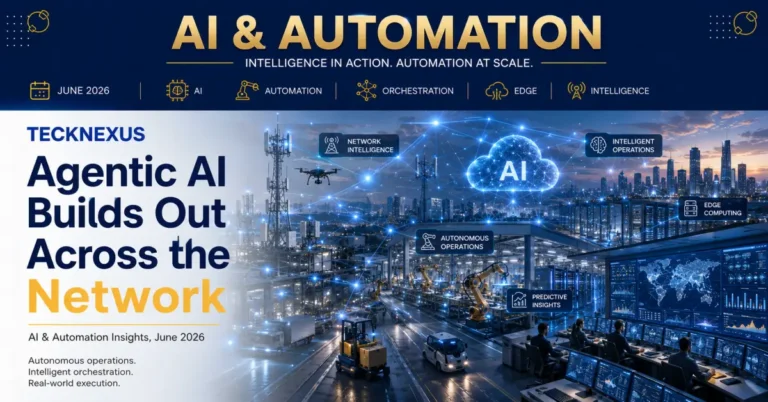
June 2026 showed agentic AI scaling from pilot to platform: industry-wide standards momentum, AI-RAN field trials from Nokia, Amdocs and KDDI, and fresh capital across data centers on three continents. This full roundup covers every deployment, partnership, funding round and governance move from the month, with tools to prioritise AI use cases and plan the network around them.
Every major vendor now offers AI for manufacturing. The problem is not options - it is knowing which use cases to prioritise for your specific factory. The TeckNexus AI Use Case Prioritiser for Manufacturing scores your options across impact, feasibility, data readiness, and payback speed.
P‑CAL’s secure mesh provided resilient communications across a complex yard, validating control loops and telemetry in the presence of interference, variable traffic density and human activity. As deployments scale, many terminals will adopt hybrid connectivity: private 5G for wide‑area mobility and interference resilience, Wi‑Fi/Wi‑Fi 6E/7 for indoor assets, and mesh for redundancy in hard‑to‑reach zones. This mirrors global port trends, where operators are rolling out private 5G to support autonomous trucks, AI‑driven analytics, drones and mobile cranes. Expect edge compute (MEC) on‑premises to host perception, fleet orchestration and video intelligence with strict latency and data‑sovereignty requirements.
A new collaboration between GSMA Foundry and Singapore’s National University Health System (NUHS) aims to operationalize connected health at scale, with Ericsson and Singtel anchoring the 5G foundation. Healthcare digitization has moved from pilots to production, but most sites still struggle with deterministic connectivity, secure data exchange and workflow integration. The program combines private 5G with digital twin, XR, IoT and ambient AI to improve outcomes and operational resilience across care pathways. Early focus areas include 5G-enabled remote surgical assistance with ultra-reliable, low-latency links; immersive XR training and simulation that compress learning curves; autonomous and semi-autonomous robotics for logistics and point-of-care tasks; and AI-guided imaging such as vein visualization.
LG Uplus is moving from rule-based automation to closed-loop autonomy, using AI agents and digital twins to accelerate toward a fully autonomous network by 2028. Its core platform, the AI Orchestration Nexus (AION), is already automating repetitive operations and has contributed to a reported 70% reduction in customer complaints about network quality—an early signal that the approach is translating into measurable outcomes. The company plans to showcase these capabilities at MWC Barcelona 2026, underscoring growing operator interest in operational AI as 5G matures and traffic patterns become more volatile.
Deutsche Telekom and T-Systems have switched on a sovereign, NVIDIA-powered AI factory in Munich’s Tucherpark, positioning Germany as a serious contender in industrial AI infrastructure. The new facility brings nearly 10,000 NVIDIA Blackwell GPUs online, including DGX B200 systems and NVIDIA RTX Pro Server GPUs, delivering up to 0.5 exaFLOPS of AI compute for training, fine-tuning, and large-scale inference. Operated by T-Systems on German soil, the platform targets industry, research, startups, and the public sector with strict controls for data protection, security, and availability. Early customers include Agile Robots, which is combining vision, robotics, and foundation models, and PhysicsX, which applies AI to technical simulation.
ABB has unveiled Automation Extended, an evolution of its distributed control systems designed to let plants add digital capabilities without disrupting mission-critical operations. The program extends ABB’s established DCS portfolio—Ability System 800xA, Symphony Plus, and Freelance—by introducing a framework to layer analytics, AI, and IoT capabilities on top of existing control assets. The core promise is modernization without downtime: operators can keep trusted control systems running while progressively adopting new functionality. Security and interoperability are central themes, with ABB positioning an open, modular ecosystem that scales across industrial domains and preserves prior investments.
Jaguar Land Rover's Solihull plant is now a model smart factory, thanks to Ericsson's private 5G deployment. The high-speed, low-latency network replaces traditional Wi-Fi and wired systems to support real-time data, AI automation, and scalable production. With collaboration from Ericsson, Fujitsu, and Litmus, the project boosts operational efficiency and showcases how private 5G is transforming the future of automotive manufacturing.
Invences & Trilogy are advancing smart farming with FarmGrid, a platform powered by private 5G, digital twins, and edge AI. Deployed across North Dakota, Nebraska, and California, FarmGrid delivers real-time farm monitoring, improves agricultural productivity, and extends rural broadband access. Using Azure IoT, Open RAN, and edge computing, the platform connects farmers with actionable data and sustainable practices.
This article highlights the top 10 private 5G and LTE deployments transforming energy and utility operations globally. From U.S. electric utilities to offshore rigs and oilfields in Africa and Asia, these real-world examples show how private networks deliver secure, resilient communications that improve reliability, safety, and operational intelligence—laying the foundation for scalable grid modernization, edge analytics, and automation.
From Singapore to Schiphol, airports are embracing private networks for airports alongside AI and digital twins to drive operational efficiency, predictive maintenance, sustainability, and smarter passenger flows. This article explores 12 real-world deployments showcasing how private network deployments for aviation are shaping the future of Airport 4.0 globally.
Jeff Bezos is stepping back into day-to-day operations as co-CEO of Project Prometheus, a new AI company reportedly funded with $6.2 billion to build “AI for the physical economy.” Project Prometheus will be co-led by Bezos and Vik Bajaj, an operator-scientist with leadership experience at Google X, Verily, and Foresite Labs. Early reports indicate the company is targeting engineering and manufacturing tasks across sectors such as aerospace, automotive, and computing hardware. Headcount is already near 100, drawing researchers from OpenAI, Google DeepMind, and Meta, signaling an aggressive push for top-tier AI talent.

Frequently Asked Questions

What is a digital twin, in practical terms?
In practical terms, a digital twin is a software model that mirrors a real physical object, system, or process closely enough, and updates frequently enough using real sensor data, that decisions can be tested against the model with meaningful confidence they’ll reflect what would actually happen in reality. Unlike a static 3D model or design blueprint, a digital twin is meant to be continuously synchronized with its physical counterpart, reflecting current conditions rather than a fixed, one-time snapshot. This makes it possible to ask ‘what happens if’ questions, like what happens if we reroute network traffic this way, and get a reasonably reliable answer without actually making that change to the real, physical system first.
How are digital twins used in telecom networks specifically?
Telecom operators build digital twins of their own networks, modeling everything from radio coverage and capacity to the behavior of virtualized core network functions, to simulate the impact of potential changes before deploying them on a live, customer-facing network. This might mean testing how a planned software update will affect performance, modeling how traffic would be rerouted during maintenance, or simulating how adding capacity in one area might affect neighboring cells, all without risking an actual outage if the simulation reveals an unexpected problem. As networks become more complex with virtualization and multi-vendor components, digital twins are increasingly valuable for catching configuration mistakes before they reach the live network.
What industries outside telecom use digital twins heavily?
Manufacturing uses digital twins extensively to simulate entire factory floors, testing how changes to production line layout would affect output before making physical changes, and to predict equipment failures by modeling wear patterns from real sensor data. Smart city initiatives use digital twins to model traffic flow, energy grids, and infrastructure systems, helping planners simulate the effects of new development before implementation. Logistics companies use digital twins to model warehouse operations and transportation networks, optimizing routes and inventory placement. Aerospace and automotive industries, where the concept originated, use digital twins extensively for design and ongoing maintenance, modeling how individual aircraft or vehicles age based on their specific real-world usage.
Why do digital twins need low-latency, high-bandwidth connectivity to work well?
A digital twin is only as useful as how current its underlying data is; if sensor data takes too long to reach the model, simulations and predictions end up being based on stale information that no longer reflects actual real-world conditions, undermining the entire premise of using the twin to make confident decisions. This is particularly critical for digital twins modeling fast-changing systems, like network traffic patterns or industrial equipment operating in real time, where conditions can shift meaningfully within seconds. Low-latency, high-bandwidth connectivity, often provided through 5G, private networks, or edge computing, ensures the constant stream of sensor data feeding a digital twin arrives quickly enough for the model to remain genuinely accurate.
What’s the difference between a digital twin and a simple simulation or 3D model?
A simple 3D model or simulation is typically a static or one-time representation, useful for visualization or testing a specific scenario at a fixed point in time, but it doesn’t automatically update as real-world conditions change. A digital twin, by contrast, is specifically designed to be continuously synchronized with its physical counterpart through an ongoing stream of real sensor data, meaning the model reflects current, evolving conditions rather than a fixed snapshot from whenever it was created. This continuous synchronization is what allows a digital twin to support ongoing operational decisions and predictive maintenance, rather than just one-time design validation, which is generally the more limited role a static simulation plays.
How accurate do digital twins actually need to be to be useful?
The required level of accuracy depends heavily on what decisions the digital twin is meant to support; a twin used for high-level capacity planning might tolerate more approximation than one used to predict the exact moment a piece of critical equipment is likely to fail. In practice, most digital twins involve a deliberate trade-off between modeling fidelity and the cost and complexity of building and maintaining that level of detail, since a perfectly accurate model of every possible variable would often be prohibitively expensive to build and keep updated. Organizations typically aim for the twin to be accurate enough that decisions made based on its predictions reliably hold up in the real world for the specific use case at hand.
What role does AI play in digital twin technology?
AI plays an increasingly central role in digital twin technology, particularly in interpreting the large volumes of sensor data feeding the twin and identifying patterns that wouldn’t be obvious through simple rule-based monitoring. Machine learning models are commonly used to predict equipment failures based on subtle patterns in sensor data that precede a breakdown, to optimize complex systems by testing many possible scenarios within the twin far faster than a human planner could manually evaluate, and increasingly, to generate realistic predictions about how a system would behave under conditions that haven’t actually been observed yet. This combination is what allows modern digital twins to move beyond simple visualization toward genuinely predictive, decision-supporting tools.
What are the biggest challenges in building and maintaining a digital twin?
Building and maintaining an accurate digital twin presents several recurring challenges. Gathering sufficiently detailed, reliable real-world sensor data across a complex system, especially older infrastructure not originally designed with extensive sensor instrumentation, can require significant upfront investment in new sensors and connectivity. Keeping the model genuinely synchronized with reality over time requires reliable, low-latency data pipelines that can become a meaningful technical undertaking in their own right, particularly at scale. There’s also an ongoing maintenance burden, since a digital twin that gradually drifts out of sync with its real-world counterpart can become actively misleading rather than simply less useful.
Sponsored by Palo Alto Networks
⚡ Utilities ⏱ 8 min ✓ Free
This tool is built and hosted by TeckNexus.
Launch Tool →
Whitepaper
Neutral host, network slicing, and autonomous ground vehicles look like three unrelated topics — but they share the same hidden security risk. See what 100 airport deployments reveal about securing the components with the broadest reach across the network....
Palo Alto Networks
Whitepaper
Airports are deploying AI surveillance, biometrics, and autonomous vehicles faster than most networks can secure them. See what 100 real-world airport deployments reveal about the airside/landside security gap — and the 4-layer framework built to close it....
Palo Alto Networks
Scroll to Top