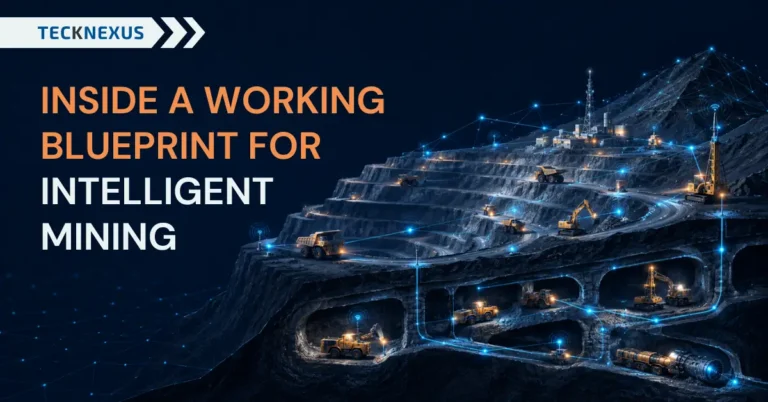
Most industry commentary on AI in mining stays at the level of ambition: predictive maintenance is coming, digital twins will transform operations, computer vision will improve safety. A blueprint presented at Huawei South Africa Connect 2026 in Johannesburg is worth attention precisely because it doesn’t stay there. It sets out a specific, layered architecture for intelligent mining — naming the connectivity technology for each operational zone, the sensing method for each monitoring task, and the partners responsible for each layer — which makes it one of the more concrete technical references available this year for how a mining site’s connectivity and AI stack actually fits together.

A Layered Connectivity Architecture for Intelligent Mining Sites
The blueprint splits connectivity by operational zone rather than treating the site as a single network problem. Private 5G covers open-pit operations, where mobile equipment, long line-of-sight distances, and higher-bandwidth applications — video, telemetry from moving vehicles — favour cellular architecture. Wi-Fi Mesh covers underground coverage, where the propagation characteristics of tunnels and the density of fixed infrastructure make a mesh topology more practical than cellular. Distributed fibre sensing handles two specific monitoring tasks — perimeter intrusion detection and conveyor idler acoustic monitoring — which is a detail worth noting on its own: fibre-based distributed acoustic sensing is a comparatively underused sensing method in mining discussions that tend to default to cameras and vibration sensors, but it’s well suited to exactly these two use cases, since it can monitor a long linear asset such as a conveyor line or a perimeter fence continuously without needing a discrete sensor at every point along it.

On top of that connectivity layer, the practical AI emphasis is edge computer vision running on existing CCTV infrastructure, rather than a wholesale camera replacement — a detail that matters for the economics of a real deployment, since it reduces the AI adoption bottleneck to a compute and integration problem rather than a hardware refresh across an entire site. The stated targets for that computer vision layer are safety monitoring and equipment anomaly detection, paired with predictive maintenance and automated reporting drawing on the same sensing infrastructure. Reusing existing camera hardware and routing its output through new edge analytics is a meaningfully lower-cost adoption path than a typical greenfield computer vision rollout, and it’s a pattern worth other verticals — ports and airports in particular, both of which already run extensive CCTV estates — paying closer attention to as a template.
Named Partners and What They Signal About the AI Layer
Two named partnerships give the blueprint more substance than a typical vendor architecture diagram. The University of Pretoria is contributing underground robotics research, which points at where the harder unsolved problems in this architecture still sit — underground mobility and autonomy remain a research-stage problem even where the connectivity to support it, Wi-Fi Mesh, is already commercially available and deployed. BCX is building the digital twin layer: a cloud-based system integrating IoT, CCTV, PLC, SCADA, and MES data through open interfaces and low-code integration tooling. That integration detail — open interfaces and low-code tooling specifically — is the more interesting signal than the digital twin concept itself, since it suggests the harder problem in mining digital twins isn’t the visualisation layer, it’s getting five different operational technology data sources to talk to each other without a fully custom integration build for every individual site.
The choice to name a systems integrator (BCX) as the party responsible for that integration layer, rather than treating it as something Huawei‘s own connectivity stack handles natively, is itself informative. It suggests the industry’s honest current position is that connectivity vendors and integration specialists remain distinct roles even inside a single vendor-led blueprint — a division of labour worth mirroring in any mining operator’s own vendor selection, rather than assuming a single connectivity provider can also deliver the OT-to-IT integration work a genuine digital twin requires.
Why the Architecture Detail Matters More Than the Location
A separate piece of industry commentary published the same week, focused on open-pit mining specifically, reinforced one part of this picture while complicating another: it confirmed private 5G‘s role connecting mobile equipment and video workloads in open-pit operations, but noted that digital twin uptake across the industry remains constrained in practice — a useful check against treating any single blueprint as evidence that the full stack is already deployed and working at scale. The Huawei South Africa blueprint should be read as an architecture reference and a stated intent, not as proof that perimeter fibre sensing, underground Wi-Fi mesh, edge CCTV analytics, and a fully integrated digital twin are all operating together today at one site.
What makes it useful regardless is the level of specificity: a mining operator or its private network integrator evaluating architecture options rarely gets a reference this explicit about which connectivity technology serves which zone, which sensing method serves which monitoring task, and which partner owns which integration layer. Most published mining AI content stays at the strategic level. This one gives enough technical detail to actually compare against an existing or planned site architecture — which is the more useful function for anyone doing real evaluation work, independent of whether every element of the stated blueprint is fully operational yet at the site where it was presented.
What a Mining Operator Should Actually Take From This Blueprint
For a mining operator building its own connectivity and AI roadmap, the most transferable element of this blueprint isn’t any single technology choice, it’s the underlying discipline of matching connectivity type to operational zone rather than defaulting to a single network technology across the whole site. A common and costly mistake in mining private network planning is treating the site as one undifferentiated coverage problem and selecting a single technology, most often private 5G, to solve it end to end, when the actual propagation, mobility, and application requirements vary sharply between open-pit, underground, processing plant, and perimeter zones. The Huawei blueprint’s zone-by-zone approach, private 5G for open-pit, Wi-Fi Mesh underground, fibre sensing for linear perimeter and conveyor assets, is a more defensible starting architecture precisely because it treats each zone’s requirements independently rather than forcing a one-size-fits-all connectivity decision, and it’s the kind of zone-differentiated thinking worth applying regardless of which specific vendors or technologies a given operator ultimately selects for each layer.
Explore the full TeckNexus Intelligence Platform — independent, buyer-neutral tools for private network and industrial AI decisions. https://tecknexus.com/intelligence/