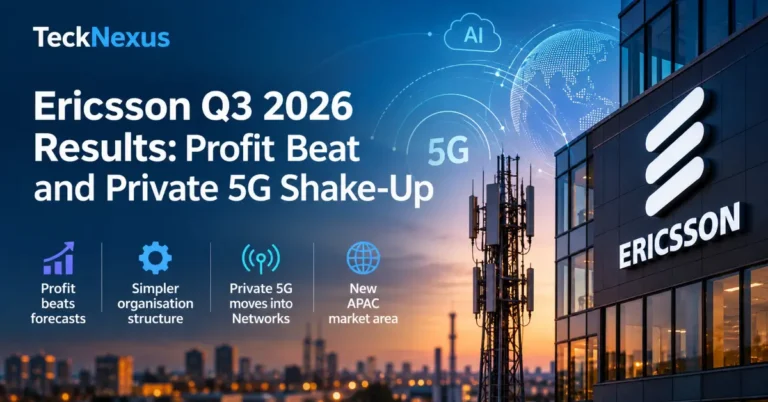
Ericsson has reported third quarter results for 2026 that came in well ahead of market expectations, and used the same day to announce a simplification of its group structure and changes to its Executive Team. It was the first quarterly report under President and CEO Per Narvinger, the former head of Business Area Networks, and it set out both the strength of the current business and the direction he intends to take it.

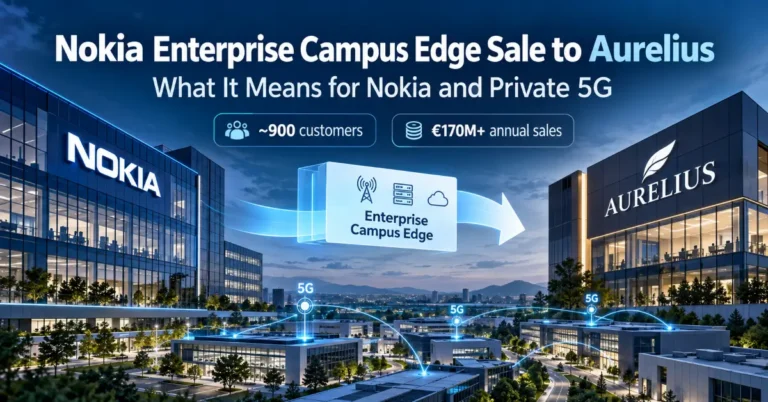
The headline numbers point to a company executing well in a market that is not growing. The structural changes say more about where Ericsson sees its next leg of growth: in intelligent, autonomous networks, in mission-critical and defence-adjacent opportunities, and in enterprise and indoor connectivity that is being moved closer to the Networks engine room. Coming two days after Nokia agreed to sell its Enterprise Campus Edge business, the timing makes this a notable week for enterprise private wireless.
Ericsson Q3 2026 Results at a Glance
| Metric | Q3 2026 | Q3 2025 | Change |
| Net sales | SEK 59.5bn | SEK 56.2bn | +6% (+7% organic) |
| Adjusted gross margin | 47.7% | 48.1% | -0.4 pts |
| Adjusted EBITA | SEK 10.1bn | SEK 15.8bn | -36% (prior year included a SEK 7.6bn capital gain) |
| Adjusted EBITA margin | 17.0% | 28.1% | |
| Net income | SEK 5.8bn | SEK 11.3bn | -49% (prior year included a divestment gain) |
| Free cash flow before M&A | SEK 4.9bn | SEK 6.6bn | -26% |
| Net cash | SEK 60.7bn | SEK 51.9bn | +17% |
Adjusted EBITA of SEK 10.1 billion was around 28% above the consensus estimate of about SEK 7.9 billion, and sales also beat forecasts. Ericsson’s shares rose by as much as 11% in Stockholm on the day. The year-on-year profit decline reflects a one-off capital gain in the third quarter of 2025; excluding it, Ericsson says adjusted EBITA would have grown. Sequentially, net sales rose 13% on the second quarter, and the company returned SEK 4.8 billion to shareholders through buybacks during the quarter.
Inside the Ericsson Q3 2026 Numbers by Segment
| Segment | Q3 2026 sales | Change | What drove it |
| Networks | SEK 38.7bn | +9% | Demand in strategic markets and near-term commercial actions; margin supported by retroactive IPR revenue |
| Cloud Software and Services | SEK 15.8bn | +3% | Steady demand, stable margin |
| Enterprise | SEK 4.6bn | -10% | Reflects the divestment of iconectiv; lower margin for the same reason |
Networks did the heavy lifting. Organic sales grew in three of four market areas, with Asia and Europe contributing and Latin America softer. IPR licensing revenue rose to SEK 3.9 billion from SEK 3.1 billion, helped by retroactive payments for previously unlicensed products. Operating expenses were lower year on year, which reflects the efficiency work of the past two years.
Narvinger noted that customer conversations during the quarter kept returning to one theme: the need for more intelligent and autonomous networks to improve performance, efficiency, robustness and resilience. He added that Ericsson is already seeing efficiency gains from AI-enabled features in its portfolio. Customer wins and deployments spanned network modernisation, differentiated connectivity and mission-critical networks.
The Ericsson Q3 2026 Outlook: Flat RAN, Rising Component Costs
The outlook was measured. Ericsson expects the RAN market to remain flat, geopolitical uncertainty to stay elevated, and component costs to weigh on gross margin in 2027. Narvinger linked those costs to the AI boom, which is drawing semiconductor and memory capacity towards data centre buildouts, and described the pressure as structural rather than a short-term squeeze.
Ericsson’s response combines immediate and longer-term measures:
- Tactical actions such as product substitution and upselling, which have helped so far.
- Pricing, with cost increases passed through to customers where possible. Some customers brought orders forward ahead of announced price rises during the quarter.
- Portfolio optimisation and supply chain changes to reduce exposure to the most constrained components.
- Efficiency gains across the organisation, including the structural simplification announced alongside the results.
Because many customer contracts run over several years, Narvinger was clear that structural mitigations will take time to flow through. He also stated the priority plainly: protecting the value of Ericsson’s technology and the profitability of its mobile networks business. That candour is useful for operators planning 2027 budgets, since equipment pricing is likely to be shaped by the same AI-driven supply pressures across the industry.
How the Ericsson Q3 2026 Restructuring Reshapes the Group
The structural changes are the most significant part of the announcement for anyone tracking enterprise and private networks. There are two main moves, both taking effect around the turn of the year.
| Change | Before | After |
| Asia-Pacific sales structure | Market Area North East Asia; Market Area South East Asia, Oceania and India | Single Market Area APAC from 1 January 2027, led by Patrick Johansson (currently Head of Market Area EMEA) |
| Ericsson Private 5G and Neutral Host | Business Area Enterprise Wireless Solutions | Business Area Networks |
| Wireless WAN | Business Area Enterprise Wireless Solutions | Standalone business reporting to Yossi Cohen, Head of Market Area Americas |
| Executive Team | Separate heads for two Asian market areas and for Enterprise Wireless Solutions | Leaner team; Chafic Nassif, Andres Vicente and Åsa Tamsons step down on 31 December 2026; search under way for a new Head of EMEA |
Narvinger said the Executive Team will be leaner and more balanced in terms of responsibilities, allowing Ericsson to act faster. Chafic Nassif, who has been with Ericsson for more than sixteen years, and Andres Vicente will support the formation of the new APAC market area before leaving the Executive Team. Åsa Tamsons, credited by Narvinger with creating new channels to enterprises for Ericsson’s portfolio, will support the integration of the Enterprise Wireless Solutions portfolio until year end.
What the Ericsson Q3 2026 Changes Mean for Private 5G
Moving Ericsson Private 5G and Neutral Host into Business Area Networks is a deliberate bet on scale. Indoor and enterprise radio products now sit in the same organisation as the company’s core RAN research and development, giving them direct access to the technology, roadmaps and volume economics of the mobile networks business. Ericsson expects indoor and enterprise solutions to grow in importance as AI agents and differentiated connectivity create new demands on in-building networks.
Keeping Wireless WAN as a standalone unit under the Americas reflects a different customer profile. Wireless WAN serves larger-scale private wireless and mission-critical deployments, where enterprises and public sector bodies need connectivity across vehicles, field sites and distributed operations. Placing it alongside the market area where much of that demand sits keeps it close to customers.
Set beside Nokia‘s announcement earlier in the week, the industry picture becomes clearer. Both of Europe‘s major network vendors are reorganising enterprise wireless, but in different directions:
| Nokia | Ericsson | |
| Campus and enterprise private wireless | Enterprise Campus Edge to be sold to Aurelius and run as a standalone company | Private 5G and Neutral Host integrated into Business Area Networks |
| Wide-area and mission-critical | Retained, aligned with defence, rail and utilities focus | Wireless WAN kept as a standalone business under the Americas |
| Underlying logic | A focused owner for a platform-led campus business | Core RAN scale and R&D synergies for indoor and enterprise products |
Neither move is an exit from private networks. Both recognise that campus private wireless and wide-area mission-critical networks are distinct businesses with different economics, and both are organising accordingly. For enterprises, the effect is a market with clearer choices: a dedicated independent specialist on one side, and an integrated offer built directly on a tier-one RAN portfolio on the other.
Where Ericsson Q3 2026 Points for Growth
Narvinger described Ericsson’s growth opportunities as a set of buckets, ranked roughly by proximity to the core business:
- Getting more from the existing market, including share gains where it makes commercial sense.
- Helping operators deploy new revenue-generating use cases, using 5G standalone capabilities such as network slicing and quality on demand.
- Adjacent business development in mission-critical networks, sensing technologies including defence applications, and enterprise.
He was frank that 5G standalone monetisation features are in use but not yet at volume, and that enterprise has not yet delivered meaningful growth, while ranking it ahead of network APIs as an opportunity. Bringing Private 5G into Networks is a practical step towards changing that, by putting the full weight of the RAN organisation behind enterprise and indoor products.
The Bigger Picture
Ericsson’s third quarter shows a company that is generating cash, beating expectations and returning capital, even in a flat RAN market. Its first reorganisation under a new CEO is aimed at speed and focus rather than retrenchment: fewer layers at the top, a single Asia-Pacific organisation, and enterprise wireless brought closer to the core technology.
The two challenges to watch in 2027 are clear. One is how quickly pricing and portfolio measures offset AI-driven component inflation. The other is whether the new home for Private 5G and indoor solutions converts enterprise interest into volume growth. With Nokia taking a different path in the same week, the private wireless market now has a live comparison of two strategies from Europe’s largest vendors.
For ongoing analysis of network vendors, private 5G and telecom AI, visit TeckNexus Intelligence at https://tecknexus.com/intelligence/, https://tecknexus.com/contenttype/newsletters/ and https://tecknexus.com/reports/.