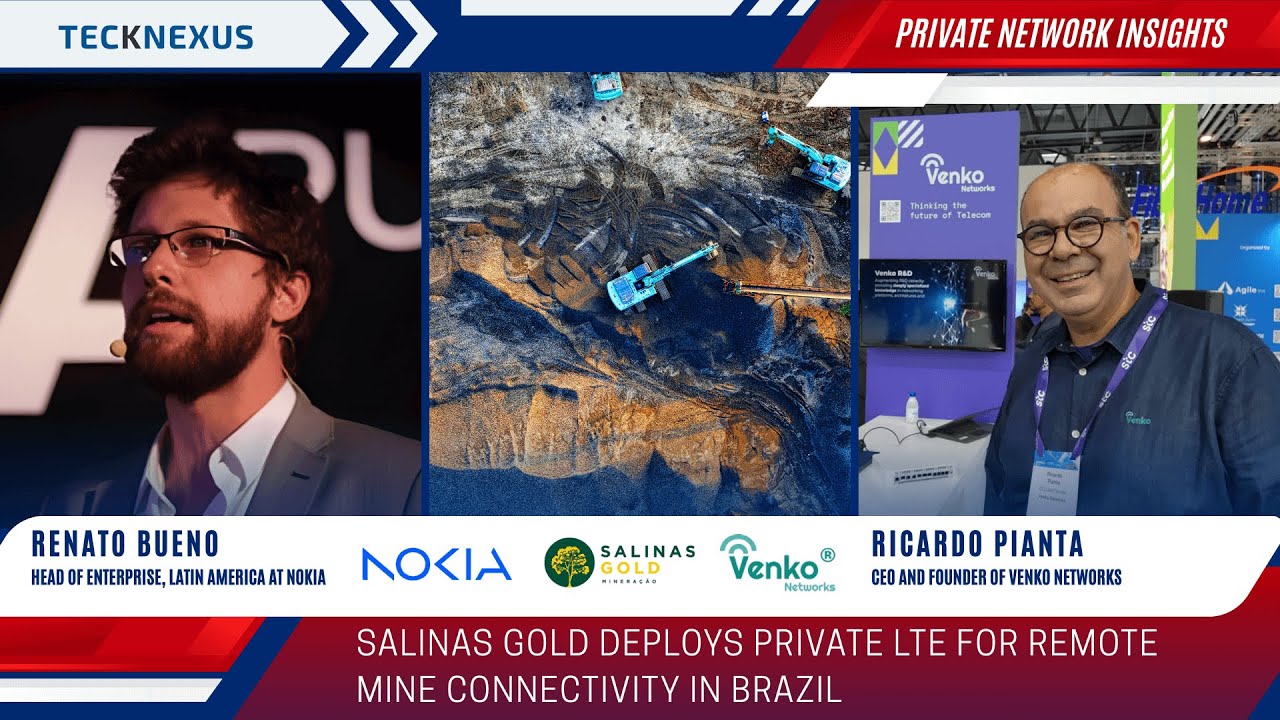
This article was prepared based on interviews with Renato Bueno, Head of Enterprise, Latin America at Nokia, and Ricardo Pianta, CEO and Founder, Venko Networks.

In the vast expanse of Mato Grosso, Brazil—where only a small percentage of the territory has access to 4G or 5G—Nokia’s private wireless deployment with Salinas Gold stands out as a compelling model for remote industrial connectivity. The project brings together private wireless technology, local integration expertise, and ecosystem collaboration to address the realities of operating in largely unserved geographies.
For Nokia, the Salinas Gold deployment represented more than a routine network rollout. It served as a proof point that combining advanced private wireless infrastructure with the right local partners can enable rapid, resilient digital transformation. The initiative united Nokia’s private wireless solutions with Venko Networks’ system integration capabilities and Ávato’s regional fiber expertise, forming a tightly coordinated ecosystem tailored to industrial requirements.
Powering Remote Mining Operations with 700 MHz Private LTE
The connectivity gap in Mato Grosso presented a fundamental challenge. With less than a quarter of the state connected, Salinas Gold required a solution designed specifically for coverage, reliability, and operational continuity rather than an off-the-shelf approach. Nokia’s use of the 700 MHz band for private LTE delivered the reach and performance necessary for reliable, high-capacity connectivity across a remote mining environment.
Speed and simplicity were core priorities. The private LTE network was fully operational in under 50 days, while its low-complexity design minimized maintenance demands in areas far from major infrastructure hubs. This approach allowed Salinas Gold to shift its focus away from basic connectivity concerns and toward productivity and operational efficiency.
From Platform to Execution: Integrating the Network on the Ground
Execution on the ground depended heavily on system integration. The opportunity reached Venko Networks through Ávato, which is part of the Avatus portfolio. While Ávato had deep regional expertise, it did not have prior experience deploying private networks. Venko stepped in as an enabler, supporting Ávato throughout the proposal and delivery process.
Venko assumed ownership of the project and delivered it using an end-to-end, white-label approach. This role ensured that the LTE core and radio access network were fully integrated and aligned with Salinas Gold’s operational requirements, translating the platform vision into a working industrial network.
Ecosystem Collaboration Enables Rapid Deployment
Collaboration across the ecosystem was central to the project’s success. Requirements gathering was led by Ávato’s team, which worked directly with the customer. Those requirements were then shared with Venko, which developed the initial network plan and consulted closely with Nokia to validate assumptions, design choices, and coverage models.
Once the proposed coverage was approved by the customer, the project moved quickly into deployment. The system was prepared in Venko’s lab with support from Nokia before being shipped to Ávato. Ávato’s field teams handled on-site installation and initial deployment, after which Venko led full system integration. SIM cards were prepared and distributed across initial test equipment, followed by installation and validation testing, with continued involvement from the customer’s IT team.
This coordinated approach enabled both rapid rollout and long-term sustainability, avoiding the logistical delays that often affect remote deployments.
Designing for Mining Realities: Coverage Over Theory
In mining environments, network design priorities differ from those of traditional enterprise sites. Latency is not always the primary concern. Instead, geography presents the greatest challenge. Uneven terrain and expansive operating areas make radio placement and coverage tuning particularly complex.
To move quickly and resolve operational issues, the deployment leveraged existing towers wherever possible. Identifying and using those assets effectively while still meeting coverage requirements was a central challenge. Despite the success of the initial phase, some areas—such as caves within the mining site—will require further expansion in a second deployment phase. Even so, reusing existing infrastructure proved well suited to delivering reliable connectivity at speed.
Tailoring the Network for Mining-Specific Needs
The Salinas Gold deployment was not designed as a highly sophisticated use case from the outset, though it is expected to evolve over time. Trucks operating within the mine were equipped with specific devices, and the primary requirement was consistent, reliable communication.
Customization focused on tuning spectrum usage to ensure that every device could communicate effectively. Restrictions were applied to control how individual devices consumed available spectrum. This was particularly important in Brazil, where the frequency allocation used for the deployment is limited. Preventing any single device from consuming excessive bandwidth was essential to maintaining overall network performance.
Planning for Expansion and Automation
Looking ahead, extending coverage into deeper areas of the mine represents the next major challenge. Some caves extend more than 150 meters below the surface, and permanent power infrastructure is often unavailable because today’s tower location may become a future excavation site.
Two approaches are being explored to address this. One involves deploying mobile stations—trucks equipped with radios mounted on top—that can be repositioned based on active exploration zones. The other focuses on increasing the transmission capacity of the units installed on mining trucks, allowing them to remain visible to the radio network even when operating inside caves. Both approaches are designed to extend connectivity without relying on fixed infrastructure.
Building for the Future with Edge and IoT Readiness
Nokia’s network design also supports long-term evolution. A fiber-based backbone combined with edge computing ensures operational continuity even if upstream connectivity is disrupted. Local processing enables advanced use cases such as real-time analytics and automation without dependence on centralized cloud resources.
The 4G core has been designed for seamless expansion, making it straightforward to add 5G capabilities or extend coverage through additional sectors or sites. The network is also ready for IoT applications, including NB-IoT and CAT-M1, enabling future machine monitoring and field control use cases.
Brazil’s regulatory environment has played a key role in enabling this progress. Anatel’s allocation of private spectrum for industries such as mining and manufacturing has allowed enterprises like Salinas Gold to take greater ownership of their connectivity strategies.
Scaling Private Wireless Across Latin America
While mining remains the most active vertical for private wireless in Latin America, Nokia is seeing growing adoption across ports, manufacturing, agribusiness, and utilities. Deployments span multiple countries, including Chile and Brazil, and extend to connected agriculture initiatives in the same Mato Grosso region.
In agribusiness, collaborations with organizations such as ConectaAgro are enabling millions of hectares to be connected through partnerships involving telecom vendors, industrial application developers, universities, and cloud providers. Utilities are also leveraging dedicated spectrum to improve automation and operational efficiency.
This momentum reflects a broader shift across the region. Industrial organizations are moving beyond experimentation and implementing private wireless to address concrete challenges, from automation and safety to energy efficiency.
Pragmatism as a Deployment Philosophy
A defining characteristic of the Salinas Gold project was its pragmatic execution approach. Private 5G and private LTE are often perceived as complex and time-consuming to deploy. By remaining flexible, understanding existing infrastructure, and responding to customer urgency, the project delivered value quickly—even if the initial deployment was not perfect.
Perfection, in this case, was viewed as an evolution rather than a prerequisite. The customer’s satisfaction with the deployment underscored that delivering a working, reliable solution at speed can be more valuable than delaying implementation in pursuit of theoretical perfection.
A Blueprint for Remote Industrial Connectivity
Nokia’s work with Salinas Gold demonstrates how private wireless can address real connectivity challenges in remote industrial environments. By combining spectrum innovation, edge-ready architecture, and strong local ecosystem partnerships, the deployment offers a repeatable blueprint for digital transformation in some of Latin America’s most difficult-to-reach locations.
As private networks continue to gain traction across mining, energy, agriculture, and manufacturing, the Salinas Gold project highlights a broader lesson: successful transformation is not defined by technology alone, but by collaboration, scalability, and long-term usability.