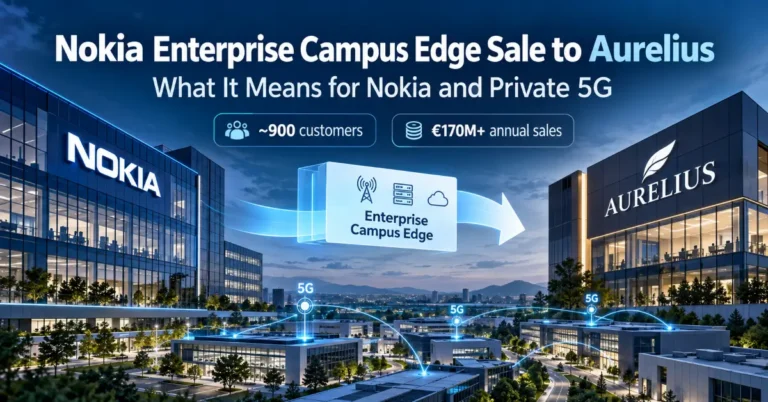
Nokia has signed a definitive agreement to sell its Enterprise Campus Edge (ECE) business to Aurelius, a global private equity investor that specialises in complex corporate carve-outs. Financial terms were not disclosed. The transaction is expected to close in the first half of 2027, subject to regulatory approvals and the completion of employee information and consultation processes.

Read quickly, the announcement looks like a large infrastructure vendor tidying its portfolio. Read in context, it says something more interesting about the state of enterprise private wireless in 2026. A business that began as an experiment inside a mobile network vendor has grown into a unit with close to 900 enterprise customers and annual sales above €170 million, and a specialist investor now sees it as a platform worth backing in its own right. That is what a maturing technology category looks like.

The Nokia Enterprise Campus Edge Deal at a Glance
| Item | Detail |
| Seller | Nokia |
| Buyer | Aurelius, through its Aurelius Opportunities Fund V |
| Business being sold | Enterprise Campus Edge: private wireless, industrial devices, on-premises OT edge and micro-edge platforms, and software applications for industrial AI use cases |
| Customers | Nearly 900 worldwide, including many Fortune 500 enterprises, across manufacturing, mining, logistics, airports, ports and power generation |
| People | Approximately 1,000 employees, with key operations in Finland, Hungary, India and the US |
| Annual sales | More than €170 million, across Europe, North and South America, APAC and the Middle East |
| Price | Not disclosed |
| Expected closing | First half of 2027 |
ECE employees are expected to transfer with the business at closing, and both companies have said their priority through the transition is continuity for customers and staff. Aurelius has set out a growth thesis rather than a cost one: it sees room for ECE to build on its position in private 5G and the industrial edge, and to extend its portfolio into AI-powered industrial automation.
How the Enterprise Campus Edge Sale Fits Nokia’s Strategy
The sale completes a process that has been visible for almost a year. At its Capital Markets Day in November 2025, Nokia’s leadership reorganised the company around the opportunities it sees in the AI era and moved ECE into a new Portfolio Businesses segment, alongside units such as fixed wireless access CPE. In its second quarter 2026 results, Nokia classified ECE as a discontinued operation and described a sale as highly probable. The fixed wireless access CPE business was sold separately, with that transaction completing at the start of October 2026.
Nokia is concentrating capital on areas where its core technology differentiates it: AI and cloud infrastructure, optical and IP networking, data centre connectivity and mission-critical networks. Order intake in its AI and cloud business more than doubled year on year to €2.8 billion in the second quarter of 2026, which illustrates where the company sees its growth.

Crucially, Nokia is not stepping away from industrial connectivity. It is separating two quite different kinds of enterprise wireless business. One is wide-area, mission-critical networking for sectors such as defence, railways and utilities, where private LTE and 5G are combined with IP and optical transport, security and network automation in large, long-cycle programmes. The other is campus and industrial edge deployment, where much of the value lies in a packaged platform, devices, on-premises edge computing and applications. The first draws directly on Nokia’s core network technology. The second is a distinct business with its own product cadence, sales motion and customer base. The separation also removes a source of overlap with the mobile operators that are Nokia’s largest customers and that increasingly sell private networks to the same enterprises.
| Dimension | Campus and industrial edge (ECE, moving to Aurelius) | Mission-critical networks (remaining with Nokia) |
| Typical customers | Factories, mines, ports, airports, power plants and logistics hubs | Defence, railways, utilities and other critical national infrastructure |
| Footprint | Single sites and campuses, increasingly multi-site estates | Regional and national wide-area networks |
| Where value sits | Packaged platform, industrial devices, OT edge and applications | Core network technology, transport, security and integration at scale |
| Deal profile | Many repeatable deployments, often delivered with partners | Fewer, larger and longer-cycle programmes |
| Strategic fit | Best served by a focused, dedicated owner | Draws directly on Nokia’s IP, optical and wireless portfolio |
Why a Standalone Enterprise Campus Edge Business Makes Sense
Inside a group with quarterly net sales of around €4.8 billion, a business of ECE’s size inevitably competes for attention and investment with divisions many times larger. Product decisions, from device ecosystems to edge software, also have to fit around the priorities of a company whose largest customers are telecom operators. As a standalone company, ECE becomes the whole focus of its owners rather than a line in a segment report.
Aurelius brings a model built for exactly this situation. It has completed more than 300 transactions, many of them carve-outs from large corporates, and employs more than 400 investment and operations professionals across ten offices in Europe, North America and Asia. Its approach centres on operational improvement after acquisition, and it has framed ECE as a business with differentiated technology, an established customer base and a clear path to broaden its offer.
Three areas are likely to shape the standalone company’s early direction:
- Product focus. Decisions on the private wireless platform, industrial devices and OT edge roadmap can be made purely against enterprise and industrial requirements.
- Ecosystem reach. An independent company has room to build partnerships with operators, systems integrators and industrial technology suppliers on its own terms.
- Industrial AI. The portfolio already includes on-premises data processing and AI-enabled applications, which gives the business a natural route into AI-powered automation, the growth area Aurelius has highlighted.
The announcements do not yet describe the commercial relationship between Nokia and ECE after closing, including technology supply, branding or the new company’s name. Those details will be among the most closely watched as the transition progresses.
What the Enterprise Campus Edge Carve-Out Says About Private Wireless
For several years, private 5G has been judged against ambitious early forecasts, and every portfolio change by a major vendor has been read as a verdict on the whole market. This deal invites a better yardstick. A business serving close to 900 paying enterprises, many of them among the world’s largest companies, with sales above €170 million, is attractive enough for a specialist investor to acquire as a standalone platform. That is a sign of substance, not retreat.
Many enterprise technology categories have followed the same arc: incubated inside a large supplier, proven with early customers, then spun out once the market is large enough to sustain focused specialists. Private wireless appears to be reaching that stage. The campus segment now supports independent specialists, operator-led managed services and integrator-led offers alongside the established infrastructure vendors, which gives industrial buyers more choice in how they procure and operate networks.
The deal also confirms a shift in where value sits. ECE’s portfolio is defined as much by on-premises OT data processing, data sovereignty and industrial AI applications as by radios. Industrial organisations increasingly evaluate private wireless as part of a broader operational data platform rather than as standalone connectivity, and a business built around that view is well placed to grow with the next wave of automation.
Enterprise Campus Edge Customers: The Road to Closing
For the nearly 900 organisations running ECE networks, the companies have set out a phased transition with continuity as the stated priority:
- Signing, 13 October 2026. The definitive agreement is in place and ECE continues to operate under Nokia ownership.
- Pre-closing period. Employee information and consultation processes are completed where applicable, and regulatory approvals are sought.
- Closing, expected first half of 2027. ECE becomes a standalone business under Aurelius ownership, with employees transferring alongside it.
- Standalone growth phase. The new owner pursues its plan to strengthen the private 5G and industrial edge position and expand into AI-powered industrial automation.
Customers with expansions or upgrades planned for 2027 will naturally want to stay close to their account teams through this period, particularly on support arrangements and roadmap timing.
The Bigger Picture
The Nokia Enterprise Campus Edge sale is a clean outcome for each party. Nokia sharpens its focus on AI infrastructure and mission-critical networks, where its core technology carries the most weight. ECE gains an owner whose sole interest is its growth. And the wider private wireless market gains one more signal that it has become an industry in its own right, able to support businesses that stand on their own balance sheets rather than inside larger ones.
The details to watch over the coming months are the standalone company’s name and brand, its partner strategy and the pace of its investment in industrial AI. Each will indicate how quickly a dedicated private wireless and industrial edge company can move once it is free to set its own course.
For ongoing analysis of private networks, industrial edge and AI, visit TeckNexus Intelligence at https://tecknexus.com/intelligence/. Also download our latest Private Network Intelligence Report.