TeckNexus · DEPLOYMENT TRACKER

Insights from Industry Leaders

Read conversations with ecosystem leaders, innovators, and TeckNexus award winners shaping private networks and telecom.

OneLayer wins “Excellence in Private Network Security” for its innovative platform providing device-level visibility, Zero Trust access control, and real-time threat detection across LTE and 5G enterprise environments. Purpose-built for private cellular networks, OneLayer enables IT and OT teams to secure and manage all connected assets—including non-cellular devices—through unified device identities and context-aware security.
Palo Alto Networks wins “Excellence in Private Network Security” for its AI-powered Zero Trust platform securing private 4G and 5G networks. Built for mission-critical environments, the solution delivers end-to-end protection across core, edge, and cloud—enabling carriers, enterprises, and critical infrastructure operators to deploy private wireless networks securely, at scale, and with confidence.
Boingo Wireless marks 25 years of innovation in neutral host wireless networks, winning global recognition for private 5G, DAS, and Wi-Fi 6/6E/7 deployments across airports, military bases, healthcare facilities, and venues. Boingo’s converged architecture combines secure, high-performance wireless infrastructure with AI, zero-trust security, and green initiatives for future-ready connectivity.

Telstra and Aqura Technologies are transforming industrial connectivity across Australia with over dozens of private 4G and 5G networks deployed in mining, logistics, ports, and defense. Aqura earns the “Private Network Excellence in System Integration” award for delivering scalable, rugged, and locally managed private cellular solutions. These deployments power automation, AI, robotics, and real-time operations across some of the world’s most challenging environments.
Spirent and Telefónica are transforming 5G private networks with automated, continuous testing through Spirent’s Landslide platform. Integrated directly into Telefónica’s 5G Automation Platform, the cloud-native solution accelerates validation, improves reliability, and reduces cost. This joint effort won “Private Network Excellence in Testing and Assurance” for advancing CI/CD/CT methodologies in enterprise 5G deployments.
Telefónica Tech selected Nearby Computing’s NearbyOne OSS platform to power its Neutral Host 5G deployments. Purpose-built for Mobile Private Networks (MPNs), the cloud-native, vendor-neutral orchestration platform enables end-to-end automation, secure multitenancy, and full-stack observability. The result is a more agile and scalable Neutral Host model—delivering approximately 30% OPEX savings, faster service delivery, and the flexibility to support enterprise use cases across multiple industries.
Lufthansa Cargo, in partnership with Ericsson and Lufthansa Industry Solutions, replaced 17 Wi-Fi access points with just two Private 5G radios at its LAX facility. The result: 97% fewer scanning delays, instant digital workflows, and edge-powered AI inspections. This strategic shift boosts efficiency and sets a new standard for scalable, connected logistics using private 5G.
Jaguar Land Rover’s Solihull plant is now a model smart factory, thanks to Ericsson’s private 5G deployment. The high-speed, low-latency network replaces traditional Wi-Fi and wired systems to support real-time data, AI automation, and scalable production. With collaboration from Ericsson, Fujitsu, and Litmus, the project boosts operational efficiency and showcases how private 5G is transforming the future of automotive manufacturing.
Salinas Gold has launched a private LTE network in partnership with Nokia, Ávato, and Venko to enable secure, real-time connectivity across its remote mining operations in Mato Grosso, Brazil. This is one of the first high-availability LTE deployments in Brazil’s mining sector and a winner of the “Private Network Excellence in Mining” award. The network improves safety, logistics, and operational efficiency by supporting telemetry, fleet tracking, and real-time communications—even in areas previously without any cellular coverage.
NTT and Nishimatsu Construction Co., Ltd. have enabled ultra-remote control of heavy construction machinery using a combination of the All-Photonics Network (APN) and local 5G. This breakthrough deployment supports real-time operation of tunnel equipment from 200+ km away, with latency reduced to under 100 ms. Developed as part of the Tunnel RemOS system, the private 5G and APN network eliminates previous limitations of LTE and Wi-Fi, improving safety, visibility, and control precision. The project earned NTT DATA the “Private Network Excellence in Construction” award and offers a scalable model for smart infrastructure, digital twins, and future construction automation.
Boingo deployed a private CBRS network at the Rhode Island Convention Center and Amica Mutual Pavilion to modernize venue connectivity for large-scale events. Integrating Wi-Fi 6 and CBRS, the system supports high-density operations like ticketing, POS, streaming, and IoT. The converged network enhances staff performance and fan experience while giving operators full control over wireless infrastructure. This project showcases how private networks can meet modern connectivity demands in sports and event venues.
Mobile Private Networks (MPNs) have reached a critical juncture, evolving from niche deployments to scalable, production-ready solutions. Enterprises are now embracing MPN-as-a-Service, combining edge computing, AI-driven operations, and hybrid spectrum strategies to deliver low-latency, secure, and flexible connectivity. Discover how Wi-Fi integration, automation, and vendor-agnostic deployment models are accelerating MPN adoption across industries.
MLGW, the largest three-service municipal utility in the U.S., partners with Nokia to launch the nation’s first private 5G network for utilities. Covering nearly all of Shelby County, the network boosts real-time operations across electric, gas, and water systems. This grid modernization supports clean energy, IoT integration, and storm resilience—setting a national benchmark for utility digital transformation.
Airports are under pressure to modernize operations, meet strict regulations, and enhance passenger experience—while keeping costs and emissions low. This article explores how private 5G networks provide the secure, low-latency, high-capacity connectivity airports need to evolve into smart, future-ready hubs—supporting automation, sustainability, and new revenue models.
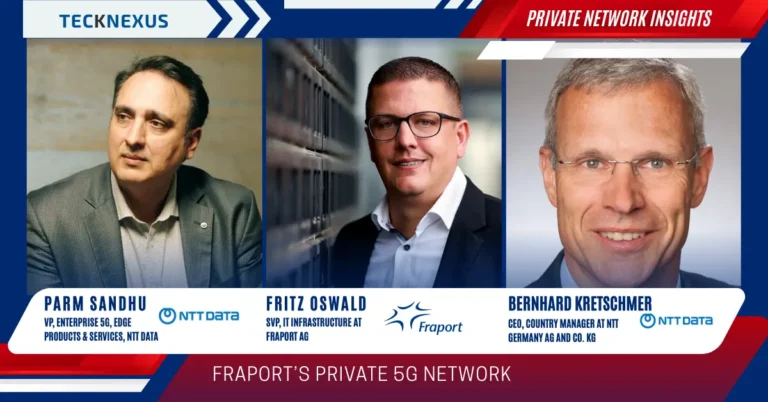
Winner – Private Network Excellence in Airports: NTT DATA, in partnership with Fraport AG, designed and implemented a large-scale private 5G network covering more than 20 km² at Frankfurt Airport. The 5G campus network provides secure, low-latency connectivity across the apron and perimeter where Wi-Fi is limited, enabling real-time data transfer, autonomous and remote operations, and a foundation for future airport digitalization. Nokia supported with private 5G RAN alongside NTT DATA’s architecture, deployment, and integration services.
Winner – Private Network Excellence in Airports, Druid Software and LMT have deployed a private 5G network at the Freeport of Riga’s Baltic Container Terminal, replacing legacy Wi-Fi to support real-time tracking, automation, and secure communications. Using the Raemis™ 5G core and edge-based architecture, the system delivers high-performance, low-latency connectivity for one of Europe’s most dynamic logistics hubs.
Showing Slide 1 of 17
Sponsored by Palo Alto Networks
⚡ Utilities ⏱ 8 min ✓ Free
This tool is built and hosted by TeckNexus.
Launch Tool →
Whitepaper
Airports are deploying AI surveillance, biometrics, and autonomous vehicles faster than most networks can secure them. See what 100 real-world airport deployments reveal about the airside/landside security gap — and the 4-layer framework built to close it....
Scroll to Top