Frequently Asked Questions
What does ‘network assurance’ actually cover day to day?
Day to day, network assurance covers continuous monitoring of network performance across multiple layers, from radio signal quality and data throughput at the cell site level, to the health of core network functions running in virtualized infrastructure, to end-to-end service quality as experienced by actual customers. It includes testing new network configurations or software updates before they’re deployed broadly, to confirm they don’t degrade performance unexpectedly. It also covers ongoing validation that service-level agreements, the specific performance promises made to certain customers or business clients, are actually being met in practice. In modern networks, assurance teams increasingly rely on automated tools that continuously collect and analyze performance data, rather than depending purely on customer complaints to surface problems.
How has assurance changed with the move to virtualized, cloud-based 5G networks?
Older, hardware-based networks were comparatively straightforward to monitor because each network function typically ran on its own dedicated, purpose-built equipment with well-defined performance characteristics. Modern 5G networks, by contrast, run largely as software across shared, virtualized cloud infrastructure, often spanning equipment and software from multiple different vendors. A single performance problem, like degraded call quality in a specific area, could originate from an issue in the radio equipment, a virtualized core network function, the underlying cloud infrastructure, or the interaction between several of these components. Assurance tools have had to evolve accordingly, gaining the ability to trace problems across these virtualized, distributed, multi-vendor layers in real time.
What role does AI play in modern network assurance?
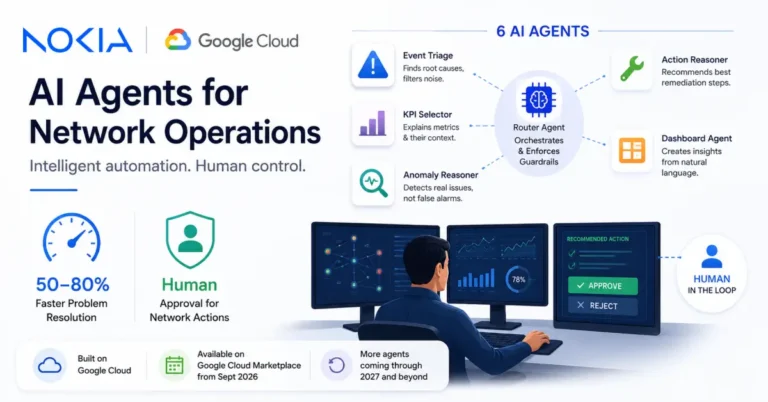
AI is shifting network assurance from a largely reactive discipline, responding to problems once they’re detected or reported, toward a more proactive one, predicting and addressing problems before they meaningfully affect customers. By continuously analyzing enormous volumes of network performance data, AI systems can identify subtle patterns or early warning signs of degrading performance that would be extremely difficult for human analysts to spot manually across a network generating millions of data points constantly. This predictive capability is particularly valuable for energy optimization, since AI-driven assurance systems are increasingly used to dynamically adjust radio power consumption based on real-time traffic, cutting energy costs without degrading the customer experience.
Why does network slicing make assurance more complicated?
Network slicing means a single physical network now hosts multiple independent virtual networks, each with its own distinct performance guarantee, such as a specific latency target for one slice supporting cloud gaming, and a different reliability target for another slice supporting a hospital’s connected medical equipment. Assurance teams therefore can’t simply monitor the network as one undifferentiated whole; they need visibility into each individual slice’s performance separately, to confirm the operator is actually delivering on the specific promise made for that slice. This adds meaningful complexity, multiplying the number of distinct performance commitments an assurance system needs to track and correctly attribute problems to.
What’s the difference between assurance and basic network monitoring?
Basic network monitoring generally refers to passively observing network status and performance metrics, essentially watching dashboards and alerts to know what’s currently happening across the network. Assurance is a broader discipline that includes monitoring as one component, but also encompasses testing, validation, and proactive quality management aimed specifically at guaranteeing the network meets defined performance commitments, not just observing whatever performance happens to occur. In practice, assurance often involves comparing real-world performance data against specific targets, triggering automated or manual remediation when performance falls short, and continuously refining the network based on what that comparison reveals.
How do operators measure whether they’re meeting service-level agreements (SLAs)?
Operators typically define specific, measurable metrics tied to each SLA, such as maximum acceptable latency, minimum guaranteed bandwidth, or a target percentage of uptime, and then use assurance tools to continuously collect real performance data against those exact metrics, often for a specific customer, service, or network slice rather than the network in aggregate. Modern assurance platforms generally provide ongoing, automated reporting against these targets rather than relying on periodic manual audits, allowing operators to catch SLA violations quickly and, in more advanced setups, automatically trigger corrective action before a violation becomes severe enough to require contractual penalties or customer compensation.
What happens when an assurance system detects a problem?
When an assurance system detects a problem, the response generally follows a few possible paths depending on severity and how advanced the operator’s systems are. In simpler or higher-severity cases, the system alerts a human network operations team, providing diagnostic context to speed up manual troubleshooting. In more advanced, automated setups, the system may trigger an automatic remediation action directly, such as rerouting traffic or restarting a malfunctioning virtualized function, without requiring human intervention at all, particularly for well-understood, low-risk issues. Increasingly, AI-driven assurance systems aim to act before the problem becomes customer-visible at all.
Why is assurance increasingly tied to customer experience, not just technical uptime?
Assurance has expanded beyond pure technical uptime metrics because customer satisfaction and business outcomes don’t always track perfectly with simple availability statistics; a network can be technically up while still delivering a poor experience due to slow speeds or subtle quality issues that don’t register as a full outage. Modern assurance increasingly incorporates customer experience metrics directly, sometimes inferred from actual usage patterns and application performance, to get a more accurate picture of what customers are actually experiencing. This matters commercially too, since for enterprise customers paying for guaranteed performance through network slicing, technical uptime alone isn’t a sufficient measure of delivered value.