Why Orange’s CUAS-as-a-Service for drone detection matters now
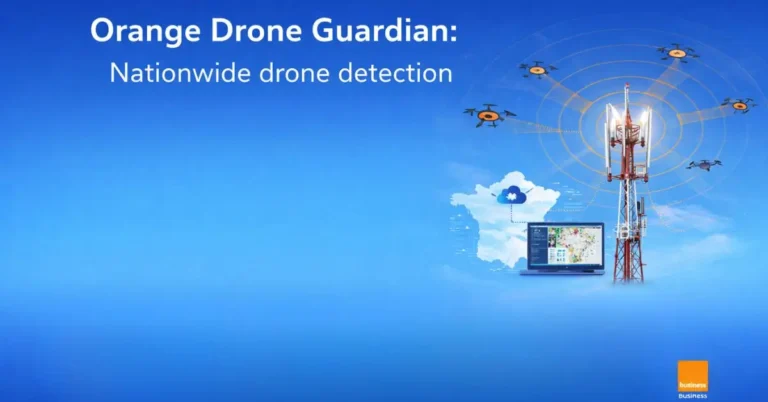
Orange Business has launched Orange Drone Guardian, a counter‑UAS service that turns telco infrastructure into a nationwide sensing fabric—arriving as drone activity, regulation, and critical-infrastructure risk converge.

Rising drone threats and EU U-space/Remote ID compliance
Commercial and hobbyist drones are proliferating, while malicious and reckless use keeps pace—forcing operators of vital importance (OIV), operators of essential services (OES), and event organizers to harden low‑altitude airspace. In Europe, initiatives such as EASA’s U‑space framework and Remote ID requirements are formalizing how unmanned traffic is supervised. Yet detection and classification at scale—especially in dense urban environments—remains a gap for airports, ports, utilities, logistics hubs, and city authorities. CUAS delivered “as a Service” lowers the barrier to entry and aligns with how enterprises increasingly procure security: outcome‑based, rapidly deployable, and continuously updated.

Turning telco towers into a nationwide drone detection network
Orange is leveraging assets few others can: secure nationwide connectivity, cloud qualified to ANSSI’s SecNumCloud 3.2 standard, a domestic security operations capability, and a tower footprint via TOTEM’s 19,700 sites across France. Those rooftops and masts provide strategic high points for sensors, improving line‑of‑sight, range, and resilience without each customer building their own infrastructure. For telecom operators, this model exemplifies a broader trend—turning networks and passive sites into active sensing platforms that deliver new enterprise security revenues.
Sovereign cloud compliance for European CUAS buyers
Data residency, lawful intercept posture, and trusted operations are now board‑level concerns in security procurement. By operating within sovereign infrastructure in France—including a Grenoble‑based cloud platform and a domestic operations center—Orange positions Drone Guardian for customers that must prove compliance to regulators and auditors. This will matter to defense‑adjacent agencies, state entities, and critical industries that face stringent assurance requirements.
Inside Orange Drone Guardian CUAS platform
The offer combines sensors, command‑and‑control software, secure cloud, and managed operations in a subscription bundle designed to scale and evolve.

Sovereign-by-design operations on SecNumCloud 3.2
Telemetry and analytics run on Orange Business’s Cloud Avenue platform, qualified to ANSSI’s SecNumCloud 3.2 level, and hosted in a sustainable data center in Grenoble. A France‑based secure operations center correlates and assesses field data in real time, enabling faster triage and incident workflows aligned to local laws and customer policies.
Nationwide coverage via TOTEM towers and rooftops
By deploying detection sensors on TOTEM’s nationwide portfolio of towers and rooftops, Orange extends surveillance reach while reducing per‑site cost and complexity. The approach enhances coverage in rural areas and urban canyons alike, improving probability of detection and direction‑finding accuracy without heavy on‑premise build‑outs.
Multi-sensor detection with AI and digital twins
The C2 software ingests multi‑sensor feeds to detect, identify, and classify drones, including in interference‑prone environments. AI models refine classification and reduce false positives over time, while digital twins of monitored areas improve planning, sensor placement, and threat scenario modeling. This matters operationally: fewer nuisance alerts, clearer flight paths, and faster determination of intent.
Open architecture with 5G Advanced sensing (3GPP Rel‑18/19)
The platform is designed to add new sensor types and software modules as threats and standards evolve. A key roadmap item is radio‑sensing using 5G capabilities emerging in 3GPP Release 18/19 under 5G Advanced. Network‑based sensing can augment RF, acoustic, and optical inputs—improving detection in cluttered environments and enabling cooperative detection with U‑space/Remote ID data.
Subscription CUAS delivery with outcome-based SLAs
Delivered as a subscription, customers gain real‑time situational awareness without large upfront capex. The service can be tailored to industrial campuses, logistics platforms, ports, airports, stadiums, and dense urban districts. Expect outcome‑oriented SLAs—mean time to detect, classification accuracy, and availability—backed by Orange’s managed connectivity and operations expertise.
Use cases and buyer checklist for CUAS
Enterprises should align CUAS adoption to operational risk, regulatory posture, and incident response maturity.
Priority environments: airports, ports, utilities, cities
High‑throughput hubs—airports, ports, rail yards, warehouses—face surveillance and contraband risks that demand persistent detection. Critical infrastructure operators must prevent incursions that threaten safety or service continuity. Cities and event organizers need temporary or semi‑permanent coverage with minimal disruption and rapid setup. For each, the as‑a‑service model accelerates time to value, while sovereign operations simplify due‑diligence for regulated sectors.
What to evaluate: coverage, accuracy, integration, compliance
Assess coverage maps and sensor siting relative to your perimeter, approach paths, and no‑fly buffers. Ask for empirical performance—probability of detection at range, classification rates across drone makes and modes, and resilience to urban multipath and RF congestion. Validate integration with PSIM/SIEM, VMS, access control, and incident management workflows. Confirm data residency, retention, and lawful‑use policies. Ensure procedures for alert escalation to authorities align with national rules on neutralization measures, which often restrict jamming or kinetic response. Finally, examine the roadmap for 5G‑enabled sensing and U‑space/Remote ID integration to future‑proof the investment.
Challenges and implications for the CUAS market
CUAS is shifting from bespoke projects to managed services, but operational, legal, and ecosystem hurdles remain.
Operational and legal constraints on detection and response
Detection is only the first step; response coordination with law enforcement and airspace managers is essential. Legal constraints on interdiction vary by country, and countermeasures may be prohibited for private entities. In parallel, urban deployments must address privacy and data minimization, especially when optical sensors are used.
Integration, data governance, and sovereignty
Enterprises will need clean interfaces between CUAS data, security operations, and business continuity playbooks. Sovereign cloud and domestic SOCs mitigate compliance risk, but multi‑tenant architectures must still enforce strict isolation, auditing, and incident reporting.
Competitive landscape: telcos vs CUAS specialists
The CUAS market includes specialists such as Dedrone, DroneShield, and defense primes like Thales. Orange’s differentiator is telco‑grade reach and operations, which can compress deployment cycles and expand coverage using existing towers and networks. If executed well, this can set a template for other operators to monetize “network‑as‑sensor” offerings in public safety and critical infrastructure.
What to watch next in CUAS and drone detection
The trajectory of this service will hinge on sensing advances, ecosystem tie‑ups, and measurable risk reduction for early adopters.
5G Advanced sensing and 3GPP standards progress
Track pilots that blend 5G radio sensing with conventional RF/optical detection, along with 3GPP progress in Release 18/19. Effective fusion should improve detection in NLOS and complex RF environments while lowering false alarms.
European rollout, U‑space tie‑ups, and partnerships
Watch for cross‑border rollouts, integration with U‑space service providers, and partnerships with airports, ports, and utility operators. Alignment with national cybersecurity agencies and civil aviation authorities will be pivotal.
Shift to outcome-based CUAS security models
Expect demand for guarantees tied to operational risk—such as incident detection time and protected‑airspace availability—rather than sensor counts. Vendors that pair sovereign operations with transparent performance analytics will win enterprise trust.