Aviation

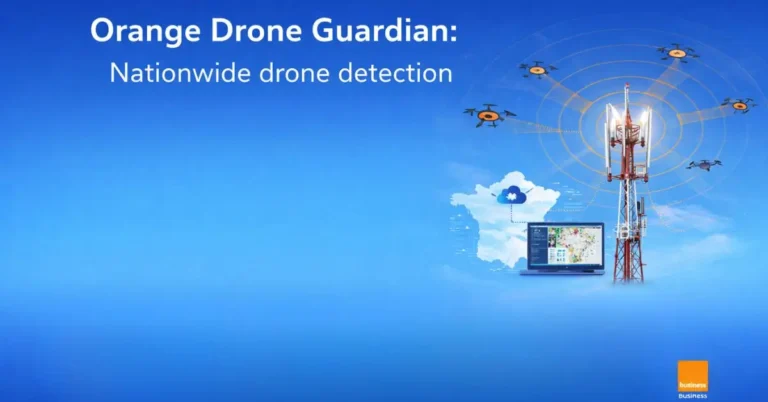
Orange Business has launched Orange Drone Guardian, a counter‑UAS service that turns telco infrastructure into a nationwide sensing fabric—arriving as drone activity, regulation, and critical-infrastructure risk converge. Orange is leveraging assets few others can: secure nationwide connectivity, cloud qualified to ANSSI’s SecNumCloud 3.2 standard, a domestic security operations capability, and a tower footprint via TOTEM’s 19,700 sites across France. The offer combines sensors, command‑and‑control software, secure cloud, and managed operations in a subscription bundle designed to scale and evolve. Delivered as a subscription, customers gain real‑time situational awareness without large upfront capex.
Airspan plans to supply a 5G Air-to-Ground (ATG) system for Space Compass’s High-Altitude Platform Station (HAPS) program, using an aircraft operating around 16–18 km to act as a stratospheric node for maritime monitoring. The end-to-end solution—airborne radios and antennas, onboard 5G processing, and a complete ground-based 5G RAN, core, and management stack—targets secure command-and-control plus real-time sensor data exchange between the HAPS and ground stations up to roughly 300 km away. After lab and pre-flight work, the team intends to validate the system on a light aircraft in 2026, followed by stratospheric trials in 2027.
BlueBird 7 is slated to lift off in late February from Launch Complex 36 at Cape Canaveral Space Force Station on the New Glenn-3 mission. It is AST SpaceMobile’s first payload on New Glenn and the second satellite in its next-generation “Block 2” campaign, following BlueBird 6. BlueBird 7 mirrors BlueBird 6 and carries a deployable array of about 2,400 square feet—the company positions it as the largest commercial communications aperture in low Earth orbit. The design, backed by thousands of patent and patent-pending claims, is engineered to deliver peak downlink rates up to 120 Mbps directly to standard, unmodified devices for voice, data, and video.
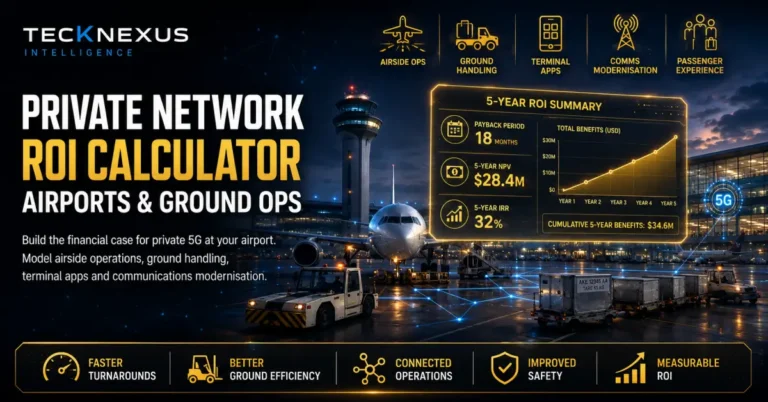
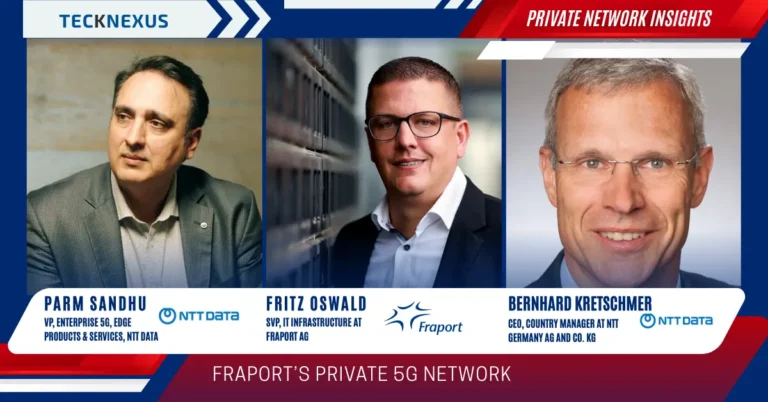
Winner – Private Network Excellence in Airports: NTT DATA, in partnership with Fraport AG, designed and implemented a large-scale private 5G network covering more than 20 km² at Frankfurt Airport. The 5G campus network provides secure, low-latency connectivity across the apron and perimeter where Wi-Fi is limited, enabling real-time data transfer, autonomous and remote operations, and a foundation for future airport digitalization. Nokia supported with private 5G RAN alongside NTT DATA’s architecture, deployment, and integration services.
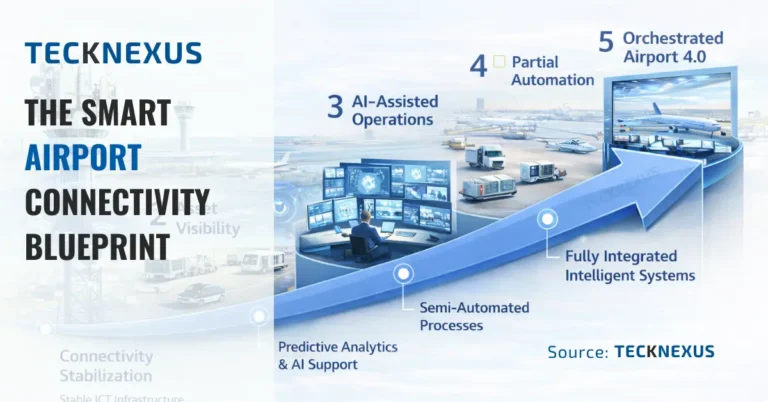
From Singapore to Schiphol, airports are embracing private networks for airports alongside AI and digital twins to drive operational efficiency, predictive maintenance, sustainability, and smarter passenger flows. This article explores 12 real-world deployments showcasing how private network deployments for aviation are shaping the future of Airport 4.0 globally.
The FAA has tapped Peraton as prime integrator for a multi‑year modernization of the National Airspace System (NAS), setting in motion a telecom-heavy refresh of networks, radios, and control systems at national scale. The FAA selected Peraton, owned by Veritas Capital, as the single program integrator to manage an initial $12.5 billion upgrade of the aging U.S. air traffic control system. Officials are targeting a three-year execution window to cut outages, improve efficiency, and reinforce safety across the NAS, with additional funding in the $19–20 billion range likely required to fully complete the plan.
ZTE, China Unicom Liaoning and Dalian Changhai Airport have put a 5G-Advanced private network with integrated sensing and communications into live service to address low-altitude security at an island test flight field. The partners deployed a private 5G-Advanced architecture that fuses high-throughput connectivity with precision sensing on the same infrastructure, tailored for a maritime, island airport where traditional patrols and single-sensor radars leave blind spots for “low, slow, small” targets such as drones and bird flocks. According to the partners, the network is running 24/7 at the test flight field and has lifted low-altitude detection accuracy near 98%. By consolidating connectivity and sensing on one footprint, the deployment claims about 30% less space and roughly 25% lower capital intensity versus separate radios and radars.
Hrvatski Telekom will deploy dedicated private 5G networks at Zagreb, Zadar, and Pula airports under a €5.6 million “NextGen 5G Airports” program co-financed by the European Commission’s CEF Digital initiative. The project was selected in a competitive CEF Digital call focused on 5G and edge for smart communities, with €3.09 million in EU grant funding and the remainder financed by Hrvatski Telekom and partners. The program targets operational efficiency, safety, and a better passenger experience through dedicated, configurable, and SLA-backed wireless infrastructure. Edge computing on or near the airport premises will enable low-latency processing for video, safety systems, and time-sensitive control.
The FCC has advanced a rulemaking that would free up a significant slice of upper C-band spectrum for 5G and future 6G services, setting the stage for a high-stakes auction and complex satellite transition by mid-2027. The Commission unanimously approved a Notice of Proposed Rulemaking (NPRM) to clear and auction between 100 and 180 megahertz in the 3.98–4.2 GHz band (upper C-band) via competitive bidding. Because 3GPP band n77 already extends up to 4.2 GHz globally, much of the 5G device and radio ecosystem can support this expansion with minimal modification, accelerating time-to-market for carriers once licenses are granted.
The Las Vegas Grand Prix is more than a spectacle this year—it’s a real-world benchmark for what 5G Standalone can deliver under extreme density, with T-Mobile integrating slicing, private 5G and edge video into broadcast, venue ops and public safety workflows. Broadcast teams are ingesting 360-degree and drone feeds over 5G with edge processing, venue commerce runs on a dedicated slice, and police leverage a 5G-connected drone for situational awareness. These deployments illustrate a practical blueprint for monetizing 5G SA and edge in venues, media, public safety and large events.
Amazon has moved its low Earth orbit broadband effort out of code-name mode and into a market-facing brand with strategic implications for telecom and enterprise buyers. Project Kuiper is now Amazon Leo, a direct reference to the low Earth orbit constellation underpinning the service. The rebrand signals a transition from R&D to commercial execution. Amazon reports more than 150 satellites in orbit today—roughly 153 by recent counts—following a string of successful launches and a completed prototype mission. The company says it will light up service as it adds coverage and capacity.
A new joint plan from Vodafone and AST SpaceMobile aims to deliver satellite broadband directly to standard smartphones across Europe under a sovereign operational model. AST SpaceMobile has submitted plans through Germany for a space-based network designed to provide broadband directly to devices across Europe. Operations would run through SatCo, a Luxembourg-based joint venture with Vodafone announced earlier this year. The timing aligns with looming European spectrum decisions and intensifying competition in direct-to-device (D2D). S-band at 2 GHz is up for renewal across the region in 2027, and 700 MHz public protection and disaster relief (PPDR) frequencies are central to resilient communications strategy.

Your Brand. Our Intelligence Tools.

Capture leads at the point of evaluation. Talk to Us →

Sponsored by Palo Alto Networks
⚡ Utilities ⏱ 8 min ✓ Free
This tool is built and hosted by TeckNexus.
Launch Tool →
Whitepaper
This whitepaper explains how utilities can use secure AI-enabled private mobile networks to modernize operations, support distributed intelligence, improve resilience, and strengthen cybersecurity across critical infrastructure. It covers AI applications, private network advantages, zero trust principles, multilayered security architecture, and governance considerations for AI-ready utility environments....
Whitepaper
Non-terrestrial networks are rapidly evolving from experimental satellite systems into an increasingly important part of the global 5G connectivity landscape. This eBook, developed by Radisys in collaboration with TeckNexus, explores how 3GPP standardization, satellite architecture innovation, and software-driven network design are reshaping NTN deployment models. It examines the transition from...
Whitepaper
Private cellular networks are transforming industrial operations, but securing private 5G, LTE, and CBRS infrastructure requires more than legacy IT/OT tools. This whitepaper by TeckNexus and sponsored by OneLayer outlines a 4-pillar framework to protect critical systems, offering clear guidance for evaluating security vendors, deploying zero trust, and integrating IT,...
Scroll to Top

Map your security gaps to real threat scenarios – including Salt Typhoon, Volt Typhoon, AI data poisoning, rogue devices, and unencrypted OT traffic.

Take the free 8-minute assessment built for utility operators evaluating AI-enabled private mobile networks. Get a readiness score across five critical domains, see where your gaps are, and receive a prioritized action plan for what to fix first.

Free • 8 minutes • Built for private network security