
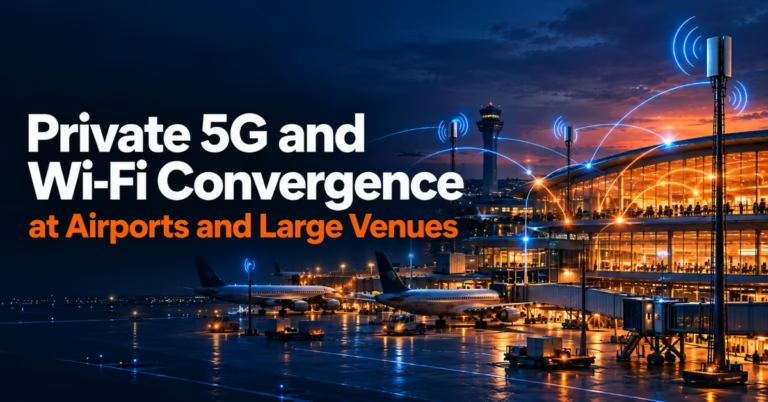
Few environments stress wireless networks like airports and large venues. A major airport combines passenger terminals, baggage halls, cargo sheds, maintenance hangars and several square kilometres of open airfield, with hundreds of organisations sharing the same site. A stadium or arena concentrates tens of thousands of people and their devices into a single bowl for a few hours, alongside ticketing, security, broadcast and concession systems that must keep working however crowded the network gets.

For years these operators relied on Wi-Fi for staff and guests, distributed antenna systems (DAS) for public mobile coverage, and professional mobile radio for voice. Private 5G has now joined that mix. The result is not a contest between technologies but a convergence question: how private 5G and Wi-Fi at airports and large venues divide the workload, share infrastructure and are operated as one estate.
Why Airports and Venues Need Both Private 5G and Wi-Fi
The two technologies are good at different things, and airports and venues need both sets of strengths.
Wi-Fi remains the right answer for passengers, fans and office staff. Every laptop and smartphone supports it, it needs no SIM credentials, and Wi-Fi 6E and Wi-Fi 7 in the 6 GHz band add large amounts of clean spectrum indoors. For guest access, back-office work and high-capacity indoor zones such as lounges, concourses and hospitality suites, Wi-Fi is cost-effective and familiar.
Private 5G suits operational systems that move, operate outdoors or cannot tolerate interference. Cellular technology offers managed handover between cells, wide outdoor coverage from fewer sites, licensed or coordinated spectrum and SIM-based device identity. That profile matches ground support equipment on the apron, baggage tractors, security vehicles, video surveillance, handheld devices used by ramp and gate staff, and autonomous vehicles. On an airfield, Wi-Fi faces long distances, metal obstructions, aircraft movements and interference from unmanaged devices, all of which cellular radio planning is designed to handle.
The division of labour that emerges is broadly an IT and OT split: Wi-Fi for people and general productivity, private 5G for critical operational traffic and mobile assets, with overlap managed deliberately rather than by accident.
Private 5G at Airports: Real Deployments
Several major airports now run private cellular networks in production, and their designs show how the technology fits alongside existing Wi-Fi.
Minneapolis-St. Paul International Airport
The Metropolitan Airports Commission has deployed a private 5G network across MSP’s five-square-mile campus, covering indoor and outdoor areas including runways, taxiways and gates. The network, from Ericsson with Insight Enterprises as reseller and service manager and Pierson Wireless handling installation, supports video surveillance, common-use ticketing equipment, tablets for the mobile workforce, HD video monitoring on the airport trams and dozens of connected airport vehicles. The driver was operational: the previous Wi-Fi infrastructure had to cope with interference from unmanaged devices, airfield obstacles and poor mobility between access points. Private 5G took on the operational workloads that Wi-Fi struggled with across the airfield.
Frankfurt Airport
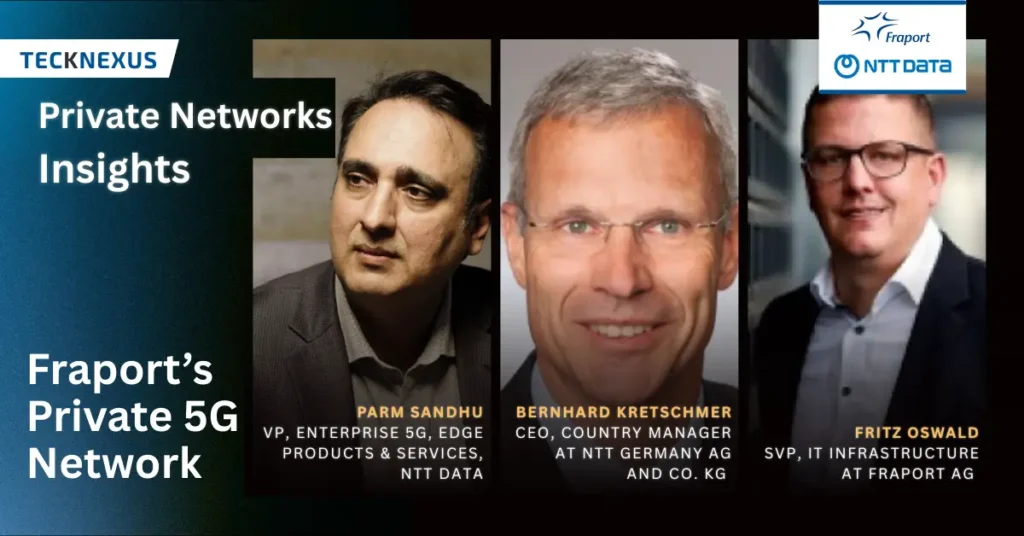
Fraport and NTT began building a private 5G campus network at Frankfurt in 2022, designed eventually to span more than 20 square kilometres across the airport premises, described at launch as Europe‘s largest private 5G network. Planned applications include autonomous driving on the apron, video-based facility monitoring using robots or drones, and wider automation, sensor, localisation and communication systems. The network is intended to be available to partner companies operating at the airport as well as Fraport itself, which reflects a model where the airport operator acts as a connectivity provider for the whole site.
Paris airports
In France, regulator Arcep awarded Hub One, a subsidiary of Groupe ADP, a 10-year licence in the 2.6 GHz TDD band in 2020 for a professional 4G and 5G network at Paris-Charles de Gaulle, Paris-Orly and Paris-Le Bourget. Air France was the first airline user. The network serves a community of more than 120,000 airport employees across roughly 1,000 companies, supporting mobile voice, professional mobile radio replacement, baggage traceability, and voice, data and video for airline operations. It was built on 4G with a path to 5G, illustrating how private cellular can also absorb legacy push-to-talk radio services.
Common threads run through all three. Each network serves a community of organisations, not only the airport operator. Each targets outdoor and mobile operational workloads where Wi-Fi struggled. And each sits alongside Wi-Fi rather than replacing it.
Private 5G and Wi-Fi Convergence at Large Venues
Stadiums, arenas, convention centres and major event sites apply the same logic in a more compressed form. Fan connectivity is still delivered mainly through high-density Wi-Fi and a DAS or small cell layer that carries the public mobile operators. Private 5G is increasingly used for the venue’s own operational systems: point-of-sale terminals, ticket scanners, security cameras, staff communications and broadcast production links.
The reasoning is capacity protection. On event day, fan traffic can saturate shared unlicensed spectrum. Moving revenue-critical and safety-critical systems onto private cellular spectrum, with its own radio resources and quality of service controls, keeps turnstiles, payments and camera feeds working when the bowl is full. Broadcast crews value the same predictability for wireless camera and production links. Temporary event sites, such as festivals and sporting events in open spaces, add portable private networks that can be deployed and removed with the event.
Dividing Workloads Between Private 5G and Wi-Fi
The table below summarises how airports and venues typically allocate common workloads:
| Workload | Typical primary network | Reasoning |
| Passenger and fan internet access | Wi-Fi | Universal device support, no SIM needed, high indoor capacity |
| Public mobile coverage in terminals and bowls | DAS or neutral host small cells | Carries the public mobile operators’ subscribers |
| Office, lounge and back-office IT | Wi-Fi | Laptop-centric, indoor, cost-effective |
| Ground support equipment and airside vehicles | Private 5G | Outdoor mobility, handover, long range |
| Video surveillance across airfield or perimeter | Private 5G | Sustained uplink, wide outdoor coverage |
| Handhelds for ramp, gate and security staff | Private 5G, Wi-Fi as fallback | Seamless mobility indoors and outdoors |
| Push-to-talk and group voice | Private LTE or 5G | Replaces or supplements professional mobile radio |
| Point of sale and ticket scanning on event day | Private 5G | Protected capacity when public spectrum is congested |
| Baggage handling and cargo tracking | Private 5G or Wi-Fi by zone | Depends on indoor versus outdoor footprint |
| Autonomous vehicles and robotics | Private 5G | Deterministic behaviour and predictable latency |
Technical Building Blocks for Private 5G and Wi-Fi Convergence
Convergence is more than running two networks on the same site. Several building blocks allow them to operate as one estate:
- Common identity and policy. Aligning SIM-based identity on the cellular side with certificate-based enterprise authentication on the Wi-Fi side lets the same device and user receive consistent access policy whichever network carries the traffic.
- Seamless guest onboarding. Passpoint and the Wireless Broadband Alliance’s OpenRoaming framework let passengers and fans join venue Wi-Fi automatically and securely using existing identities, removing captive portals and making Wi-Fi feel more like cellular.
- Standards-based interworking. 3GPP defines how a 5G core can serve devices over Wi-Fi, through the Non-3GPP Interworking Function for untrusted access and the Trusted Non-3GPP Gateway Function for trusted access. Access Traffic Steering, Switching and Splitting (ATSSS) allows a single device session to use both networks at once, moving or duplicating traffic according to policy.
- Multi-path at the device. Industrial routers and handhelds can bond or duplicate traffic over private 5G and Wi-Fi, so critical flows continue if one link degrades.
- Shared physical infrastructure. Fibre, power, poles, ducts and equipment rooms serve Wi-Fi access points, private 5G radios and DAS or neutral host small cells together, reducing cost and disruption to terminals and bowls.
- Unified management. A single management and monitoring layer across both technologies lets one operations team correlate issues and apply consistent policy.
Spectrum and Governance for Airport and Venue Convergence
Spectrum access for private 5G at airports and venues depends on national frameworks: CBRS in the United States, local and professional licences such as the 2.6 GHz professional band in France, and shared or local licences in the UK and Germany, among others. On the Wi-Fi side, the opening of the 6 GHz band in many countries has transformed indoor capacity, although rules differ by region.
Airports also face spectrum considerations that other venues do not. Radio altimeters operate in the 4.2 to 4.4 GHz band, and aviation authorities have placed restrictions on nearby mid-band 5G deployments to protect them. Any private 5G design at an airport must be coordinated with aviation safety requirements from the outset.
Governance is the other half of convergence. Airports host airlines, ground handlers, retailers, government agencies and contractors, each with their own devices and priorities. Successful models treat the airport or venue operator as a neutral connectivity provider for the whole site, offering private 5G and Wi-Fi services to tenants with clear service tiers, rather than allowing each organisation to build its own overlapping network. The Frankfurt and Paris models both reflect this approach.
Planning Private 5G and Wi-Fi Convergence
Operators planning a converged estate typically work through a consistent sequence:
- Inventory workloads and users across all tenants, classifying each by mobility, location, criticality and device type.
- Map coverage zones for indoor, outdoor, airside and landside or bowl and concourse areas, identifying where each technology is primary.
- Define the identity model so that SIM, eSIM and enterprise credentials support consistent policy across both networks.
- Design shared infrastructure for fibre, power and mounting positions to serve Wi-Fi, private 5G and public coverage together.
- Set service tiers for tenants and internal users, including priority rules for event days or disruption scenarios.
- Establish unified operations with one monitoring view and clear responsibility for each network layer.
The Future of Private 5G and Wi-Fi at Airports and Venues
The trajectory is towards a single converged connectivity service in which the technology behind each connection becomes largely invisible to the user. Wi-Fi 7 raises indoor capacity further, standalone private 5G brings network slicing to separate tenants and applications on shared infrastructure, and AI-driven operations help small teams run large multi-technology estates. Airports and venues that plan private 5G and Wi-Fi together, with shared infrastructure, common identity and a neutral-host operating model, will be best placed to support automation, better passenger and fan experiences and new services on the same foundation.
For deeper analysis on connectivity for airports and large venues, explore the TeckNexus Intelligence Platform at https://tecknexus.com/intelligence/