Intelligence Journeys
AI Use Cases for Utilities
Private Broadband for Utilities

Autonomous Vehicles

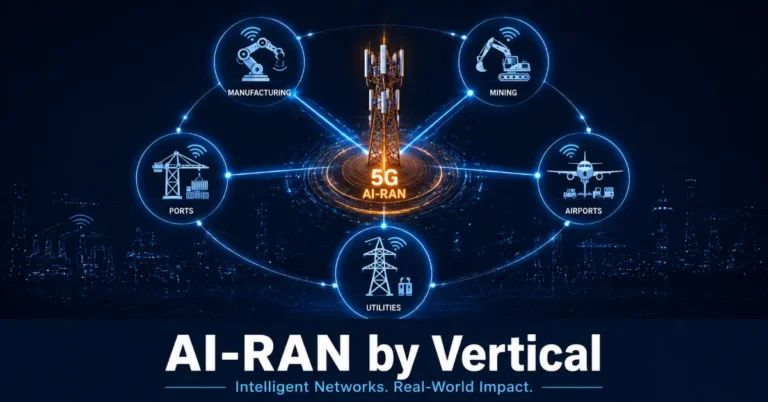
South Korea's government-backed AI-RAN pilot only names two industrial settings directly. Here's what its technical requirements actually translate to for the other three verticals still waiting on a named deployment.
T-Mobile CTO John Saw's 'kinetic token' framework describes how Physical AI — robots, autonomous vehicles, industrial automation — changes what networks must do. The public telco debate that followed misses the most immediate implication: industrial private 5G networks are already, structurally, kinetic token infrastructure.
P‑CAL’s secure mesh provided resilient communications across a complex yard, validating control loops and telemetry in the presence of interference, variable traffic density and human activity. As deployments scale, many terminals will adopt hybrid connectivity: private 5G for wide‑area mobility and interference resilience, Wi‑Fi/Wi‑Fi 6E/7 for indoor assets, and mesh for redundancy in hard‑to‑reach zones. This mirrors global port trends, where operators are rolling out private 5G to support autonomous trucks, AI‑driven analytics, drones and mobile cranes. Expect edge compute (MEC) on‑premises to host perception, fleet orchestration and video intelligence with strict latency and data‑sovereignty requirements.
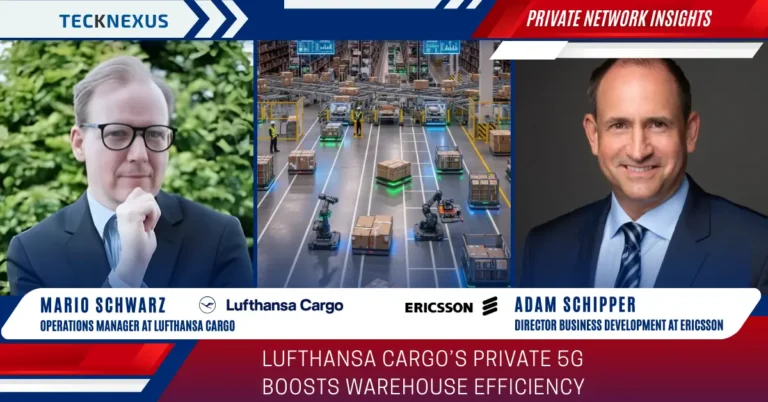
Lufthansa Cargo, in partnership with Ericsson and Lufthansa Industry Solutions, replaced 17 Wi-Fi access points with just two Private 5G radios at its LAX facility. The result: 97% fewer scanning delays, instant digital workflows, and edge-powered AI inspections. This strategic shift boosts efficiency and sets a new standard for scalable, connected logistics using private 5G.
A landmark private 5G pilot at EMSTEEL with e& UAE signals how industrial networks in the region are evolving from connectivity add-ons to strategic infrastructure. The pilot delivers dedicated, high-speed wireless coverage across complex industrial spaces that are often hostile to traditional Wi‑Fi and public cellular. For manufacturers in the UAE, this is a meaningful milestone: it showcases a path to secure, deterministic wireless that can carry safety-critical and time-sensitive workloads on the shop floor. Private 5G gives factories a foundation to adopt connected worker tools, real-time quality control, AI-assisted operations, and digital twins without moving sensitive data off-site.
Alibaba Cloud is integrating Nvidia’s Physical AI toolchain into its Cloud Platform for AI, bringing robotics-grade simulation, training, and deployment capabilities to customers. Alibaba and Nvidia unveiled a partnership that embeds Nvidia’s embodied AI development tools directly into Alibaba’s machine learning platform. The integration targets robotics, autonomous driving, and “connected spaces” such as warehouses and factories. Physical AI refers to software that models the real world in 3D, generates synthetic data, and trains control policies with reinforcement learning before deploying to physical systems. Developers on Alibaba Cloud gain access to toolchains for data processing, simulation-based training, and real-world reinforcement learning.
IMDEA Networks, with partners UC3M, UAM, and UPM, launches DISCO6G—an ambitious 6G project integrating real-time communication and environmental sensing. Led by Jess Omar Lacruz, the initiative focuses on ISAC systems, intelligent surfaces, AI-driven signal optimization, and non-invasive diagnostics to enhance healthcare, smart mobility, and autonomous systems.

Intelematics, Australia’s leader in connected vehicle services, is expanding into New Zealand, offering advanced features like eCall, Stolen Vehicle Tracking, iCall and bCall. This move supports improved road safety outcomes and helps auto manufacturers comply with ANCAP’s updated safety protocols, enhancing emergency response times and overall vehicle security.
Nvidia GTC 2025 introduced AI advancements, including Blackwell Ultra AI chips, agentic AI, and AI Factories. With innovations in robotics, generative AI, and AI-driven cloud computing, Nvidia is shaping the future of AI-powered industries. Discover how these technologies are transforming healthcare, finance, automotive, and enterprise applications.
NVIDIA has launched Halos, a full-stack AI-powered safety system designed to enhance autonomous vehicle (AV) development. By integrating AI models, simulation tools, and compliance frameworks, Halos ensures AV safety from cloud to car. With industry partners like Continental, onsemi, and OMNIVISION, NVIDIA is setting new safety benchmarks for self-driving technology.
General Motors (GM) is strengthening its AI collaboration with NVIDIA to revolutionize manufacturing, vehicle design, and autonomous technology. By leveraging AI-powered digital twins, intelligent robotics, and advanced driver-assistance systems, GM aims to enhance efficiency, safety, and innovation across its operations. This partnership marks a major step toward smarter factories, faster vehicle development, and the future of AI-driven transportation.

Partner Hubs

Download content, access intelligence tools, and hear from executives.

Partner Events

  • M360 ASEAN
  • FutureNet Asia 2026
  • Network X Vienna 2026
Scroll to Top