
Hema Kadia

Tech News & Insight
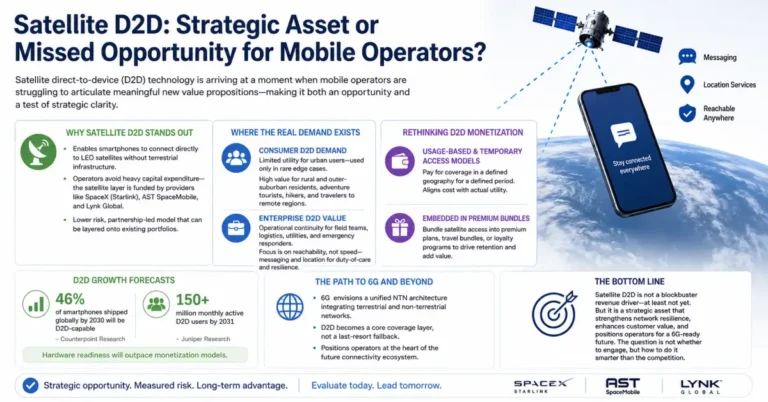
AST SpaceMobile is signaling a pivotal year ahead as it moves from demonstrations to commercial direct-to-device coverage with major operators and an aggressive launch schedule. The company’s plan to begin “intermittent nationwide” service in early 2026, followed by continuous coverage later in the year, is also a forcing function for device vendors, standards work, and MNO network integration. As AST scales to 45–60 BlueBird satellites by end-2026, pass frequency and overlap increase to support “continuous” service across the U.S., Europe, Japan, and other priority markets. AST reports over $3.2 billion in cash and liquidity.
Tech News & Insight
A new pilot in Spain shows that the upper 6 GHz band can deliver 5G-class coverage with far higher capacity, positioning it as a prime spectrum option for 5G-Advanced and 6G. The 6.425–7.125 GHz range (3GPP Band n104) is the last sizable mid-band window that is not tied to legacy mobile use in Europe. The trial found that with higher-order massive MIMO and active antennas, the upper 6 GHz layer can match the practical coverage of 3.5 GHz from existing macro sites. European regulatory clarity, device support and refined coexistence rules are the next critical catalysts for scale.
Tech News & Insight
A new neutral host 5G deployment at 10 World Trade in Boston’s Seaport sets a practical blueprint for scalable, multi-operator indoor connectivity in Class A commercial real estate. Most mobile traffic is generated indoors, yet macro networks struggle to penetrate dense, energy-efficient buildings. The 10 World Trade deployment—delivered by Boston Global Investors (BGI) with Aspen Venue Partners and Ericsson – addresses all three pressures with a small-cell-based, neutral host design that multiple operators can share while also supporting private 5G and future network slicing. The model aligns with broader industry trends: 3GPP-based indoor systems, shared infrastructure economics, and spectrum agility that includes CBRS in the U.S.
Tech News & Insight
Alphabet will invest €5.5 billion in Germany through 2029 to expand AI-capable cloud infrastructure and office capacity, anchoring new buildouts in the Frankfurt Rhine-Main region. Google will construct a new data center in Dietzenbach, near Frankfurt, and continue scaling its Hanau campus opened in 2023. With Frankfurt’s role as Europe’s interconnection hub—home to DE-CIX—placement in Rhine-Main positions Google to serve latency-sensitive AI, analytics, and financial services workloads. Google Cloud will bring expanded capacity for services such as Vertex AI and Gemini models into its German regions, enabling enterprises to run training, fine-tuning, and inference closer to users and data.
Tech News & Insight
SoftBank has exited Nvidia and is redirecting billions into AI platforms and infrastructure, signaling where it believes the next phase of value will concentrate. SoftBank sold its remaining 32.1 million Nvidia shares in October for approximately $5.83 billion, and also disclosed a separate $9.17 billion sale of T-Mobile US shares as part of a broader reallocation into artificial intelligence. The proceeds are earmarked for a significant expansion of SoftBank’s AI portfolio, including a major investment in OpenAI and potential participation in “Stargate,” a next-generation AI data center initiative co-developed by OpenAI and Oracle. Despite exiting Nvidia’s equity, SoftBank retains about 90% ownership of Arm.
Tech News & Insight
Reliance Jio’s six-plan lineup for November 2025 blends low entry pricing with AI, cloud, and OTT hooks, signaling how prepaid is evolving from pure connectivity to service-led bundles. Starting at Rs 189, Jio is segmenting prepaid users by usage intensity (voice-first, balanced data, and long-validity) while nudging them into its digital stack: JioTV for content, JioAICloud for storage, and on select offers, Google Gemini Pro for AI. As 5G coverage and usage expand, Jio’s add-ons are designed to create reasons to stay on-network and upgrade. AI benefits in prepaid are rare globally; anchoring them to eligibility criteria and higher-tier 5G plans suggests an upsell path that can improve monetization without headline tariff hikes.
Tech News & Insight
Anthropic will spend $50 billion on U.S.-based AI data centers, signaling a rapid new phase for domestic compute capacity with direct consequences for power, fiber, and cloud interconnects. Anthropic plans a multi-year, $50 billion program to develop custom data center campuses in the United States, beginning with Texas and New York and with additional sites to follow. The initial wave targets 2026 go-lives, with an estimated 800 permanent jobs and roughly 2,400 construction roles tied to the program.
Tech News & Insight
Hewlett Packard Enterprise and seven partners have formed a global consortium to accelerate fault-tolerant, hybrid quantum computing that can be deployed alongside today’s high performance computing and semiconductor ecosystems. Dr. Masoud Mohseni of HPE Labs serves as quantum system architect, coordinating a full-stack effort to design a practically useful, cost-effective “quantum supercomputer,” with the near-term emphasis on hybrid integration, error-correction maturity, and manufacturability. The Alliance is structuring work around the most stubborn barriers to scale: error correction, orchestration with classical systems, and semiconductor-grade design and manufacturing. Aligning supercomputing and semiconductor leaders around a single roadmap increases the odds of reaching fault tolerance on economically viable timelines.
Tech News & Insight
Nokia will remain TNN’s sole 5G RAN and managed services supplier for four more years, underpinning Denmark’s next phase of high-performance, energy-efficient, and increasingly autonomous mobile networks. The renewed agreement modernizes TNN’s nationwide 5G footprint with Nokia’s AirScale Radio Access Network portfolio and AI-driven MantaRay solutions to improve speed, capacity, and customer experience for more than three million users. Deployment highlights include Habrok Massive MIMO radios for mid-band capacity, Pandion multi-band remote radio heads for broad coverage, and AI-ready AirScale basebands (Ponente, Lodos, Levante) powered by ReefShark system-on-chip silicon to scale throughput while reducing power consumption.
Tech News & Insight
Nokia and Latvia’s LMT are aligning 5G radio and defense capabilities to deliver a field-ready, private tactical communications system for Baltic and coalition forces. Nokia will integrate its 5G radio portfolio with LMT’s defense solutions to build a secure, high-capacity, and resilient tactical network tailored to Baltic military needs. The joint system is designed for dedicated use cases, enabling real-time data exchange across uncrewed platforms, sensors, and dismounted teams. The goal is improved situational awareness, faster decision cycles, and assured interoperability for collective defense.
Tech News & Insight
Ookla’s new handheld analyzer targets the in-building Wi‑Fi blind spot that drives churn, repeat truck rolls, and enterprise downtime. Across fiber, DOCSIS 4.0, fixed wireless access, and emerging LEO satellite, access speeds to the premises keep rising, but customer satisfaction is slipping because the experience is now judged over Wi‑Fi inside the site. Households run dozens of wireless devices, ethernet ports are disappearing, and enterprises are shifting to wireless‑first architectures on Wi‑Fi 6/6E today and Wi‑Fi 7 (802.11be) next. Surveys show most households faced Wi‑Fi issues in the past year, a large share required a truck roll, and a meaningful portion of those visits did not resolve the issue on the first attempt—fueling churn and avoidable Opex.
Tech News & Insight
Reports indicate SK Group will reduce executive ranks by up to 30%, a move that would reshape decision-making across affiliates including SK Telecom (SKT). For SKT, which sits at the nexus of the group’s AI, cloud, and connectivity ambitions, executive trims would concentrate authority and compress approval chains at a sensitive time for 5G monetization and AI platform bets. Executive consolidation at a Tier-1 operator tends to reset priorities, procurement rhythms, and partner engagement models.
Tech News & Insight
A cascade of offers from OpenAI, Google, and Perplexity—amplified by Airtel and Reliance Jio—signals a deliberate push to convert India’s scale into durable AI usage, data, and future revenue. With more than 900 million internet users, rock-bottom mobile data prices, and a young, mobile-first population, India offers the world’s deepest top-of-funnel for AI adoption. Giving away premium access—such as a year of ChatGPT’s low-cost “Go” tier, Jio’s bundling of Gemini, or Airtel’s tie-up with Perplexity Pro—maximizes trial, habituation, and data collection across diverse languages and contexts. Even a low single-digit conversion rate translates into millions of subscribers, while non-converters still contribute valuable signals that improve models.
Tech News & Insight
A new joint plan from Vodafone and AST SpaceMobile aims to deliver satellite broadband directly to standard smartphones across Europe under a sovereign operational model. AST SpaceMobile has submitted plans through Germany for a space-based network designed to provide broadband directly to devices across Europe. Operations would run through SatCo, a Luxembourg-based joint venture with Vodafone announced earlier this year. The timing aligns with looming European spectrum decisions and intensifying competition in direct-to-device (D2D). S-band at 2 GHz is up for renewal across the region in 2027, and 700 MHz public protection and disaster relief (PPDR) frequencies are central to resilient communications strategy.
Tech News & Insight
Telus is in active talks to bring partners into its data-centre and AI business, signaling a capital-light approach to scale sovereign AI compute in Canada. Partner capital can accelerate GPU procurement, facility buildouts, and interconnect investments while aligning with customers that require sovereign environments distinct from hyperscale public clouds. Management addressed investor concerns about potential AI compute oversupply by emphasizing a modular build strategy, adding capacity in phases as demand materializes. The timing aligns with tightening data-residency requirements, heightened AI adoption, and demand for local alternatives to U.S.-centric infrastructure. This reduces stranded capital risk in a market with volatile GPU supply, rapid chip roadmaps, and evolving workload profiles.
Tech News & Insight
Singtel has sold another slice of its Bharti Airtel holding, freeing up capital to fund growth while continuing to rebalance a long-standing strategic investment. Singapore-based Singtel monetised roughly 0.8% of Airtel for about S$1.5 billion (approximately US$1.2 billion), recording an estimated net gain of S$1.1 billion. The sale is part of a multi-year capital management programme launched in 2021. Management has framed the initiative as a way to strengthen the balance sheet and redeploy capital into higher-growth digital infrastructure and digital services, while progressively equalising its Airtel ownership with Bharti Enterprises over time.
Tech News & Insight
Google has unveiled next‑generation TPU accelerators with up to a 4x performance boost and secured a multiyear Anthropic commitment reportedly worth billions, signaling a new phase in AI infrastructure competition. Google introduced new Tensor Processing Units that deliver roughly four times the performance of prior generations for training and inference of large models. Beyond speed, the design targets better performance-per-watt, a critical lever as AI energy costs surge. Anthropic has secured access to Google Cloud TPU capacity at massive scale, with reports citing availability up to one million TPU chips over the term of the agreement.
Tech News & Insight
SoftBank and OpenAI have formed SB OAI Japan, a jointly owned entity that will commercialize “Crystal intelligence,” a bundled enterprise AI offering focused on management and operations in Japan. The venture will combine OpenAI’s enterprise-grade models and tooling with localization, integration, and support led by SoftBank in-market. Crystal intelligence is positioned as a turnkey solution that pairs model access with domain-specific implementation, governance, and support. SoftBank plans to deploy the solution across its own group companies, validate outcomes in production, and recycle those learnings back into SB OAI Japan’s offerings.
Tech News & Insight
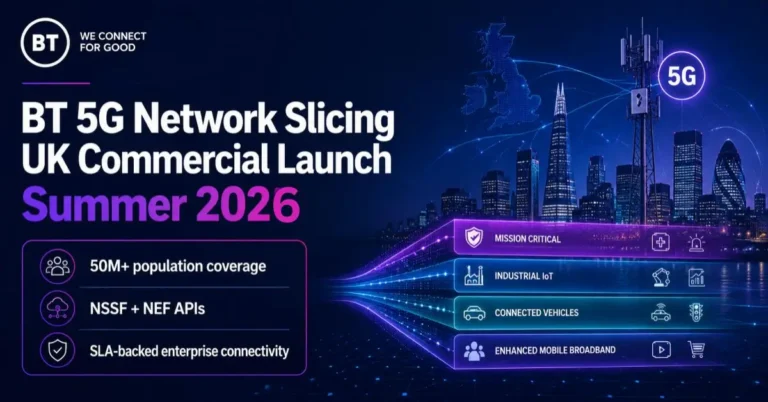
BT Group and its consumer brand EE plan to offer a Starlink-powered home broadband product focused on underserved locations where fixed-line build is constrained by terrain, sparsity, or cost. The service targets “ultrafast” downlink performance, with Starlink capable of delivering up to roughly 280 Mbps and latency in the low tens of milliseconds. Commercial availability is slated for the second half of 2026, giving BT time to industrialise ordering, installation, support, and integration into its existing product catalogue and systems. LEO fills the last 1–5% gap where full fibre is slow or uneconomic to reach.
Tech News & Insight
BT is pressing ahead with cost-cutting as it confronts sharper broadband competition, softer device demand, and structural declines in legacy services. BT reduced its total workforce by about 6% in the first half of its financial year, down to roughly 111,000 employees from 116,000 at the start of the period. The group reported around £250 million in additional annualized cost savings, bringing cumulative savings to about £1.2 billion across the first 18 months of the program and reaffirming a target of £3 billion in annual savings. Group revenue for the six months to September 30 declined about 3% year over year to £9.8 billion. Openreach’s broadband base contracted, with approximately 242,000 fewer broadband customers in Q2 FY25.
Tech News & Insight
New data from the Car Connectivity Consortium’s 2025 Future of Vehicle Connectivity Report signals how OEMs, suppliers, and mobile platforms will prioritize standards, security, and interoperability to scale the next phase of software-defined vehicles. The market is past pilots: executives are moving budget into customer experience and fleet productivity where ROI is visible within a year, but only if solutions are secure, easy to use, and proven to interoperate across brands, devices, and regions. The CCC’s data provides a directional roadmap for where to invest in the in-vehicle wireless stack and the edge-to-cloud controls that make those experiences trustworthy.
Tech News & Insight
Telefónica delivered modest organic growth and wider 5G and fiber reach in Q3, while resetting free cash flow expectations amid operational and macro headwinds. Group revenue reached €8,958 million in Q3, with organic growth of 0.4%, and EBITDA rose organically by 1.2% to €3,071 million. 5G coverage reached 78% across core markets, while FTTH passings rose 9% to 82.6 million premises. Telefónica now expects 2025 free cash flow of €1.5–€1.9 billion. The company reaffirmed 2025 guidance for growth in revenue, EBITDA, and EBITDA minus CapEx.
Tech News & Insight
Apple is reportedly nearing a deal to license Google’s Gemini for Siri, a move that would reshape assistant architectures and near-term AI roadmaps across devices and networks. Multiple reports indicate Apple is close to licensing a custom version of Google’s Gemini model, reportedly at a scale of around 1.2 trillion parameters, for roughly $1 billion per year. The model would power a major Siri upgrade while Apple continues building its own foundation models. The objective is clear: boost Siri’s reasoning and task execution in the near term without ceding control over Apple’s system-level integrations or search defaults.
Tech News & Insight
October’s job-cut announcements surged, with AI and cost control reshaping staffing plans across technology and adjacent sectors. Planned layoffs spiked to roughly 153,000 in October, up more than 180% from September and about 175% from a year ago, according to the latest Challenger job-cuts tally. Year-to-date announcements for 2025 have crossed 1.09 million, the highest October-through-period since the pandemic shock of 2020 and above comparable 2009 levels. The cuts reflect a pivot from growth-at-any-cost to profitability, with AI rebalancing roles and budgets across the stack. Across reasons given, cost reduction led by a wide margin, and AI adoption was the second-largest driver, underscoring both macro pressure and structural transformation.
Tech News & Insight
SkyMirr’s Sky5G Wireless Router being named a CES 2026 Innovation Awards Honoree signals that antenna-first design is emerging as a decisive lever for 5G customer-premises equipment performance and reliability. The Consumer Technology Association’s awards program recognizes design and engineering that materially advances user outcomes, and SkyMirr’s selection draws attention to a core differentiator: its MuLCAT (Multi-Layer Coupling Controlled Antenna Technology) architecture. Rather than treating the antenna as a downstream component, MuLCAT integrates a multi-layer coupling approach to increase isolation, broaden usable bandwidth, and suppress interference in compact enclosures.
Tech News & Insight
Snap and Perplexity are joining forces to embed a conversational AI search experience directly into Snapchat’s chat interface, signaling a new distribution model for AI and a fresh monetization path for social platforms. Perplexity will integrate its AI-powered answer engine natively into Snapchat, beginning a global rollout in early 2026. Under the agreement, Perplexity will pay Snap $400 million over one year, via a mix of cash and equity, as the integration scales. Snap expects revenue contribution from the partnership to begin in 2026. The move is notable as Snap’s first large-scale integration of an external AI partner directly in-app.
Tech News & Insight
A fresh technical report from Broadband Forum details how a single outdoor 5G Fixed Wireless Access connection can deliver gigabit broadband to multiple apartments by reusing a building’s existing wiring. The document defines an architecture where one high-capacity 5G FWA modem—preferably operating on mmWave (3GPP FR2, roughly 24–40 GHz)—is installed on the roof or exterior of a multi‑dwelling unit (MDU) and then shared across many tenants. Instead of running new fiber to every unit, the approach leverages in‑place infrastructure such as coaxial cabling, twisted pair, or legacy telephone wiring to distribute service from a centralized point (attic, basement, or telecom closet) to apartments.
Tech News & Insight
Nokia’s tie-up with OneLayer brings carrier-grade security and OT-aware visibility into one stack, addressing the core adoption barrier for private 5G/LTE in utilities: protecting highly distributed, mission-critical operations at scale. Together, the companies deliver a zero-trust model that spans radio to application: authenticated device identity, continuous posture assessment, role-based segmentation at the cellular (DNN/QoS flow) and IP layers, and orchestrated mitigation. Bottom line: With utilities accelerating private LTE/5G rollouts, Nokia and OneLayer are packaging the controls that regulators, insurers, and boards now expect—bringing OT-aware zero trust into the cellular domain without adding operational complexity.
Tech News & Insight
Telefónica has launched a 2026–2030 plan to accelerate growth, simplify operations, and unlock up to €3 billion in savings while doubling down on its core markets and technology investments. Revenue is guided to a 1.5%–2.5% CAGR from 2025–2028, accelerating to 2.5%–3.5% in 2028–2030; adjusted EBITDA is guided to the same ranges across the two periods. Telefónica targets a gross impact of up to €2.3 billion in 2028 and €3 billion by 2030, driven by technology and operational excellence, process simplification, digital transformation, and monetization of legacy network assets as shutdowns progress.
Tech News & Insight
LG Uplus is working with AWS on agentic AI that automates installation of cloud‑native network software, with early claims of up to 80% faster turn‑ups versus manual methods. LG Uplus and AWS partnered to develop an AI-driven approach that installs complex network software stacks without human intervention. The system uses Amazon Bedrock alongside AWS’s Strands-Agents SDK to orchestrate multiple cooperating AI agents. These agents are pre-trained on network design and implementation documents so they can execute the full workflow – provisioning cloud infrastructure, collecting device and network parameters, generating configurations, performing installation, and troubleshooting.
Tech News & Insight
OECD data shows fixed and mobile broadband have shifted from build-out to scale-up, with fibre and 5G underpinning a new phase of digital infrastructure. Fixed broadband penetration across the OECD rose to 36.5 subscriptions per 100 inhabitants by end-2024, up from 32 in 2019, while the fibre share of fixed lines jumped from 28 percent to 47 percent over the same period. Gigabit-tier offers (≥1 Gbps) moved from 4 percent of subscriptions in 2019 to 19 percent in 2024, signaling both wider availability and growing appetite for very high throughput. On mobile, average monthly data consumption per subscription increased 2.5x—from 6 GB at end-2019 to 15 GB in 2024, aligned with more video, cloud, and AI-assisted applications shifting to handhelds and connected devices.
Tech News & Insight
Orange has reached a non-binding agreement to acquire Lorca’s 50% stake in MasOrange for €4.25 billion in cash, aiming for sole control of Spain’s leading operator by customer base. The transaction would shift MasOrange from joint control (Orange and Lorca JVCO, owner of MásMóvil) to full ownership by Orange. Full control simplifies governance, accelerates synergy capture, and gives Orange greater flexibility in network investment, pricing, and product roadmap execution in Spain. Orange expects to sign a binding agreement before end-2025, subject to agreement on final terms. Completion is targeted for the first half of 2026, assuming standard merger-control review.
Tech News & Insight
A coordinated launch in the Netherlands brings standardized, network-powered security APIs to market at national scale. KPN, Odido, and Vodafone Netherlands have jointly introduced a set of security services based on CAMARA, the open-source API framework hosted by the Linux Foundation and aligned with the GSMA Open Gateway program. Working with the Dutch COIN association, the operators are exposing harmonized, privacy-aware network signals that enterprises can use to strengthen authentication and reduce online fraud. The Dutch launch prioritizes identity-centric use cases. Number Verification allows apps to confirm that a user’s device and mobile number match the current session—often silently in the background—reducing one-time password SMS dependency.
Tech News & Insight
OpenAI has signed a multi‑year, $38 billion capacity agreement with Amazon Web Services (AWS) to run and scale its core AI workloads on NVIDIA‑based infrastructure, signaling a decisive shift toward a multi‑cloud strategy and intensifying the hyperscaler battle for frontier AI. The agreement makes OpenAI a direct AWS customer for large‑scale compute, starting immediately on existing AWS data centers and expanding as new infrastructure comes online. AWS and OpenAI target the bulk of new capacity to be deployed by the end of 2026, with headroom to extend into 2027 and beyond.
Tech News & Insight
At SK AI Summit 2025, CEO Jung Jaihun outlined plans to expand the Ulsan artificial intelligence data center (AIDC) to 1GW-class capacity, stand up a nationwide trio of hubs (Gasan in the Seoul metro, Ulsan in the south, and a new southwest site), and take the model into Southeast Asia starting with Vietnam. The operator is also deepening technology collaborations with Amazon Web Services (AWS) on Edge AI and with NVIDIA on AI-RAN and a Manufacturing AI Cloud; it intends to buy more than 2,000 NVIDIA RTX PRO 6000 Blackwell GPUs and scale Korea’s largest GPU cluster, Haein, as core compute for industrial AI workloads.
Tech News & Insight
CrowdStrike and NVIDIA are aligning open models, edge inference, and agentic tooling to push real-time, autonomous cyber defense into data centers, clouds, and MEC sites where telecom and enterprise workloads actually live. By pairing CrowdStrike’s Charlotte AI AgentWorks with NVIDIA’s Nemotron open models, NeMo Data Designer, NeMo Agent Toolkit, and NIM microservices, the partners aim to shrink detection-to-response windows from minutes to milliseconds, and to do so where latency is lowest—at the edge. The companies expanded their collaboration to deliver always-on, continuously learning AI agents that defend cloud, data center, and edge environments using open and enterprise-grade NVIDIA AI components integrated with CrowdStrike’s Agentic Security Platform.
Tech News & Insight
TELUS has taken full ownership of TELUS Digital, a move designed to consolidate AI-powered customer experience, SaaS, and automation capabilities across its telecom, health, and agriculture businesses while unlocking material cost efficiencies. TELUS acquired all remaining TELUS Digital shares for US$4.50 per share, valuing the transaction at approximately US$539 million and issuing a small portion of TELUS common shares alongside cash to complete the deal; the entity will be delisted from the TSX and NYSE and cease public reporting. Management targets roughly US$150 million in annual efficiencies from automation, business simplification, and tighter cross-selling.
Tech News & Insight
AI buildouts have flipped a decade of flat U.S. electricity growth into a structural uptrend, with consumer price concerns rising in parallel. After years of steady demand, U.S. load is climbing as commercial and industrial users tap more power, and hyperscale data centers are now a central driver of the shift. Data centers are estimated to consume roughly 4% of U.S. electricity today—more than twice their share in 2018—and some credible scenarios place that figure in the high single digits to low teens by 2028, depending on the trajectory of AI training and inference footprints.
Tech News & Insight
The Federal Communications Commission plans a November vote to rescind a January ruling that tied carrier cybersecurity obligations to CALEA, resetting the regulatory posture after high-profile intrusions tied to Chinese state-linked actors. In January, the FCC interpreted the Communications Assistance for Law Enforcement Act (CALEA) to require telecommunications carriers to protect their networks against unlawful access or interception, and paired that interpretation with a proposal to require written cybersecurity plans and baseline controls. The commission signals it will pivot to a more targeted, collaborative posture with carriers instead of a one-size-fits-all mandate.
Tech News & Insight
Vodafone named Dell Technologies a strategic infrastructure provider for a five-year Open RAN buildout across Europe, signaling a move from trials to scaled, automated 5G networks. Vodafone will expand one of Europe’s largest Open RAN footprints using Dell infrastructure as part of a multi-year radio access modernization program. Dell will supply its PowerEdge XR8000 series servers, including the XR8620t and the latest XR8720t with Intel Xeon 6 SoC. Vodafone also plans to adopt the Dell Telecom Infrastructure Automation Suite (DTIAS) to provide the Infrastructure Management Service within its Open RAN architecture, designed to automate Day 0/1/2 lifecycle operations for O-Cloud infrastructure.
Tech News & Insight
Virgin Media O2 has struck a multi‑year agreement with Starlink Direct to Cell to deliver satellite‑to‑mobile service across rural UK not‑spots, positioning O2 as the first British operator to integrate Starlink’s constellation with licensed mobile spectrum. Branded as O2 Satellite, the service will initially support messaging and basic data on existing smartphones when users move beyond terrestrial signal. O2 is targeting landmass coverage beyond 95% within a year of launch, using Starlink’s 650+ low‑Earth orbit satellites to act as “cell sites in space.” Customer rollout is planned for early 2026, with pricing to follow and an extra monthly fee anticipated.
Tech News & Insight
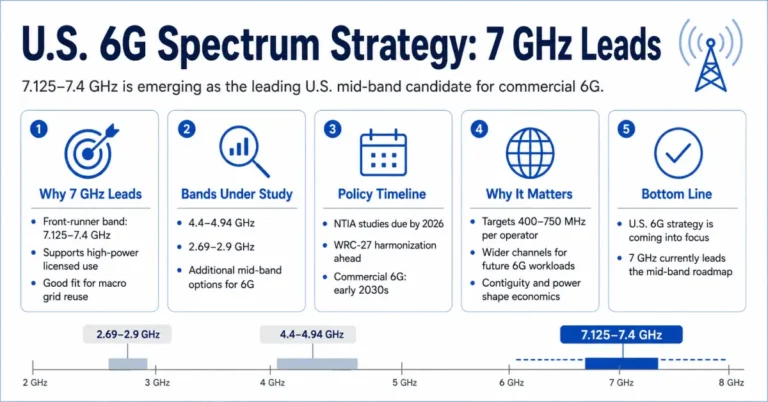
The FCC is circulating a proposal to reconfigure and auction a significant slice of upper C-Band spectrum, with a vote slated for November and a public comment period to shape the details. The draft notice of proposed rulemaking (NPRM) seeks input on auctioning up to 180 MHz of upper C-Band in the contiguous United States for licensed mobile broadband, with a floor of at least 100 MHz mandated by Congress for auction by July 2027. Commissioner Brendan Carr frames the objective as maximizing mid-band capacity for 5G and setting the stage for 6G, while maintaining aviation safety.
Tech News & Insight
Hyundai Motor Group and NVIDIA are expanding their partnership to build a large-scale “physical AI” stack that fuses autonomous driving, smart factories, and robotics with national-scale infrastructure in Korea. The companies plan to stand up an AI factory built on 50,000 NVIDIA Blackwell GPUs to unify model training, validation, and deployment across vehicles and plants. Backed by an approximately $3 billion public–private investment, the effort includes a Physical AI Application Center, an NVIDIA AI Technology Center, and regional data centers developed in concert with Korea’s Ministry of Science and ICT.
Tech News & Insight
Samsung and NVIDIA are scaling a 25-year alliance into an AI-driven manufacturing platform that fuses memory, foundry, robotics and networks on a backbone of accelerated computing. Samsung plans to deploy more than 50,000 NVIDIA GPUs to infuse AI across the company’s manufacturing lifecycle—from chip design and lithography to equipment operations, logistics and quality control. The “AI factory” is designed as a unified, data-rich fabric where models continuously analyze and optimize processes in real time, shrinking development cycles and improving yield and uptime. The scope goes beyond semiconductors to include mobile devices and robotics, signaling a company-wide digital transformation anchored in accelerated computing.
Tech News & Insight
NEC is moving to scale its cloud and SaaS business support capabilities with a $2.9 billion acquisition of CSG Systems International, positioning Netcracker at the center of the combined telecom monetization play. CSG brings a sizable recurring-revenue portfolio in digital BSS, billing, charging, and customer engagement used by communications, cable, media, and digital service providers, complementing Netcracker’s OSS/BSS, orchestration, and service automation strengths. The all-cash deal values CSG at approximately $2.9 billion on an enterprise value basis and has unanimous board approval, with closing targeted for 2026 pending CSG shareholder approval and customary antitrust and other regulatory reviews.
Tech News & Insight
NVIDIA and Nokia unveiled a strategic partnership to deliver commercial AI-RAN products built on NVIDIA’s Aerial RAN Computer Pro (ARC-Pro) platform and Nokia’s RAN software portfolio, with NVIDIA committing a $1 billion equity investment in Nokia at approximately $6.01 per share, subject to customary closing conditions. The companies are targeting an AI-native RAN that runs both radio workloads and AI inference on a software-defined, accelerated platform, with a cumulative AI-RAN market opportunity that Omdia estimates will exceed $200 billion by 2030. ARC-Pro is positioned as a 6G-ready accelerated computing platform that couples connectivity, compute, and sensing, enabling upgrades from 5G-Advanced to 6G largely via software.
Tech News & Insight
Meta, Alphabet, and Microsoft signaled that AI infrastructure is now a multi-year capital priority measured in tens of billions per year. In their latest results, Meta guided capital expenditures into the $70–72 billion range with an even larger step-up expected the following year. Alphabet raised its 2025 capex outlook to $91–93 billion, up sharply from prior estimates. Microsoft reported $34.9 billion of capex in the most recent quarter, materially above expectations and up strongly year over year. These figures point to the largest synchronized build-out of compute, storage, and networking capacity in the history of cloud.
Tech News & Insight
According to the latest Speedtest Intelligence findings from Ookla, the share of states where at least 60% of tested fixed-broadband users achieve the FCC’s 100 Mbps down/20 Mbps up benchmark rose sharply between late 2024 and the first half of 2025. That count climbed from 22 states (plus Washington, D.C.) to 38 states (plus D.C.), signaling faster last‑mile networks and better in-home performance for a sizable portion of U.S. households. Progress on equity also accelerated. In the first half of 2025, 33 states reduced the performance gap between urban and rural users—while 17 saw the gap widen versus the second half of 2024.
Tech News & Insight
MTN has launched StarEdge Horizon, a Layer 2 service over SpaceX’s Starlink designed to move enterprise traffic on a private path to MTN points of presence (PoPs), bypassing the public internet and reducing latency, jitter, and operational complexity. The service extends a private Layer 2 domain from remote sites over Starlink into MTN regional PoPs, where enterprises can centralize internet egress, security, and policy. QoS and segmentation protect prioritized traffic, while multi-link redundancy reduces site-level downtime risks. By bringing a private Layer 2 architecture to Starlink, MTN’s StarEdge Horizon turns LEO from best-effort internet into a controllable enterprise transport.
Tech News & Insight
SoftBank and NVIDIA have validated a fully software-defined, GPU-accelerated AI-RAN that delivers 16-layer massive MU-MIMO outdoors—an inflection point for vRAN performance, Open RAN scalability, and AI-native RAN design. SoftBank’s AI-RAN product, AITRAS, executed the entire 5G physical layer on NVIDIA GPUs at the Distributed Unit and demonstrated stable 16-layer multi-user MIMO downlink in an outdoor trial at NVIDIA’s Santa Clara campus. The system connected to O-RAN-compliant radios via Split 7.2x and achieved roughly three times the spectral efficiency and throughput of a conventional 4-layer setup while maintaining per-user rates under high load. The field results show that software-only massive MIMO on GPUs can meet macro-radio conditions without bespoke silicon.

TeckNexus Newsletters

I acknowledge and agree to receive TeckNexus communications in line with the T&C and privacy policy

Tech News & Insight
Enterprises adopting private 5G, LTE, or CBRS networks need more than encryption to stay secure. This article explains the 4 pillars of private network security: core controls, device visibility, real-time threat detection, and orchestration. Learn how to protect SIM and device identities, isolate traffic, secure OT and IoT, and choose...

Sponsored by: OneLayer

     
Whitepaper
Telecom networks are facing unprecedented complexity with 5G, IoT, and cloud services. Traditional service assurance methods are becoming obsolete, making AI-driven, real-time analytics essential for competitive advantage. This independent industry whitepaper explores how DPUs, GPUs, and Generative AI (GenAI) are enabling predictive automation, reducing operational costs, and improving service quality....
Whitepaper
Explore how Generative AI is transforming telecom infrastructure by solving critical industry challenges like massive data management, network optimization, and personalized customer experiences. This whitepaper offers in-depth insights into AI and Gen AI's role in boosting operational efficiency while ensuring security and regulatory compliance. Telecom operators can harness these AI-driven...
Supermicro and Nvidia Logo
Scroll to Top

Feature Your Brand in Private Network Magazines

With Award-Winning Deployments & Industry Leaders
Sponsorship placements open until Nov 21, 2025