
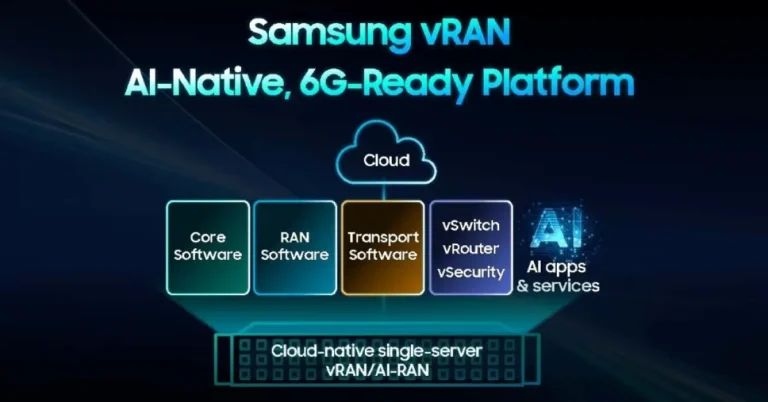
The race to close the gap between 5G‘s theoretical promise and its real-world performance has a new milestone. Samsung Electronics and Qualcomm Technologies have jointly validated Power Class 1 (PC1) capability for 5G Fixed Wireless Access (FWA) on a virtualized RAN (vRAN) architecture — a combination the industry has not demonstrated before. For telecom executives and network strategists, this is more than a lab achievement. It signals a meaningful shift in how operators can approach uplink performance, coverage economics, and the infrastructure readiness required to support increasingly demanding applications.
The Technical Case for PC1 on vRAN: What the Validation Proves
To appreciate why this validation matters, it helps to understand the standards framework underpinning it and the specific problem it addresses.
Power Class 1 Explained: Why Higher Output Power Changes FWA Economics
Power Class is a 3GPP-defined standard that governs how strongly a device can transmit its signal toward a base station. Counterintuitively, a lower class number denotes higher output power — meaning PC1 devices transmit more powerfully than PC1.5 or PC2 devices. For FWA deployments, where customer premises equipment (CPE) must maintain reliable uplink connections across varying distances and building penetration scenarios, the ability to transmit at higher power levels is operationally significant. Until now, PC1 capability had not been validated within a fully software-driven, virtualized RAN environment — a gap that limited operators’ ability to combine open, flexible RAN architectures with premium uplink performance.
Lab Results Breakdown: 10x Uplink Gains and 40% Coverage Extension
The validation was conducted in Samsung‘s R&D lab using its vRAN software stack paired with 3.7GHz massive MIMO radios, and a test device equipped with Qualcomm‘s X85 modem chipset. The results were striking in their scale. Samsung reported that applying PC1 delivered up to ten times higher uplink throughput at the cell edge compared to Power Class 1.5. Additionally, PC1 extended usable coverage range by up to 40% versus PC1.5 — meaning devices can maintain quality connections significantly farther from the base station. For operators managing dense suburban deployments or rural FWA rollouts where cell-edge performance is a persistent pain point, these are not incremental gains.
Why PC1 vRAN Validation Arrives at a Critical Inflection Point for 5G FWA
The timing of this breakthrough aligns with several converging pressures reshaping how operators must think about network capacity and uplink architecture.
Rising Uplink Demand: How AI and Industrial Applications Are Reshaping Network Design
For years, network design has prioritized downlink throughput — and for good reason, given the dominance of video streaming and content consumption. But the traffic mix is changing rapidly. AI-driven services, augmented and virtual reality applications, autonomous systems, and real-time industrial data transmission are all inherently uplink-intensive. A manufacturing facility using computer vision for quality control, a remote worker on a video collaboration platform, or a logistics operator pushing sensor data from edge devices — all of these generate substantial uplink demand. When those users sit at the edge of coverage or in signal-challenged indoor environments, conventional FWA CPE running at lower power classes struggles to deliver acceptable performance. PC1 on vRAN directly addresses this constraint.
vRAN Maturity: From Proof of Concept to Commercial-Scale Performance
The virtualized RAN market has matured considerably over the past three years, with Tier-1 operators in North America, Europe, and Asia Pacific moving from proof-of-concept deployments toward commercial-scale rollouts. Samsung has been a central figure in this evolution, particularly through its long-standing vRAN collaboration with Verizon. Validating PC1 within a vRAN context is strategically important because it demonstrates that software-driven RAN architectures are not a performance compromise — they can support advanced 3GPP capabilities on par with, or in combination with, traditional hardware-centric approaches. For solution architects evaluating vRAN vendor selection, this expands the capability envelope they can present to internal stakeholders.
FWA Differentiation: Why Uplink Quality Is Becoming a Competitive Advantage
Fixed Wireless Access has emerged as one of the most commercially viable 5G use cases for operators globally, offering a lower-cost path to broadband delivery compared to fiber builds in many markets. As operators look to differentiate their FWA offerings — particularly in business and enterprise segments — uplink performance and coverage reliability become competitive differentiators, not just technical specifications. The ability to offer PC1-grade uplink performance on a vRAN-powered network gives operators a compelling story for enterprise customers who need consistent, high-quality connectivity for data-intensive workloads.
Field Trials to Commercial Launch: What the 2027 Roadmap Means for Operators
Laboratory validation is a necessary but insufficient milestone — what the industry watches for is the trajectory toward commercial deployment.
Live Network Testing: Early Signals From U.S. Tier-1 Field Trials
Building on the lab results, Samsung and Qualcomm have already conducted field tests on a U.S. Tier-1 operator’s network. While Samsung has not publicly named the operator, the company’s established vRAN partnership history with Verizon makes it a logical candidate to watch. Field trials in live network conditions introduce variables — interference, real-world propagation, mixed traffic loads — that lab environments cannot fully replicate, making this progression an important validation step.
Planning for 2027: How Operators Should Act on the PC1 FWA Roadmap Now
Samsung has indicated that PC1 FWA capability on vRAN is expected to be commercially available in 2027. For operators currently in planning cycles for network investment and FWA expansion, this timeline is actionable. Procurement and architecture teams should be evaluating vendor roadmaps against this capability now, particularly as 5G-Advanced specifications continue to raise the performance bar and as enterprise customer expectations for uplink quality escalate in parallel.
Strategic Takeaways for Network Operators and Enterprise Buyers
This milestone carries strategic implications that extend beyond the two companies involved.
For network operators, the key question is whether their current vRAN vendor relationships and chipset ecosystems are positioned to support PC1 FWA at scale. The Samsung-Qualcomm collaboration demonstrates that ecosystem alignment — between RAN software, radio hardware, and device silicon — is essential to unlocking these capabilities. Operators should be pressure-testing vendor roadmaps and exploring field trial opportunities ahead of the 2027 commercial window.
For enterprise buyers and CTOs evaluating 5G connectivity for facilities at coverage boundaries or in challenging RF environments, PC1 FWA represents a meaningful improvement in service reliability for uplink-heavy applications. As AI inference at the edge, real-time video analytics, and connected industrial systems become standard infrastructure requirements, the uplink performance floor matters enormously.
The Samsung-Qualcomm PC1 vRAN validation is, at its core, a signal that the 5G ecosystem is closing the gap between architectural flexibility and performance leadership — and that the competitive landscape for FWA is about to get more technically sophisticated.