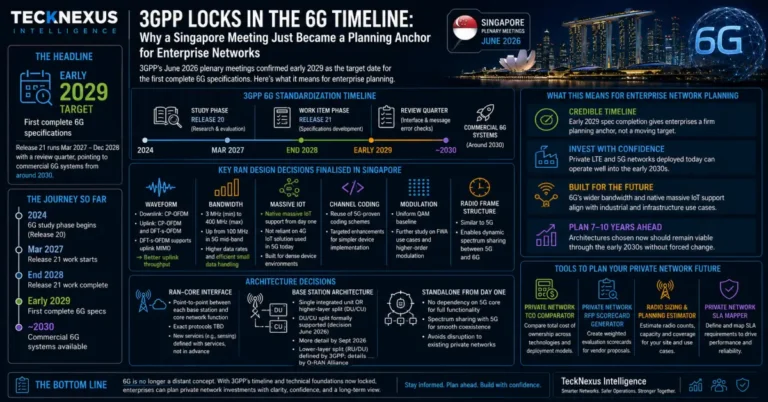
3GPP

Verizon Business, KDDI and BMW Group announced a connected-vehicle partnership on July 9, 2026 that puts newly manufactured BMW and MINI vehicles for the US market on Verizon's nationwide 5G Standalone network — the first vehicles to use that network since its launch. Here's what the Verizon BMW connected vehicles deal actually covers, how KDDI's platform fits in, and what it signals for enterprise IoT and network slicing beyond the automotive sector.
With GSA counting 2,003 private mobile network references, June 2026's story shifted from whether private cellular works to what it returns. This roundup covers TeckNexus's vertical ROI tools, 3GPP's confirmed 6G timeline, AI moving into the RF layer, CBRS SAS consolidation, and a widening set of verticals from mining to healthcare.
A 99.99% uptime SLA means nothing if it does not reflect what your critical use cases actually require. The TeckNexus Private Network SLA Mapper translates your operational requirements — AGV control, video surveillance, IoT sensing - into the precise latency, throughput, and reliability parameters your vendor must design to.
T-Mobile's Dynamic CX applies AI to its Self-Organizing Network architecture, scanning public data sources - event schedules, ticketing platforms, social activity — to anticipate high-density demand before it strains the network. Launching ahead of the 2026 FIFA World Cup across eleven U.S. host cities, the capability shifts network management from reactive triage to proactive resource allocation. Opensignal data from February through May 2026 already shows T-Mobile leading mobile experience metrics in all eleven markets, a baseline Dynamic CX is engineered to sustain under peak load conditions.
SpaceX is evolving from a rocket company into a vertically integrated infrastructure conglomerate with direct implications for satellite connectivity, defense communications, AI, and enterprise network strategy. With a planned $2 trillion Nasdaq IPO targeting $75 billion in capital, over $6 billion in cumulative U.S. government contracts, and Starlink expanding as a tier-one connectivity layer, SpaceX is positioning itself as a direct competitor in telecom markets. Telecom operators and enterprise IT leaders must stress-test their non-terrestrial network strategies now, before IPO capital accelerates SpaceX's competitive timelines across every market it touches.
Samsung Electronics and Qualcomm Technologies have jointly validated Power Class 1 capability for 5G Fixed Wireless Access on a virtualized RAN architecture — a combination the industry has not demonstrated before. Testing showed up to ten times higher uplink throughput at the cell edge and up to 40% greater coverage range versus Power Class 1.5. With field trials already underway on a U.S. Tier-1 operator network and commercial availability targeted for 2027, this milestone signals a meaningful shift in uplink performance, coverage economics, and vRAN capability for operators and enterprise buyers alike.
Telefonica Spain and Barcelona-based Sateliot have announced a strategic collaboration to integrate 5G Non-Terrestrial Networks with terrestrial 5G standalone deployments, moving NTN from standards discussion into active deployment planning. Built on the 3GPP Release 17 NTN standard and validated through a 2023 ESA-supervised interoperability test, the partnership targets defense, industrial IoT, maritime, and critical infrastructure sectors. The hybrid architecture supports unmodified NB-IoT devices connecting directly via LEO satellite, lowering enterprise adoption barriers and establishing a replicable model for operator-satellite collaboration across the telecom industry.
Verizon posted 55,000 postpaid phone net additions, a modest beat that underscores stabilizing consumer trends and stronger execution in premium plans and broadband cross-sell. The net add beat is small in absolute terms, but strategically important: it points to improving churn and a healthier mix of high-value subscribers after several quarters of intense promotional pressure. Management coupled the result with a constructive outlook characterized by service revenue resilience and disciplined capital intensity, hinting at a tighter or modestly raised full‑year guide. For a market still digesting 5G investment cycles, this steady footing matters more than splashy net‑add gains.
P‑CAL’s secure mesh provided resilient communications across a complex yard, validating control loops and telemetry in the presence of interference, variable traffic density and human activity. As deployments scale, many terminals will adopt hybrid connectivity: private 5G for wide‑area mobility and interference resilience, Wi‑Fi/Wi‑Fi 6E/7 for indoor assets, and mesh for redundancy in hard‑to‑reach zones. This mirrors global port trends, where operators are rolling out private 5G to support autonomous trucks, AI‑driven analytics, drones and mobile cranes. Expect edge compute (MEC) on‑premises to host perception, fleet orchestration and video intelligence with strict latency and data‑sovereignty requirements.
Deutsche Telekom is weighing a structural overhaul that would collapse its 53% ownership of T-Mobile US into a single, unified company spanning both sides of the Atlantic. Reports indicate Deutsche Telekom is exploring an all-stock transaction in which a new holding company would acquire both Deutsche Telekom and T-Mobile US, with current shareholders of each ending up as owners of the combined entity. The new group could pursue dual listings in the U.S. and Europe, eliminating today’s parent–subsidiary setup and aligning governance, strategy, and capital allocation under one roof.
Sponsored by Palo Alto Networks
⚡ Utilities ⏱ 8 min ✓ Free
This tool is built and hosted by TeckNexus.
Launch Tool →
Whitepaper
Airports are deploying AI surveillance, biometrics, and autonomous vehicles faster than most networks can secure them. See what 100 real-world airport deployments reveal about the airside/landside security gap — and the 4-layer framework built to close it....
Palo Alto Networks
Scroll to Top