3GPP

Vodafone Business has introduced 5G+ Local Slicing and a new Network Boost service, marking the first commercial, contract-backed 5G slicing offer for UK enterprises and a priority option for business traffic in high-demand areas. Enterprises are moving real-time operations, AI inference, and critical transactions onto mobile networks and need deterministic performance, not best-effort connectivity. By offering a dedicated, assured “lane” on its 5G Standalone (SA) network within defined local areas, Vodafone Business is addressing a long-standing performance and assurance gap that previously pushed many organizations toward private 4G/5G. Slices can be permanent or temporary and scaled as needs change.
Verizon’s role as Official Telecommunication Services Sponsor for FIFA World Cup 2026 and Official Tournament Supporter for FIFA Women’s World Cup 2027 elevates mega-event connectivity into a proving ground for 5G, fiber, FWA and broadcast at unprecedented scale. The World Cup concentrates extreme traffic densities, with each match expected to generate more than 50 terabytes of in-stadium data—an order of magnitude that forces operators to optimize spectrum, radio density and backhaul in tandem. Verizon’s capacity uplift—adding 5G spectrum to deliver an estimated 3x to 5x boost across all host stadiums—will benchmark real-world 5G ROI where venue, fan, and operational requirements converge.
Enterprises need indoor mobile coverage that works like the macro, integrates with private wireless, and sets a path to 5G and AI without ripping-and-replacing infrastructure. InfiniG’s Neutral Host as a Service turns a CBRS shared-spectrum deployment into an extension of public mobile networks using a 3GPP MOCN architecture. Employees, contractors, and visitors get native service from AT&T, T-Mobile, and Verizon on their existing SIMs—no apps, no plan changes. The Nokia RAN is 5G-ready out of the box, protecting investments as operators certify 5G Standalone and VoNR on neutral host. Radios and gateways are software-upgradable, so enterprises can deploy today for LTE and move to 5G without swapping hardware.
Amazon will acquire Globalstar to accelerate Amazon Leo’s direct-to-device (D2D) roadmap, secure midband MSS spectrum, and extend satellite coverage to smartphones and IoT beyond terrestrial reach. Amazon is acquiring Globalstar in a cash-and-stock deal valued at roughly $11.5 billion, with Globalstar shareholders able to elect $90 per share in cash or Amazon stock subject to a cash cap and proration. Closing is targeted after regulatory approvals and satellite milestones, with Amazon guiding to 2027. Amazon plans to deploy a next-generation D2D system starting in 2028, delivering voice, messaging, and data to unmodified mobile devices.
US Mobile and Starlink have launched limited-time bundles that combine Starlink residential service with US Mobile’s unlimited mobile plans under a single account and bill. Entry pricing starts at $47 per month, which effectively blends a $30 Starlink residential tier (targeted around 100 Mbps) with a $17 US Mobile base unlimited plan. Higher Starlink speed tiers are available at $77 per month for a 200 Mbps option and $117 per month for a “Max” service that targets 400 Mbps or more. Compared with Starlink’s typical standalone rates of $50, $80, and $120 for the same speed tiers, the bundles represent meaningful savings for households that want both mobile and home internet.
ETSI has introduced OpenOP Release 1 as an open-source operator platform for telco cloud, designed to standardize capability exposure and federation at the edge while creating a practical bridge from 5G-Advanced to early 6G experimentation. Networks are becoming software-first and distributed, but operators still face fragmented exposure of network capabilities and inconsistent approaches to multi-operator edge. OpenOP targets this gap with a standards-aligned, open implementation that lets developers consume telecom capabilities via CAMARA APIs and deploy applications across federated edge zones. Release 1 provides a working, end-to-end baseline with integrated components for exposure, orchestration, federation, and AI-assisted intent, suitable for hands-on testing and integration.
Orange Business has launched Orange Drone Guardian, a counter‑UAS service that turns telco infrastructure into a nationwide sensing fabric—arriving as drone activity, regulation, and critical-infrastructure risk converge. Orange is leveraging assets few others can: secure nationwide connectivity, cloud qualified to ANSSI’s SecNumCloud 3.2 standard, a domestic security operations capability, and a tower footprint via TOTEM’s 19,700 sites across France. The offer combines sensors, command‑and‑control software, secure cloud, and managed operations in a subscription bundle designed to scale and evolve. Delivered as a subscription, customers gain real‑time situational awareness without large upfront capex.
AT&T’s five-year, $250 billion U.S. network commitment sets the tone for the next phase of fiber, 5G, and satellite convergence as traffic, AI workloads, and resilience requirements climb sharply. The 2026–2030 window aligns with the industry’s transition into 5G-Advanced (3GPP Release 18/19), the scaling of edge AI, and increased cloud traffic between homes, enterprises, and hyperscalers. Data growth is no longer linear, and the cost of downtime is rising. Large, front-loaded builds in fiber and 5G Radio Access Network (RAN), paired with new satellite overlays, are how national carriers will chase coverage, performance, and reliability targets simultaneously.
NTT DOCOMO and Keio University have validated that commercial 5G Standalone (SA) can stably support haptic-grade robot teleoperation using network slicing and configured grant—turning years of URLLC theory into practical results. By pairing 3GPP-configured grant scheduling with a low-latency slice and Keio’s Real Haptics technology, DOCOMO showed that public 5G SA can carry force and tactile feedback with the determinism required for safe, precise manipulation. The KPIs demonstrate material improvements in latency stability, force fidelity, and motion smoothness—indicators that the control loop is resilient enough for practical tasks.
NTT DATA’s private 5G rollout across 50 Cargill facilities signals that industrial connectivity is moving from pilot projects to standardized, multi-site execution. NTT DATA has deployed private 5G at Cargill manufacturing and processing locations worldwide—mostly in the United States with live sites in Europe—enabling a connected workforce, robotics, and edge AI across plants that are often too large and complex for conventional Wi‑Fi or wired networks to cover reliably. Manufacturers are consolidating on common digital platforms and need predictable, low-latency wireless for operational data, mobile human–machine interfaces, and autonomous systems; private 5G—built on 3GPP standards with SIM-based security and policy-based QoS—offers deterministic performance at scale where legacy networks struggle.
American Tower’s latest outlook puts a hard number on a trend most operators feel on the ground: the network needs to double by the end of the decade to absorb 5G, fixed wireless access, and AI-driven traffic. Mobile data growth remains the primary engine for new network investment. As 5G adoption scales and fixed wireless access expands, capacity pressure is shifting from coverage to throughput. The next leg comes from AI. New applications—from on-device inference to computer vision at the edge—demand more bandwidth, tighter latency, and stronger uplink. That profile is different from today’s downlink-heavy usage and will stress radios, backhaul, and site power.
A new collaboration between GSMA Foundry and Singapore’s National University Health System (NUHS) aims to operationalize connected health at scale, with Ericsson and Singtel anchoring the 5G foundation. Healthcare digitization has moved from pilots to production, but most sites still struggle with deterministic connectivity, secure data exchange and workflow integration. The program combines private 5G with digital twin, XR, IoT and ambient AI to improve outcomes and operational resilience across care pathways. Early focus areas include 5G-enabled remote surgical assistance with ultra-reliable, low-latency links; immersive XR training and simulation that compress learning curves; autonomous and semi-autonomous robotics for logistics and point-of-care tasks; and AI-guided imaging such as vein visualization.
Sponsored by Palo Alto Networks
⚡ Utilities ⏱ 8 min ✓ Free
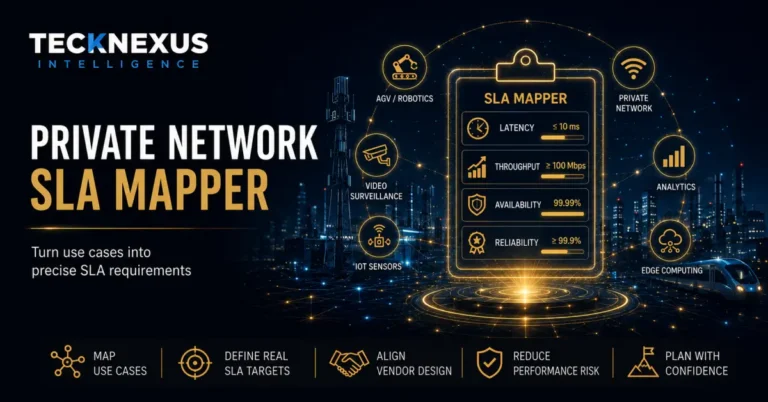
This tool is built and hosted by TeckNexus.
Launch Tool →
Whitepaper
Neutral host, network slicing, and autonomous ground vehicles look like three unrelated topics — but they share the same hidden security risk. See what 100 airport deployments reveal about securing the components with the broadest reach across the network....
Palo Alto Networks
Whitepaper
Airports are deploying AI surveillance, biometrics, and autonomous vehicles faster than most networks can secure them. See what 100 real-world airport deployments reveal about the airside/landside security gap — and the 4-layer framework built to close it....
Palo Alto Networks
Scroll to Top