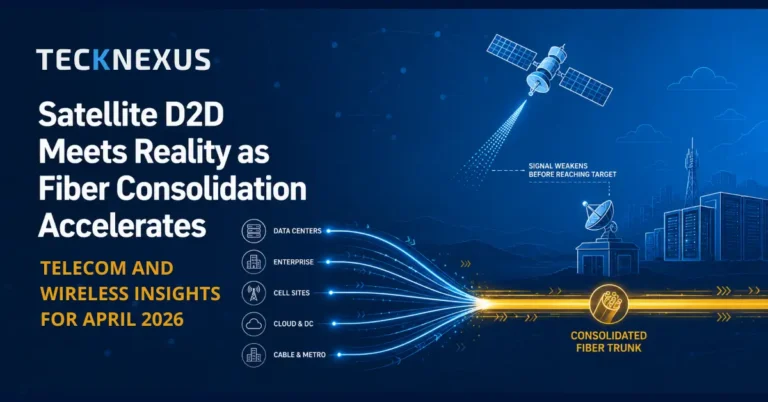
Telecom and Wireless Insights – April 2026’s roundup: T-Mobile admits satellite direct-to-device usage is falling short of expectations, fiber consolidation accelerates through new JVs and a potential €20B SFR deal, 6G‘s timeline gets murkier rather than clearer, and optical networking rides the AI supercycle.
At a glance – Advanced Connectivity Insights for April 2026
- T-Mobile CEO Srini Gopalan admitted during Q1 2026 earnings that its T-Satellite direct-to-device service is seeing far less usage than projected, with 1.8 million free beta sign-ups failing to translate into strong paid engagement.
- T-Mobile inked two separate 50/50 fiber joint ventures — with Oak Hill Capital (combining GoNetspeed and Greenlight Networks) and with Wren House — to accelerate FTTP reach and multi-gig capacity.
- Orange, Bouygues Telecom, and Free–iliad entered exclusive negotiations to acquire SFR from Altice France at a €20.35B enterprise value, while Deutsche Telekom explored collapsing its 53% T-Mobile US stake into a single transatlantic holding company.
- 6G‘s timeline showed real inconsistency this month: 3GPP is reportedly targeting “around 2030” — a shift from the 2029 framing Ericsson and others used at MWC Barcelona in March.
- Nokia‘s optical business surged roughly 20% on hyperscaler demand tied to its Infinera bet, while Ciena advanced hyper-rail photonics and next-gen coherent optics amid a stock surge.
- The FCC adjusted satellite spectrum allocations to expand broadband capacity, as Rogers, Deutsche Telekom, and KDDI all extended satellite-linked connectivity plays.
1. Satellite/NTN reality check meets spectrum expansion
The month’s most important satellite story is an admission, not an announcement:
- T-Mobile — T-Satellite usage shortfall: CEO Srini Gopalan admitted during Q1 2026 earnings that its T-Satellite direct-to-device service is seeing far less usage than projected, largely because T-Mobile’s terrestrial network already leaves few coverage gaps for consumers. 1.8 million free beta sign-ups have not translated into strong paid engagement, with Apple‘s free Globalstar-based satellite messaging adding competitive pressure.
- Rogers: expanded satellite-to-mobile roaming coverage across the US for Canadian subscribers via a partnership with T-Mobile’s T-Satellite network, targeting areas lacking terrestrial coverage.
- Deutsche Telekom & Starlink: partnered to offer business broadband services using Starlink‘s low-Earth orbit satellite connectivity.
- KDDI: deployed 5G connectivity, integrated Starlink satellite services, and offered generative-AI illustrated messaging at Japanese music festivals.
- FCC: updated satellite spectrum policies to enable greater broadband capacity, adjusting allocations and usage rules for satellite services.
- Why it matters for buyers: the month’s most important satellite story isn’t a new launch or partnership — it’s an operator publicly admitting that a flagship D2D service is underperforming, in an environment where regulators are simultaneously freeing up more satellite spectrum. That combination suggests the current bottleneck for D2D isn’t spectrum access, it’s genuine consumer coverage need — most subscribers with strong terrestrial service don’t need it yet. → Assess where satellite/NTN genuinely fills a coverage gap in your footprint with TeckNexus Network Planning tools.
2. Fiber consolidation and capital reshuffling accelerate
Capital and corporate structure moved as much as technology this month:
- T-Mobile: inked two separate 50/50 fiber joint ventures — one with Oak Hill Capital combining GoNetspeed and Greenlight Networks into a single platform, and a second with infrastructure investor Wren House — to accelerate FTTP reach, add multi-gig capacity, and broaden its multi-access broadband portfolio.
- Deutsche Telekom: is weighing a structural overhaul that would collapse its 53% ownership of T-Mobile US into a single, unified transatlantic company, reportedly exploring an all-stock transaction via a new holding company.
- Orange, Bouygues Telecom & Free–iliad: entered exclusive negotiations with Altice France to acquire SFR at a €20.35B enterprise value, with exclusivity granted until 15 May 2026 to finalize terms and transaction documents.
- CableFinder & Lightpath: partnered to integrate Lightpath’s fiber carrier services into CableFinder’s telecom sales and quoting platform for channel partners.
- USTelecom: intensified its push for permitting reform on federal lands, urging the Departments of Interior and Agriculture to adopt new White House guidance letting agencies skip full environmental reviews for low-impact infrastructure projects.
Why it matters for buyers: capital and corporate structure moved as much as technology this month — two operators are restructuring at the ownership level (Deutsche Telekom/T-Mobile US, the SFR consortium bid) while T-Mobile is using JV structures rather than outright ownership to scale fiber reach. Buyers and partners should watch which structure — JV, acquisition, or holdco consolidation — becomes the dominant fiber-scaling model, since it changes who you’re actually negotiating with. → Model comparable buildout economics with TeckNexus ROI/TCO tools.
3. 6G’s timeline gets murkier, not clearer
Worth flagging directly: this month’s 6G timeline framing doesn’t cleanly match last month’s:
- 3GPP: is reportedly advancing a 6G standards timeline toward “around 2030,” while flagging unresolved questions about AI integration and cross-vendor interoperability — a framing that sits in tension with the 2029 target Ericsson and T-Mobile/Qualcomm both cited at MWC Barcelona in March.
- Qualcomm: outlined its view of 6G Integrated Sensing and Communications (ISAC) as both a network-efficiency tool and a new service platform, positioning ISAC within an AI-native 6G architecture that converges connectivity, compute, and sensing.
- LG Uplus & Japanese operators: signed the Tokyo Accord with NTT Docomo, KDDI, Rakuten Mobile, and SoftBank at the GSMA APAC CEO and 6G Alliance Summit, focused on interoperable platforms, cross-border digital trust, and coordinated 6G/AI standards.
- Nokia & Orange: announced a collaboration to explore AI-native design principles for future 6G networks, without disclosing technical architecture or trial details.
Why it matters for buyers: this month’s 3GPP timeline framing (“around 2030”) doesn’t cleanly match the 2029 target cited by Ericsson and T-Mobile/Qualcomm just one month earlier. That’s not necessarily a contradiction — different sources may describe different milestones (first specifications vs. broader standard completion) — but buyers building multi-year 6G-adjacent roadmaps should treat the exact date as still unsettled rather than locked in, and confirm which milestone any vendor’s “2029” or “2030” claim actually refers to. → Track 6G planning assumptions with TeckNexus Network Planning tools.
4. Optical networking rides the AI supercycle
Optical is emerging as one of the clearer, quantifiable beneficiaries of AI-driven demand:
- Nokia: is prioritizing optical networking, citing its Infinera-related move and reporting roughly 20% revenue growth in the segment, framed within demand growth from the AI supercycle discussed at its Capital Markets Day; separately, Nokia reported momentum in optical networking with hyperscaler customers while its mobile segment awaits AI-driven spending, with its Nvidia partnership still at pilot stage.
- Ciena: highlighted advances in hyper-rail photonics, next-generation coherent optical solutions, and AI-driven network automation amid a stock surge.
- HPE: showcased AI-driven networking spanning Scale Up, Scale Out, and Scale Across at OFC 2026, covering Ethernet for AI fabrics, 1.6T Ethernet switching, PTX-class routing, and AI-powered operations for data center, DCI, and WAN environments.
Why it matters for buyers: optical networking is emerging as one of the clearer, quantifiable beneficiaries of AI-driven demand this month — Nokia’s ~20% segment growth is a concrete number in a space where most “AI supercycle” claims remain qualitative. For buyers planning data center interconnect or backhaul capacity, optical vendor selection is increasingly an AI-capacity-planning decision, not a separate transport-layer one. → Model capacity and interconnect economics with TeckNexus Network Planning and ROI/TCO tools.
5. Enterprise 5G and private wireless infrastructure broadens
Enterprise wireless is diversifying across technology types and verticals rather than consolidating around one architecture:
- Vodafone Business: launched commercial 5G network slicing, enabling differentiated enterprise connectivity with performance isolation and SLAs, though specific markets and technical partners weren’t disclosed.
- SAF Tehnika: expanded wireless backhaul offerings for US enterprise and private 5G/LTE deployments, including point-to-point and point-to-multipoint links, ultra-low-latency gear, and RF spectrum analysis tools aimed at reducing fiber dependency.
- Digi International: launched an industrial 5G router integrating active eSIM, on-device edge compute, and AI-driven operations, positioned for private LTE/5G and compliance-focused deployments.
- Eino: introduced an agentic network observability platform combining agent-based reasoning with a 3D digital twin to design, monitor, and troubleshoot multi-technology enterprise wireless networks spanning private 5G, Wi-Fi, IoT, FWA, and DAS, built on NVIDIA GPUs and ray tracing.
- InCoax Networks: secured its first US operator order, via distributor CTIconnect, to deploy a multi-gigabit in-building access solution with open-access fiber operator Underline.
- HealthTech Magazine: published an explainer on why healthcare organizations are adopting private 5G over or alongside Wi-Fi, citing lower latency, higher device density, mobility, and SIM/eSIM-based zero-trust security.
Why it matters for buyers: enterprise wireless infrastructure is diversifying across technology types (private 5G, Wi-Fi, FWA, DAS) and verticals (healthcare, industrial) rather than consolidating around one architecture — and the tooling to manage that complexity, like Eino’s multi-technology observability platform, is maturing alongside it. → Compare architecture fit across technologies with the TeckNexus Technology Selector and Network Planning tools.
6. Mega-events stress-test network capacity
2026’s biggest connectivity showcase is already shaping capacity planning:
- Verizon — FIFA World Cup 2026: as Official Telecommunication Services Sponsor for FIFA World Cup 2026 and Official Tournament Supporter for the FIFA Women’s World Cup 2027, Verizon is positioning the tournament as a proving ground for 5G, fiber, FWA, and broadcast connectivity at unprecedented scale, with each match expected to generate extreme, concentrated traffic density.
- Verizon — postpaid net adds: separately posted 55,000 postpaid phone net additions, a modest but strategically important beat pointing to improving churn and a healthier mix of high-value subscribers after several difficult quarters.
Why it matters for buyers: mega-events remain one of the few settings where operators can genuinely stress-test 5G, fiber, and FWA capacity simultaneously under real, extreme, concentrated demand — the World Cup result will be a meaningful public data point on network readiness heading into 2026’s biggest connectivity showcase. → Benchmark event-scale capacity planning with TeckNexus Network Planning tools.
Every April item, with full source detail, is on the curated Telecom and Wireless Monthly Insights page →
A note on scope: this roundup focuses on connectivity and network infrastructure specifically. For this month’s AI model, AI-RAN silicon, and agentic AI stories — including Nokia’s $1B Nvidia partnership naming T-Mobile as an AI-RAN anchor customer — see the companion AI & Automation Insights, April 2026.
What this means if you’re planning connectivity infrastructure
April’s throughline is that connectivity infrastructure is consolidating and diversifying at the same time — fiber ownership is restructuring at the corporate level even as enterprise wireless splinters across more technology types, and the most confidently-stated 6G date from one month ago (2029) is already being reported differently the next (2030). Five moves follow directly from the month:
- Treat satellite D2D as a targeted coverage-gap solution, not a mass-market feature — T-Mobile’s own usage data suggests most subscribers with strong terrestrial coverage don’t need it yet.
- Watch which fiber-scaling structure wins out — JV (T-Mobile), outright acquisition (the SFR consortium), or holdco consolidation (Deutsche Telekom/T-Mobile US) — since each implies a different long-term negotiating counterpart.
- Don’t lock in 6G planning assumptions around a single date — confirm whether any vendor’s 2029 or 2030 claim refers to first specifications or full standard completion.
- If your roadmap includes data center interconnect or backhaul capacity, treat optical vendor selection as an AI-capacity-planning decision — Nokia’s ~20% optical growth this month is a concrete signal of where AI-driven demand is landing first.
- Benchmark your own enterprise wireless architecture choices (private 5G, Wi-Fi, FWA, DAS) against the World Cup as a real-world capacity stress test once results are public.
Catching up? Last month’s inaugural edition is here: AT&T’s $250B Bet Sets the Tone as AI-RAN Strategies Diverge: Advanced Connectivity Insights, March 2026 →
→ Start with the TeckNexus Intelligence Platform — independent, buyer-neutral tools for spectrum, TCO, architecture, and RFP decisions.
This analysis is drawn from TeckNexus’s full curated Telecom and Wireless Monthly Insights for April 2026. See every deployment, product, and partnership update →
The TeckNexus Intelligence Platform is buyer-neutral and TeckNexus-authored. Vendor co-branded Intelligence Packs are labelled as such and kept separate from the neutral core tools.
| RELATED TOOL
Which connectivity investment — fiber, satellite, 6G, or private wireless — should you prioritise? With fiber ownership restructuring, satellite D2D underperforming initial projections, and 6G’s exact timeline still unsettled, the decisive question is where to commit capital now versus keep flexible. TeckNexus’s Network Planning tools map architecture, spectrum, and capacity decisions against your deployment horizon, while ROI/TCO tools model the buildout economics behind fiber, satellite, and private wireless investments. |