Apple

Anthropic's Mythos model, launched under Project Glasswing in April 2026, has exposed critical fault lines in how allied governments coordinate on AI safety and access. The White House controls who receives access beyond U.S. borders, with the European Commission told it must seek U.S. permission before any access is granted. For European enterprises and telecom operators, this creates a structural challenge: holding regulatory authority over AI through the EU AI Act while lacking direct visibility into the frontier models they are tasked with overseeing.
Deutsche Telekom's transition from Ericsson to Mavenir as its primary 5G standalone core provider represents a fundamental rethinking of how Tier 1 operators architect and operate networks in the cloud-native era. Mavenir now carries all standalone 5G traffic in Germany, while Ericsson handles legacy 4G and non-standalone 5G. Driven by the Horizontal TelCo Cloud initiative, the shift has already produced measurable results including 65% energy savings in live testing and three commercial network slicing deployments, with Apple FaceTime set to leverage these capabilities at consumer scale via iOS 26.
T-Mobile CEO Srini Gopalan admitted during Q1 2026 earnings that its T-Satellite direct-to-device service is seeing far less usage than projected, largely because T-Mobile's terrestrial network leaves few coverage gaps for consumers. With 1.8 million free beta sign-ups failing to translate into strong paid engagement, and Apple's free Globalstar satellite messaging compressing the addressable market, T-Mobile is pivoting toward enterprise connectivity. Its new SuperBroadband offering pairs 5G with Starlink LEO broadband, targeting businesses in healthcare, retail, and energy that require resilient, always-on connectivity across distributed locations.
Samsung Electronics is accelerating its U.S. foundry strategy with the Taylor plant set to begin operations, anchored by 2-nanometer AI chips for Tesla’s next-generation self-driving platforms. After breaking ground in late 2022 with an initial $17 billion investment, Samsung’s Taylor fab is now holding its equipment installation ceremony and transitioning from build-out to run-up. For the U.S. semiconductor base, Taylor represents an advanced-node capacity point that complements Samsung’s existing Austin operations and expands domestic options beyond a single supplier. Tesla’s AI5 design has taped out, signaling it is ready for volume manufacturing, with AI6 following closely and expected to incorporate low-power DDR (LPDDR) memory to meet stringent automotive power budgets.
Amazon will acquire Globalstar to accelerate Amazon Leo’s direct-to-device (D2D) roadmap, secure midband MSS spectrum, and extend satellite coverage to smartphones and IoT beyond terrestrial reach. Amazon is acquiring Globalstar in a cash-and-stock deal valued at roughly $11.5 billion, with Globalstar shareholders able to elect $90 per share in cash or Amazon stock subject to a cash cap and proration. Closing is targeted after regulatory approvals and satellite milestones, with Amazon guiding to 2027. Amazon plans to deploy a next-generation D2D system starting in 2028, delivering voice, messaging, and data to unmodified mobile devices.
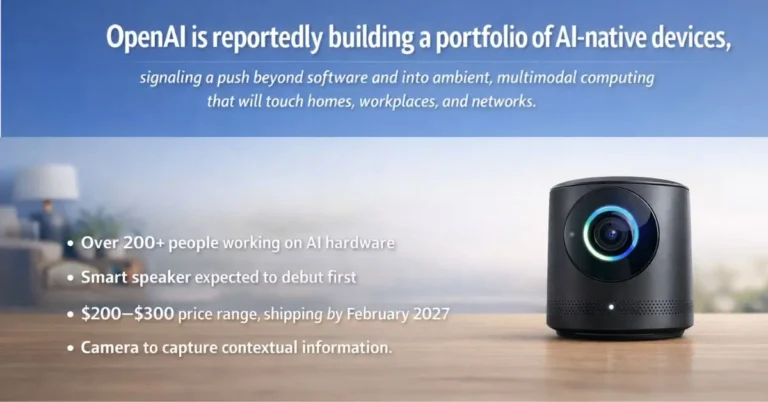
OpenAI is reportedly building a portfolio of AI-native devices, signaling a push beyond software and into ambient, multimodal computing that will touch homes, workplaces, and networks. Multiple reports indicate OpenAI has over 200 people developing a family of AI-enabled hardware, with a smart speaker expected to debut first. Early guidance points to a price in the $200–$300 range and a ship window no earlier than February 2027. The device is said to include a camera to capture contextual information about users and surroundings—an explicit bet on multimodal AI that fuses voice, vision, and environment for richer interactions.
Apple’s purchase of Israeli start-up Q.ai accelerates its shift toward multimodal, audio-first wearables and tighter on-device AI. Apple acquired Q.ai, a Tel Aviv-based AI company operating in stealth since 2022, in a transaction reported around $2 billion, making it Apple’s second-largest acquisition after Beats. The move lands as Apple pushes a broader AI refresh across devices and services, including a reworked Siri due next month and a reported integration of Google’s Gemini into Apple Foundation Models. The core value is a human-computer interface designed to reduce friction between intent and AI execution. This enables “silent speech” and context awareness without overt voice commands or touch.
BlueBird 7 is slated to lift off in late February from Launch Complex 36 at Cape Canaveral Space Force Station on the New Glenn-3 mission. It is AST SpaceMobile’s first payload on New Glenn and the second satellite in its next-generation “Block 2” campaign, following BlueBird 6. BlueBird 7 mirrors BlueBird 6 and carries a deployable array of about 2,400 square feet—the company positions it as the largest commercial communications aperture in low Earth orbit. The design, backed by thousands of patent and patent-pending claims, is engineered to deliver peak downlink rates up to 120 Mbps directly to standard, unmodified devices for voice, data, and video.
New data points to a step-change in cellular IoT adoption as 5G broadens into mid-tier and massive-scale use cases while 4G-era LPWA keeps expanding. Omdia forecasts cellular IoT connections to reach roughly 5.9 billion by 2035, driven by expanding addressable use cases across industrial automation, utilities, transportation, retail, and consumer-adjacent categories such as wearables. The growth profile is no longer tied only to premium 5G performance; instead, scaled adoption is coming from three complementary pillars: 5G RedCap for mid-tier performance at lower cost, 5G Massive IoT (evolving NB-IoT/LTE-M under a 5G core), and 4G LTE Cat-1bis for low-cost devices that still require voice or moderate throughput.
The administration plans an executive order to set a single national AI rulebook and override state-level frameworks, a move with immediate implications for telecom, cloud, and enterprise AI strategies. President Trump signaled he will sign an executive order establishing a uniform federal approach to AI governance that preempts state regulations. Reports indicate the order aims to reduce compliance friction by replacing diverse state rules with a lighter-touch national framework focused on competitiveness. State officials from both parties, safety advocates, and labor groups are preparing to fight the order, citing risks related to consumer harm, deepfakes, hiring bias, and child safety. On the other side, Silicon Valley leaders warn that 50-state compliance regimes could deter innovation and blunt national competitiveness.
New consumer research commissioned by Viasat and executed by GSMA Intelligence signals that non-terrestrial networks (NTN) are becoming a mainstream buying factor for mobile subscribers. The survey of more than 12,000 smartphone users across 12 countries finds persistent coverage gaps: over a third of respondents lose basic cellular service multiple times per month. That pain point is translating into intent. Roughly six in ten consumers say they would pay extra for satellite-enabled connectivity on their phones, and nearly half indicate they would switch operators if out‑of‑coverage service were included in their plan. On average, those willing to pay would accept a 5–7% uplift on their current monthly bill, with outliers such as India approaching a 9% premium.
This dispute underscores the weakness of today’s data-sharing “plumbing.” Scraping is brittle, hard to audit, and raises legal risk. The industry will likely move toward standardized, consent-driven APIs that let customers securely share specific data fields for comparison and switching. Telecom can borrow from open banking: OAuth 2.0 and OpenID Connect flows, fine-grained scopes, auditable logs, and tokenized access with time limits. TM Forum Open APIs and carrier-to-carrier data-sharing frameworks could underpin such exchanges, while CTIA and GSMA initiatives provide governance. Done right, portability can be fast for consumers and compliant for operators.

Your Brand. Our Intelligence Tools.

Capture leads at the point of evaluation. Talk to Us →

Sponsored by Palo Alto Networks
⚡ Utilities ⏱ 8 min ✓ Free
This tool is built and hosted by TeckNexus.
Launch Tool →
Whitepaper
This whitepaper explains how utilities can use secure AI-enabled private mobile networks to modernize operations, support distributed intelligence, improve resilience, and strengthen cybersecurity across critical infrastructure. It covers AI applications, private network advantages, zero trust principles, multilayered security architecture, and governance considerations for AI-ready utility environments....
Whitepaper
Non-terrestrial networks are rapidly evolving from experimental satellite systems into an increasingly important part of the global 5G connectivity landscape. This eBook, developed by Radisys in collaboration with TeckNexus, explores how 3GPP standardization, satellite architecture innovation, and software-driven network design are reshaping NTN deployment models. It examines the transition from...
Whitepaper
Private cellular networks are transforming industrial operations, but securing private 5G, LTE, and CBRS infrastructure requires more than legacy IT/OT tools. This whitepaper by TeckNexus and sponsored by OneLayer outlines a 4-pillar framework to protect critical systems, offering clear guidance for evaluating security vendors, deploying zero trust, and integrating IT,...
Scroll to Top

Map your security gaps to real threat scenarios – including Salt Typhoon, Volt Typhoon, AI data poisoning, rogue devices, and unencrypted OT traffic.

Take the free 8-minute assessment built for utility operators evaluating AI-enabled private mobile networks. Get a readiness score across five critical domains, see where your gaps are, and receive a prioritized action plan for what to fix first.

Free • 8 minutes • Built for private network security