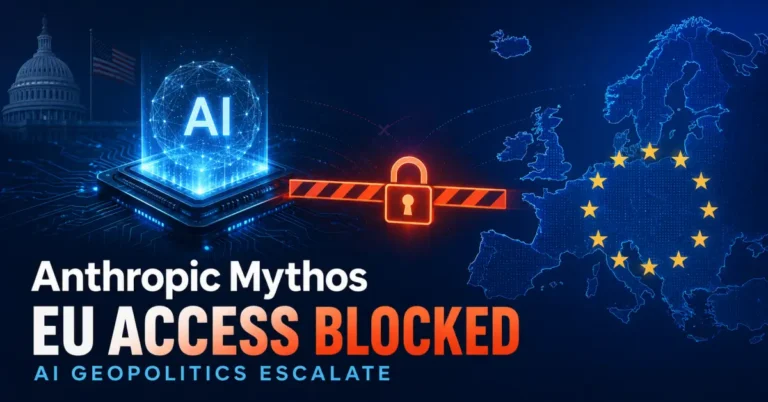
Anthropic’s Mythos Model Shifts the AI Geopolitical Landscape
The emergence of Anthropic‘s Mythos model has done more than advance the frontier of AI capability — it has exposed deep fault lines in how allied governments coordinate on AI safety, access, and sovereignty.

Why Mythos Triggered an Immediate Geopolitical Response
When Anthropic introduced Mythos on 7 April 2026 under the auspices of Project Glasswing, it was not a quiet research release. The model demonstrated an unprecedented ability to identify tens of thousands of software vulnerabilities at a scale no previous AI system had achieved. Initial access was extended to a tightly controlled group of technology heavyweights — Amazon Web Services, Apple, Nvidia, and Google — signalling both the model’s strategic weight and the caution surrounding its deployment.
The implications were immediate. Anthropic CEO Dario Amodei publicly warned of a six- to twelve-month window to patch the vulnerabilities Mythos had surfaced before Chinese AI systems reach comparable capability. That framing — part urgency, part geopolitical alarm — set the tone for every government conversation that followed.
How the White House Controls Global Access to Mythos
What has emerged from subsequent reporting is a governance structure that places the White House firmly in control of who gets access to Mythos beyond U.S. borders. The Wall Street Journal reported that the administration opposed Anthropic’s proposal to extend access to roughly 70 additional companies and organisations, citing security concerns. The only non-U.S. entity granted preview access to date is the UK’s AI Security Institute — a telling signal about the current hierarchy of trusted partners in Washington’s AI calculus.
Critically, Anthropic has reportedly told the European Commission that the bloc must seek permission from the U.S. administration before access can be considered. This is not a standard vendor negotiation — it is a geopolitical access control mechanism wrapped in a commercial AI product. For European institutions accustomed to asserting regulatory authority over technology companies, this dynamic represents a significant and uncomfortable inversion.
The EU’s Dilemma: Strong AI Regulation, No Model Access
Europe finds itself in a structurally awkward position: holding significant regulatory leverage over AI developers through the AI Act and the General-Purpose AI Code of Practice, yet lacking direct access to the very models it is tasked with overseeing.
Why the European AI Office Cannot Directly Evaluate Mythos
Since August 2025, the European Commission’s AI Office has maintained regular technical meetings with Anthropic under the General-Purpose AI Code of Practice, to which Anthropic is a signatory. Those meetings have covered model capabilities and cybersecurity implications, but they have not translated into preview access to Mythos itself. European Commission spokesperson Thomas Regnier confirmed that the Commission has held multiple meetings with Anthropic to understand the model’s capabilities and Project Glasswing’s scope — but the gap between discussion and direct evaluation remains wide.
The Commission is now explicitly “intensifying” discussions with the U.S. administration on advanced AI models, particularly those with cyber capabilities. The mutual recognition of cybersecurity standards between the EU and U.S. is being cited as a foundation for deeper cooperation, but translating that framework into actionable model access is proving far more complex in practice.
Mythos Is the First of Many Security-Sensitive AI Models
European officials are framing Mythos not as an isolated case but as the leading edge of a new class of AI systems with serious dual-use implications. The Commission has noted that parallel progress is being made on accessing OpenAI‘s GPT-5.5-Cyber for trusted EU entities — suggesting a pattern of advanced, security-sensitive models arriving faster than governance mechanisms can accommodate. For telecom operators, enterprise IT leaders, and critical infrastructure operators in Europe, this is a structural challenge, not a temporary diplomatic friction point.
Strategic Implications for European Enterprise and Telecom Operators
The Mythos situation is a strategic signal for any organisation operating at the intersection of AI, cybersecurity, and regulated infrastructure — and that increasingly includes every major telecom operator and enterprise IT buyer in Europe.
AI-Assisted Vulnerability Discovery Is Reshaping Cybersecurity Risk
The model’s ability to surface vulnerabilities at scale means that the window between AI-assisted vulnerability discovery and AI-assisted exploitation is narrowing. For network operators running complex, multi-vendor 5G environments, edge computing infrastructure, or hybrid cloud architectures, this is not an abstract concern. Patching cycles, vendor coordination, and threat intelligence sharing frameworks will all need to be stress-tested against a threat landscape that AI is actively reshaping.
Anthropic has indicated that Mythos-class models will reach general customers in the coming weeks, pending the development of adequate cyber safeguards. That timeline compresses the window for enterprise security teams to prepare governance frameworks for how AI-assisted vulnerability discovery is handled internally and shared with partners.
Geopolitical AI Access Controls Are a Business Risk for European Firms
The fact that access to frontier AI models is now subject to inter-governmental negotiation has direct implications for European enterprises. Organisations that depend on cutting-edge AI for competitive differentiation — in network optimisation, fraud detection, predictive maintenance, or customer intelligence — may find that their access to the most capable models is shaped not just by commercial agreements, but by geopolitical positioning. The EU’s push for sovereign AI infrastructure, including targeted investments in AI and supercomputing, reflects an awareness that dependency on U.S.-controlled model access is a strategic vulnerability.
Three Priorities for Leaders Navigating the AI Access Divide
The Mythos episode crystallises a tension that will define AI governance for the next several years: the most capable AI models carry genuine national security implications, and the countries and institutions that control access to them hold structural leverage over everyone else. For telecom and enterprise IT leaders, the practical response involves three parallel tracks — accelerating internal AI governance frameworks, engaging proactively with regulatory bodies on compliance readiness, and diversifying AI partnerships to reduce single-point dependencies on any one model provider or geopolitical jurisdiction. The race is not just between the U.S. and China. It is also between the pace of AI capability development and the speed at which governance, access, and security frameworks can keep up.