Cybersecurity

T-Mobile's Dynamic CX applies AI to its Self-Organizing Network architecture, scanning public data sources - event schedules, ticketing platforms, social activity — to anticipate high-density demand before it strains the network. Launching ahead of the 2026 FIFA World Cup across eleven U.S. host cities, the capability shifts network management from reactive triage to proactive resource allocation. Opensignal data from February through May 2026 already shows T-Mobile leading mobile experience metrics in all eleven markets, a baseline Dynamic CX is engineered to sustain under peak load conditions.
Anthropic's Mythos model, launched under Project Glasswing in April 2026, has exposed critical fault lines in how allied governments coordinate on AI safety and access. The White House controls who receives access beyond U.S. borders, with the European Commission told it must seek U.S. permission before any access is granted. For European enterprises and telecom operators, this creates a structural challenge: holding regulatory authority over AI through the EU AI Act while lacking direct visibility into the frontier models they are tasked with overseeing.
Volt Typhoon wasn't just a cyberattack - it was a strategic warning about the IT/OT boundary every utility now operates across. Zero trust is the only security model built for this threat environment, and private mobile networks are the foundation that makes it implementable. Here's what utilities need to know — and act on now.
Edge AI is reshaping how utilities manage the grid — moving intelligence from the control room to the substation itself. Small language models, autonomous agents, and hardened edge routers are enabling faster fault detection, predictive maintenance, and real-time load optimization. But distributed intelligence demands distributed security. Here's what utilities need to build both.
Verizon's 2026 Data Breach Investigations Report, based on analysis of more than 31,000 security incidents, finds that 31% of all breaches now originate from software vulnerability exploitation—surpassing stolen credentials as the leading initial access vector. Generative AI is accelerating this shift, with threat actors applying AI across an average of 15 distinct attack techniques. Ransomware remains pervasive, though ransom payments are declining. For telecom and enterprise IT leaders, the report signals an urgent need to treat vulnerability management as a real-time discipline and embed AI-native security tooling into defense operations.
Eight of the most influential US telecommunications carriers — including AT&T, Verizon, T-Mobile, and Comcast — have established the Communications Cybersecurity Information Sharing and Analysis Center, known as C2 ISAC. Governed by the CISOs of each founding company and led by a director with CISA and FBI experience, C2 ISAC is designed to deliver real-time, actionable threat intelligence across competing carriers that collectively defend America's critical communications infrastructure. Operations are expected to begin in June 2026.
AI is reshaping utility operations, but many deployments still depend on public or legacy networks not designed for mission-critical OT, uplink-heavy telemetry, or cyber-resilient grid automation. This article explains why private mobile networks are becoming essential for secure AI-enabled utilities, reducing exposure to threats like Salt Typhoon and Volt Typhoon while supporting reliable, low-latency grid operations.
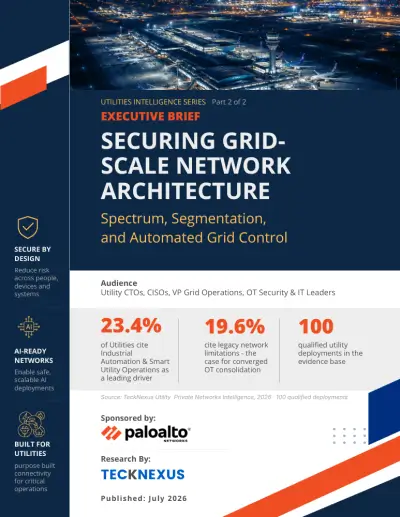
AI is moving from the data center to the substation — and the attack surface is expanding with it. Anterix, GE Vernova, and Palo Alto Networks lay out why private mobile networks are the only communications foundation that keeps pace with both the opportunity and the threat.
T-Mobile and Ericsson are delivering measurable AI-native RAN results at commercial scale on a live 5G Advanced network. Ericsson's AI-native Scheduler with Link Adaptation replaces rule-based logic with a neural network that predicts RF conditions in real time, achieving close to 10 percent spectral efficiency improvement and up to 15 percent downlink throughput gains. Separately, Ericsson validated its Cloud RAN software running on NVIDIA AI infrastructure, enabling hardware-agnostic deployment. Together, these advances signal that AI-native networking is no longer theoretical — it is executing at national scale.

Your Brand. Our Intelligence Tools.

Capture leads at the point of evaluation. Talk to Us →

Sponsored by Palo Alto Networks
⚡ Utilities ⏱ 8 min ✓ Free
This tool is built and hosted by TeckNexus.
Launch Tool →
Whitepaper
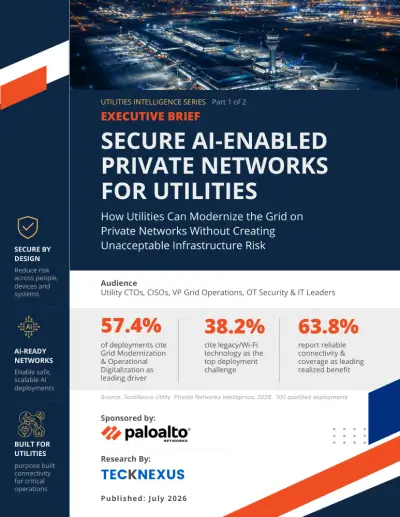
This whitepaper explains how utilities can use secure AI-enabled private mobile networks to modernize operations, support distributed intelligence, improve resilience, and strengthen cybersecurity across critical infrastructure. It covers AI applications, private network advantages, zero trust principles, multilayered security architecture, and governance considerations for AI-ready utility environments....
Whitepaper
Non-terrestrial networks are rapidly evolving from experimental satellite systems into an increasingly important part of the global 5G connectivity landscape. This eBook, developed by Radisys in collaboration with TeckNexus, explores how 3GPP standardization, satellite architecture innovation, and software-driven network design are reshaping NTN deployment models. It examines the transition from...
Whitepaper
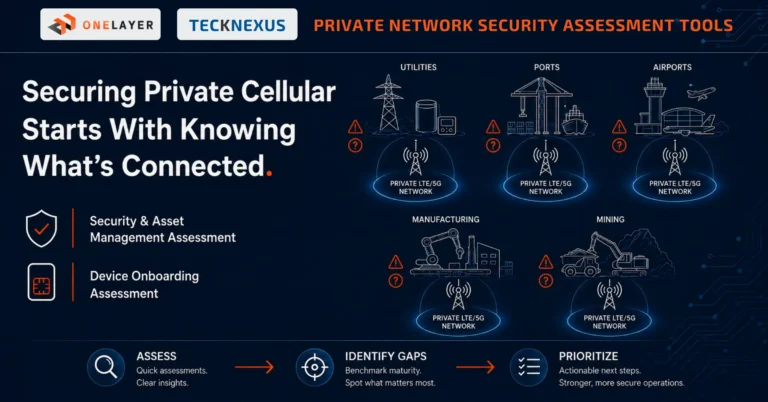
Private cellular networks are transforming industrial operations, but securing private 5G, LTE, and CBRS infrastructure requires more than legacy IT/OT tools. This whitepaper by TeckNexus and sponsored by OneLayer outlines a 4-pillar framework to protect critical systems, offering clear guidance for evaluating security vendors, deploying zero trust, and integrating IT,...
Scroll to Top

Map your security gaps to real threat scenarios – including Salt Typhoon, Volt Typhoon, AI data poisoning, rogue devices, and unencrypted OT traffic.

Take the free 8-minute assessment built for utility operators evaluating AI-enabled private mobile networks. Get a readiness score across five critical domains, see where your gaps are, and receive a prioritized action plan for what to fix first.

Free • 8 minutes • Built for private network security