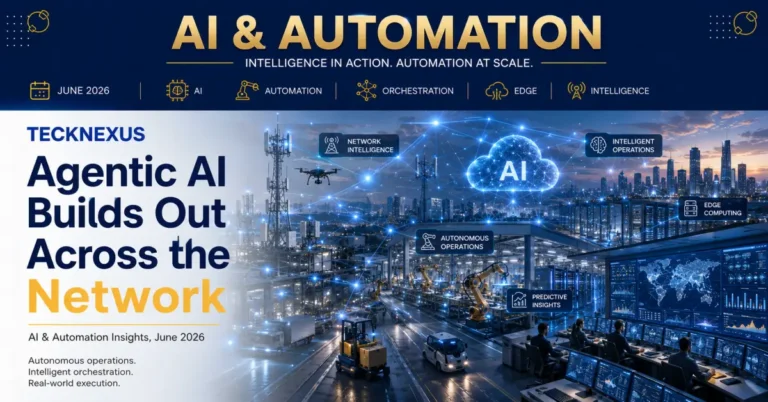
June’s telecom AI story was about scale: industry-wide momentum toward shared agentic AI frameworks, AI moving deeper into the RAN through field trials from Nokia, Amdocs and KDDI, and fresh capital flowing into AI infrastructure across Latin America, India, Korea and the US. Operators kept shipping AI into live operations, partnerships broadened across the ecosystem, and governance and security investment grew alongside the capability. This roundup covers the full month — every deployment, partnership, funding round, and governance move — organised for buyers building an AI and automation roadmap.

The signal this month: agentic AI kept moving from demonstration toward durable infrastructure, and the ecosystem around it broadened rather than consolidated around any single approach. Multiple industry bodies advanced shared frameworks for how AI agents should operate, be governed, and interoperate across vendors — useful groundwork for buyers and vendors alike, since common reference points reduce integration risk on all sides. AI also pushed further into the network itself, with several vendors validating AI-RAN approaches in the field rather than only in the lab. Capital kept moving in parallel, with fresh billions committed to AI data centers and compute, and operators across regions kept putting AI to work in orchestration, customer experience, and vertical-specific deployments. Partnerships broadened across silicon, cloud, systems-integration and operator ecosystems, and governance and security investment scaled alongside the new capability. For buyers, the takeaway: agentic AI is becoming real, well-governed infrastructure — which makes this a good moment to prioritise where it pays off first, and to plan the network it will run on.
At a glance — June 2026
- Industry bodies advanced shared frameworks for agentic AI: new model-operations, data-governance, and agent-security initiatives emerged from standards organizations working with members including Accenture, AT&T, Databricks, Google, Huawei, Salesforce and Verizon.
- Nokia and Google Cloud embedded six Gemini-powered AI agents into Nokia’s Assurance Center, targeting 50–80% faster fault resolution while keeping human engineers in the approval loop.
- Verizon detailed its Level 4 network autonomy architecture: 70 million automated changes in 2025 and roughly 33,000 engineers turned into software developers using Claude Code.
- An open, community-backed foundation for telecom AI agents launched with support from China Mobile, Orange and ZTE, adding an open-source path alongside vendor and standards-body efforts.
- Nvidia introduced a secure agent runtime and long-running agent blueprints at DTW Ignite 2026, with partner demonstrations from SoftBank, Amdocs and NTT DATA.
- Nokia and Nvidia announced a collaboration on an AI–RAN platform aimed at 6G, integrating Nvidia AI processors into Nokia‘s 5G radio equipment; Amdocs field-validated a separate multivendor AI-RAN blueprint with Supermicro and Fujitsu‘s 1Finity.
- KDDI launched a RAN Digital Twin collaboration with Nvidia, Keysight and Samsung Research America; South Korea’s ETRI committed roughly KRW 47 billion through 2030 to a national AI-RAN research program.
- AWS committed a further US$13 billion to India through 2030 (total India commitment: US$48 billion), and NTT, SK Group and Chunghwa Telecom launched a US$500 million IOWN AI Fund.
- Groq raised US$650 million to expand into AI inference data centers, and SpaceX signed a multi-year, roughly US$150-million-a-month compute deal with Reflection AI at its Colossus 2 facility.
- GSMA‘s Mobile Economy Africa 2026 report highlighted African operators moving AI from strategy to deployment, including Airtel Uganda’s spam-detection rollout and MTN‘s US$45 million AI-native RAN investment.
- Telefónica Deutschland, T-Mobile, TPG Telecom and Bouygues Telecom all advanced named, in-production AI systems spanning orchestration, network optimization, NPS and broadband quality of experience.
- Governance and security investment scaled alongside capability, from EU cybersecurity frameworks (CRA, NIS-2, RED) to new operator AI governance blueprints and AI/ML security platforms.
1. Momentum builds for shared agentic AI frameworks
Several industry efforts advanced in parallel this month, each addressing a different piece of the same question: how should multiple vendors let AI agents operate safely and interoperably across live telecom environments. Standards work progressed on model operations, data governance, and agent-security guardrails, developed with a broad member base spanning cloud providers, systems integrators, and operators. An open-source foundation for telecom AI agents also launched, backed by several major operators and vendors, adding a community-driven path alongside the standards work.
Nvidia contributed a runtime layer for policy-governed agent access and long-running agents, demonstrated by SoftBank, Amdocs and NTT DATA, while ServiceNow and Microsoft both pointed to a further shift ahead in how agentic AI could reshape telecom business models and enterprise workflows, not just network operations.
Nokia and Google Cloud gave the governance conversation a concrete implementation: six Gemini-powered AI agents embedded in Nokia’s Assurance Center target 50–80% faster network fault resolution, built around what Nokia calls ‘glass box autonomy’ — AI handles analysis and recommendation, but human engineers retain approval authority over any action that touches the network. It’s a deliberate design choice, and Nokia argues explainability at the point of approval is why this generation of automation will stick where earlier, more opaque approaches stalled.
Why it matters for buyers: more shared reference points for agentic AI benefit the whole ecosystem — they give vendors a common language to build toward and give buyers an easier basis for comparison, reducing bespoke integration work over time. → Prioritise and compare AI initiatives with the TeckNexus AI Prioritiser.
2. AI-RAN moves from roadmap to field trials
AI-RAN saw genuine field progress this month alongside continued research investment. Nokia and Nvidia announced a collaboration on an AI-RAN platform aimed at 6G, integrating Nvidia AI processors into Nokia’s 5G radio and access equipment, with early use-case work already under way with operator partners. Amdocs, working with Supermicro and Fujitsu‘s 1Finity, field-validated a separate multivendor AI-RAN blueprint combining Open vRAN software, Nvidia GH200 compute and Red Hat OpenShift orchestration, then packaged the result as a reusable workflow in its aOS platform.
KDDI and KDDI Research launched a RAN Digital Twin collaboration with Nvidia, Keysight and Samsung Research America to validate AI models against realistic network conditions ahead of live deployment, targeting a prototype by 2028. South Korea’s ETRI committed roughly KRW 47 billion through 2030 to a national AI-RAN research program, and Marvell and Samsung both continued aligning their RAN platforms toward interoperability with leading AI compute providers. This builds on earlier multi-vendor AI-RAN groundwork, including Qualcomm and Nokia Bell Labs’ AI-driven channel-state-feedback interoperability work.
Why it matters for buyers: AI-RAN approaches now span a real maturity range, from field-validated blueprints available today to multi-year research programs — useful context for sequencing engagement and setting realistic timelines with any given partner. → Map AI-RAN and architecture options against your deployment horizon with TeckNexus Network Planning tools. Related reading: Qualcomm & Nokia Bell Labs Unveil AI-Powered Wireless Network Interoperability.
3. Capital keeps flowing into AI infrastructure
The buildout underneath all of this kept accelerating across regions. Telconet plans three new Latin American data centers by 2026 and a Quito AI-only facility scaling from 10MW to 100MW by 2028, backed by a US$550 million capex plan tied to two new submarine cable systems. AWS added a further US$13 billion commitment to India through 2030 — taking its total India investment to US$48 billion — with more than US$21 billion earmarked specifically for AI and cloud. NTT, SK Group and Chunghwa Telecom jointly committed US$500 million to an IOWN AI Fund built around photonics-based data transport for AI workloads, AirTrunk laid out plans for up to 5GW of AI-ready capacity in India, and Groq raised US$650 million to expand into operating AI inference data centers, building on a licensing agreement with Nvidia.
SpaceX also signed a large multi-year compute deal with Reflection AI for Nvidia GB300 capacity at its Colossus 2 facility in Memphis, running through 2029 — one of several deal wins this month alongside Orange Business’s long-term GenAI deployment for a French hospital group. On the silicon side, Qualcomm’s move into rack-scale AI inference accelerators is a related infrastructure signal worth tracking as the compute layer diversifies beyond GPUs. A dependency that rarely appears in this planning surfaced in a Fiber Broadband Association and RVA white paper analysed by TeckNexus this month: the AI data centre build-out needs roughly 2x the fibre route miles and 2.3x the fibre miles by 2029 — a fibre interconnection gap that sits upstream of every AI data center commitment above.
Why it matters for buyers: AI compute is becoming a distinct infrastructure category with its own capex cycle, power requirements and site-selection logic. If your roadmap depends on edge or regional AI capacity, factor power and site readiness into planning early. → Model deployment and capacity options with TeckNexus Network Planning tools and the ROI/TCO tools Related reading: Qualcomm AI200/AI250 AI Chips for Data Center Inference.
4. Operators put AI to work in operations and customer experience
Away from the standards and infrastructure headlines, operators kept shipping named, in-production AI systems. Telefónica Deutschland is building an in-house ‘Jarvis’ platform to orchestrate network, application and operational workflows across a multi-cloud estate, while a German operator’s Multi-Domain Service Orchestration rollout points to further agentic-AI-driven orchestration upgrades ahead across the industry.
T-Mobile introduced Dynamic CX AI Network Optimization to tune network performance around customer experience, TPG Telecom is applying AI to lift Net Promoter Score, and Bouygues Telecom expanded AI-based analytics for broadband quality of experience in France.
Orange Business secured a long-term deployment of its Live Intelligence generative AI platform for a French public hospital group covering roughly 15,000 health professionals — a sovereign-AI use case beyond the network itself. GSMA‘s Mobile Economy Africa 2026 report showed the same shift happening regionally, citing Airtel Uganda’s SMS spam-detection rollout and MTN‘s US$45 million investment in AI-native RAN development suited to multi-vendor, power-constrained environments.
Why it matters for buyers: operational AI now spans orchestration, network optimization, customer experience, and vertical-specific sovereign deployments across every region — good evidence for building your own prioritised roadmap rather than waiting for a single flagship use case to prove out. → Identify where AI pays off first in your own operations with the TeckNexus AI Prioritiser.
5. Partnerships broaden across silicon, cloud and systems integration
The partnership layer widened considerably this month. HP is rolling out AI agents across its internal operations alongside adopters including BBVA, Cisco and T-Mobile. Tech Mahindra and Telefónica combined platform engineering with AI-first operations across Telefónica’s footprint.
Singtel partnered with Digital Industry Singapore on a multi-year AI transformation program, TIM partnered with Google on discounted Gemini-branded AI plans with carrier billing in Italy, and Schneider Electric joined an AI data center program to expand compute capacity and industrial infrastructure. On the silicon side, Marvell is enhancing its OCTEON base station platform to interoperate directly with Nvidia GPUs for AI-RAN, extending the same multi-vendor interoperability logic behind the Nokia-Nvidia and KDDI collaborations covered above.
Mavenir and Red Hat took a different angle on partnership value, launching an Integrated AI Platform that lets operators meter, bill and govern AI token consumption through existing BSS infrastructure — opening a third procurement path for enterprise buyers, bundled with connectivity rather than built or bought separately.
Why it matters for buyers: the breadth of this month’s partnerships — spanning silicon, cloud, systems integration and operator transformation programs — means AI procurement increasingly touches multiple layers of the stack at once. → Structure vendor and partner evaluation with the TeckNexus RFP Scorecard Generator and compare architecture options with Network Planning tools.
6. AI’s efficiency dividend becomes part of the ROI story
Alongside new capability, June brought clearer evidence that AI is beginning to show measurable operating leverage for large operators and technology vendors, with efficiency gains flowing through to cost structure as well as customer-facing capability. Several large operators and vendors linked workforce and organizational changes in part to AI-driven efficiency as they continue to scale AI infrastructure investment. Separately, commentary on wide-area network capacity offered a useful data point for planners: current capacity appears sufficient to absorb growing AI and agentic AI traffic, suggesting near-term congestion concerns from AI workloads are, for now, overstated.
The workforce side of that efficiency story has a perception dimension too: a June 2026 Reuters/Ipsos poll found 53% of Americans fear AI will cost someone in their household a job, and TeckNexus’s analysis of Recon Analytics data across 137,000+ survey responses found that fear is universal and doesn’t decrease with AI exposure — what changes with exposure is hope, and it’s hardening fastest among non-users. For enterprises, that reframes AI adoption as a change-management problem as much as a technology one.
Why it matters for buyers: as AI programs mature, build the business case around the full return — efficiency and opex benefits alongside new capability and revenue upside — so the investment case reflects where value is actually landing. → Quantify the full picture with the ROI/TCO tools.
7. Governance and security investment grows alongside capability
Governance and security kept pace with capability from several directions. In the EU, the Cyber Resilience Act, NIS-2 and the Radio Equipment Directive are making cybersecurity a mandatory part of the industrial product and operations lifecycle, with analysis noting that automated attacks on European industry and critical infrastructure now carry a substantial annual cost. A major operator outlined a global AI governance blueprint centered on agentic AI and a trust framework, and a technology vendor deployed a dedicated platform to protect the data and models behind operator AI/ML systems.
Neon Cyber introduced AI-native browser security to help govern workforce use of generative AI and SaaS, and Milestone Systems outlined how synthetic data can help scale AI-driven video analytics under emerging regulatory frameworks in Australia. Standards work on agent-interaction security (see Section 1) is the industry-wide counterpart to these vendor and operator investments. A separate disclosure this month, involving unauthorized large-scale access to a frontier AI model’s agentic-reasoning and coding capabilities, underscored why access control and monitoring are becoming a standard part of responsible AI deployment across the industry.
Why it matters for buyers: governance frameworks and security platforms are maturing in step with agentic AI capability — a healthy sign for an ecosystem scaling this quickly. Treating agent access control and vendor security posture as a normal part of procurement, alongside cost and performance, will help buyers keep pace. → Structure vendor and security scoring with the TeckNexus RFP Scorecard Generator.
8. Regulation, policy, and market signals
Google Cloud and the Philippines’ Department of Information and Communications Technology expanded a multi-year collaboration to embed enterprise AI into public services and strengthen nationwide cybersecurity, aligned with the Philippine Development Plan.
In funding and market-structure news, SK Telecom became the first Asian private company to secure Horizon Europe research funding, targeting next-generation quantum cryptography, while Jio outlined plans for a constellation of more than 1,600 low-earth-orbit satellites within two to three years in partnership with Elon Musk’s firm — a reminder that AI infrastructure and connectivity strategy are increasingly discussed in the same breath. Developer-tooling adoption also featured: Cursor continued to draw developer adoption with its AI-powered coding environment, mentioned alongside OpenAI and Anthropic in the current wave of AI developer tools, and Orange signaled a continued strategic focus on AI, trusted cloud and cybersecurity alongside its global wholesale infrastructure footprint.
Export-control geopolitics also surfaced directly this month: access to Anthropic’s Mythos model was blocked for EU users as AI export-control tensions escalated, with the White House controlling access beyond US borders and the European Commission required to seek US permission before any access is granted — exposing fault lines in how allied governments coordinate on AI safety and access.
Why it matters for buyers: policy, funding and market-structure signals increasingly shape the AI infrastructure buyers will have access to — worth tracking alongside the more visible product and partnership news. → Explore the broader intelligence set at the TeckNexus Intelligence Platform.
9. Thought leadership: toward the autonomous telco
Beyond individual deployments, June’s thought leadership converged on a common destination: the autonomous telco. Oracle outlined an autonomous telco operating model that extends TM Forum‘s autonomous-networks principles beyond the network into business and customer domains, emphasizing AI-driven, intent-based, closed-loop decisioning across OSS, BSS and IT to reduce manual coordination and improve agility. Industry commentary elsewhere pointed to agentic and generative AI developer tools and techniques increasingly underpinning telco-led AI infrastructure and operations more broadly — a sign that the operating-model conversation and the standards conversation from Section 1 are converging.
Verizon supplied the most concrete evidence yet that this operating model is already running at scale: CTO Yago Tenorio detailed the carrier’s Level 4 network autonomy architecture — 70 million automated changes in 2025, roughly 33,000 engineers turned into software developers using Claude Code, and a new common data layer capturing what the network previously couldn’t see. The instructive point for enterprise buyers is the build sequence Verizon followed, not just the destination: autonomy was built on a developer culture shift before it was built on agents.
T-Mobile CTO John Saw’s ‘kinetic token’ framework extends the same trajectory into Physical AI — robots, autonomous vehicles, industrial automation — describing data constructs that don’t just represent information but trigger real-world action, and arguing that networks built for kinetic tokens require deterministic performance and ultra-low latency that most current architectures don’t yet deliver.
TeckNexus’s analysis of the framework argues the public telco debate that followed missed the most immediate implication: industrial private 5G networks are already, structurally, kinetic token infrastructure. Together, Oracle’s operating model, Verizon’s build sequence, and T-Mobile’s kinetic token framing are converging on the same conclusion from three different angles — a sign that the operating-model conversation and the standards conversation from Section 1 are the same conversation.
Why it matters for buyers: the autonomous-telco framing gives buyers a useful lens for sequencing AI investment — network automation, business-process automation and customer-facing automation are increasingly part of one connected roadmap rather than three separate initiatives. → Build that roadmap with the TeckNexus AI Prioritiser.
Every June item, with full source detail, is on the curated AI & Automation Monthly Insights page →
10. TeckNexus analysis: prioritising AI by vertical
Alongside the news cycle, TeckNexus published a run of vertical-specific prioritisation frameworks this month, reflecting the same pattern across four industries: every major vendor now offers AI for the sector, and the hard part is no longer finding options but sequencing them.
The Airport AI Prioritiser addresses a distinctly multi-stakeholder environment — airside operations, terminal management and passenger experience each have different value drivers and different budget owners, and the tool generates a ranked action plan by stakeholder role.
The AI Use Case Prioritiser for Mining spans a wide maturity spectrum, from proven autonomous haulage systems to emerging ore-body modelling, and scores options against what is both valuable and achievable for a specific operation.
The AI Use Case Prioritiser for Ports tackles a data-rich but underused environment, scoring candidate applications by operational impact, data readiness and implementation feasibility.
And a companion Ports ROI Calculator quantifies crane automation, yard AGV, smart gate and connectivity benefits in a five-year model built for board-level review. Together with the previously covered AI Use Case Prioritiser for Manufacturing, TeckNexus now has ranked, vertical-specific prioritisation frameworks live across four industries.
Why it matters for buyers: generic AI prioritisation frameworks miss the sector-specific dimensions that actually determine sequencing — stakeholder structure at airports, safety governance in mining, data maturity at ports. → Use the vertical-specific AI Prioritiser tools for your industry, and quantify the payoff with the ROI/TCO tools.
Every June item, with full source detail, is on the curated AI & Automation Monthly Insights page →
What this means if you’re evaluating AI and automation investments
June’s throughline is that agentic AI is scaling as real, well-governed infrastructure, with a broadening ecosystem rather than a single winning approach. Six moves follow directly from the month:
- Watch the emerging shared frameworks for agentic AI — they benefit vendors and buyers alike by reducing bespoke integration work over time, and are worth factoring into how you compare agent-based offerings.
- Sequence AI-RAN engagement by maturity — field-validated blueprints and multi-year research programs both have a place, but call for different timelines and different commercial conversations.
- Factor power and site readiness into AI infrastructure planning early — AI compute is becoming a distinct capex and site-selection category of its own.
- Map your own AI roadmap across orchestration, network optimization, customer experience and vertical use cases, rather than waiting for a single flagship deployment to prove the model.
- Build AI business cases around the full return, including efficiency and opex benefits alongside new capability, so the investment case reflects where value is actually landing.
- Treat agent access control and vendor security posture as a normal part of procurement — governance and security investment are scaling alongside capability, and buyers benefit from asking about both.
New to this series? Read our companion roundup: Private Network Insights, June 2026 →
→ Start with the TeckNexus Intelligence Platform — independent, buyer-neutral tools for AI, ROI, network planning, and RFP decisions, useful to enterprises, vendors and the broader ecosystem alike.
This analysis is drawn from TeckNexus’s full curated AI & Automation Monthly Insights for June 2026. [See every deployment, product, and partnership update here →]. The TeckNexus Intelligence Platform is buyer-neutral and TeckNexus-authored. Vendor co-branded Intelligence Packs are labelled as such and kept separate from the neutral core tools.
| RELATED TOOL
Which AI use case should you prioritise — and how do you plan the network around it? With agentic AI scaling across the ecosystem, the decisive questions are prioritization and planning. TeckNexus’s AI Prioritiser tools rank candidate AI applications by impact, feasibility, data readiness and payback — so investment starts with the strongest candidates. TeckNexus’s Network Planning tools help map the architecture, spectrum and capacity decisions that AI-driven workloads depend on. Both are part of the broader TeckNexus Intelligence Platform, independent and useful to enterprises and the vendor ecosystem alike. Explore the AI Prioritiser → tecknexus.com/tool_category/ai_prioriser/ Explore Network Planning tools → tecknexus.com/tool_category/network-planning/ Explore the full Intelligence Platform → tecknexus.com/intelligence/ |