Intelligence Journeys
AI Use Cases for Utilities
Private Broadband for Utilities

Singtel

July 2026's roundup: Hughes Network Systems nears bankruptcy as SpaceX files to launch 100,000 satellites, Nokia's AI-RAN commercial deployments trail Ericsson's 15+ by a full order of magnitude, the FCC finalizes a $6.3B C-band incentive package and closes AT&T's $23B EchoStar spectrum deal, and fiber capital and industrial 5G both keep expanding globally.
June 2026 showed agentic AI scaling from pilot to platform: industry-wide standards momentum, AI-RAN field trials from Nokia, Amdocs and KDDI, and fresh capital across data centers on three continents. This full roundup covers every deployment, partnership, funding round and governance move from the month, with tools to prioritise AI use cases and plan the network around them.
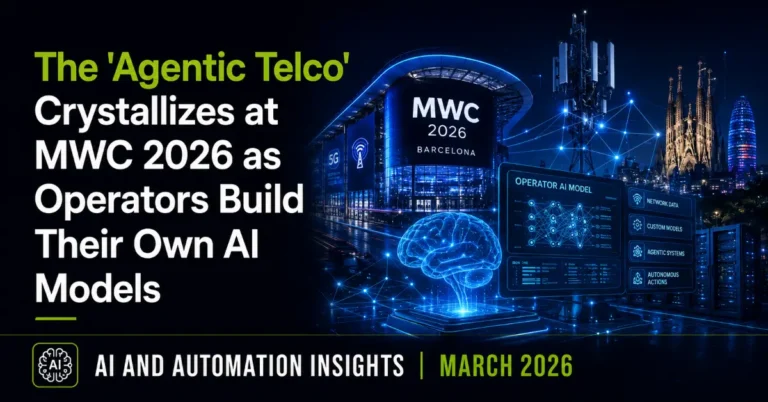
March 2026's roundup: GSMA, Google Cloud, Huawei, and AWS all converge on an "agentic telco" framing at MWC Barcelona, SoftBank and SK Telecom build proprietary telecom-specific AI models and infrastructure, and physical AI reaches airports, drones, and network edge sites — with AI-RAN and connectivity infrastructure covered separately in our companion Advanced Connectivity Insights, March 2026.
Live Streaming on Wed, 4 Mar at 12:00 - 13:00 CET
What does it take to truly challenge the status quo and redefine what is possible? In this keynote, we sit down with three visionary leaders who are harnessing deeply disruptive technologies to reshape industries and reimagine how we work, create, and play. From the future of sustainable connectivity in the AI era to the reinvention of professional services and the rise of new forms of digital companionship and entertainment, this session explores how bold ideas become real-world systems. Join us to hear their stories, their lessons, and their visions for a future transformed by imagination, scale, and ambition.

A new collaboration between GSMA Foundry and Singapore’s National University Health System (NUHS) aims to operationalize connected health at scale, with Ericsson and Singtel anchoring the 5G foundation. Healthcare digitization has moved from pilots to production, but most sites still struggle with deterministic connectivity, secure data exchange and workflow integration. The program combines private 5G with digital twin, XR, IoT and ambient AI to improve outcomes and operational resilience across care pathways. Early focus areas include 5G-enabled remote surgical assistance with ultra-reliable, low-latency links; immersive XR training and simulation that compress learning curves; autonomous and semi-autonomous robotics for logistics and point-of-care tasks; and AI-guided imaging such as vein visualization.
Singapore has confirmed an attempted cyber‑espionage campaign against its national telecom backbone, highlighting a rising class of APT activity aimed at network devices and virtualized cores rather than traditional IT endpoints. Singapore’s Cyber Security Agency (CSA) and Infocomm Media Development Authority (IMDA) disclosed that all four major operators—Singtel, StarHub, M1 and Simba Telecom—were targeted by UNC3886 in incidents last year. The threat actor gained limited access to segments of telco systems and exfiltrated a small volume of network‑related technical data. There was no service disruption, no personal data exposure and, critically, sensitive and segregated systems (including 5G networks) were not compromised.
Ericsson’s latest Mobility Report points to a clear shift: operators are turning 5G capabilities into differentiated, SLA-backed services rather than just selling more data at higher speeds. After years of building coverage and capacity, 5G networks are mature enough to commercialize features like guaranteed latency, uplink boosts, and application-aware prioritization. The catalysts are in place: more 5G Standalone (SA) cores, rising traffic from video creation and immersive apps, and enterprise demand for predictable performance across sites and clouds. The net result is momentum behind premium, differentiated connectivity that can be priced, assured, and exposed to partners.
Reports indicate SK Group will reduce executive ranks by up to 30%, a move that would reshape decision-making across affiliates including SK Telecom (SKT). For SKT, which sits at the nexus of the group’s AI, cloud, and connectivity ambitions, executive trims would concentrate authority and compress approval chains at a sensitive time for 5G monetization and AI platform bets. Executive consolidation at a Tier-1 operator tends to reset priorities, procurement rhythms, and partner engagement models.
Singtel has sold another slice of its Bharti Airtel holding, freeing up capital to fund growth while continuing to rebalance a long-standing strategic investment. Singapore-based Singtel monetised roughly 0.8% of Airtel for about S$1.5 billion (approximately US$1.2 billion), recording an estimated net gain of S$1.1 billion. The sale is part of a multi-year capital management programme launched in 2021. Management has framed the initiative as a way to strengthen the balance sheet and redeploy capital into higher-growth digital infrastructure and digital services, while progressively equalising its Airtel ownership with Bharti Enterprises over time.
Australia is moving quickly to shore up the 000 emergency call service ahead of the bushfire season by hauling telco chiefs to Canberra and fast‑tracking reforms. The Australian Communications and Media Authority (ACMA) has opened a compliance investigation, and Optus has appointed Kerry Schott to lead an independent technical review into the failures. The reforms build on proposals flagged after the nationwide Optus outage in November 2023 and signal a shift from after‑the‑fact reporting to proactive assurance for a service that must be available under extreme conditions.

Partner Hubs

Download content, access intelligence tools, and hear from executives.

Partner Events

  • M360 ASEAN
  • FutureNet Asia 2026
  • Network X Vienna 2026
Scroll to Top