
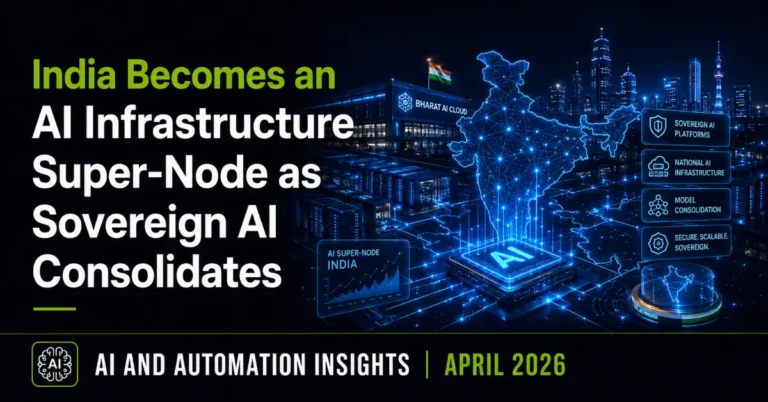
April 2026’s roundup: India draws a wave of multi-billion-dollar AI infrastructure commitments led by Reliance and Google, sovereign AI consolidates as Cohere moves to acquire Aleph Alpha, AI-RAN names its first anchor customer, and physical AI pushes from pilot toward production.

At a glance – AI & Automation Insights for April 2026
- Jio Platforms and Reliance Industries committed ₹10 lakh crore (~$120B) to AI over seven years, including multi-gigawatt data centers starting with a 120MW Jamnagar facility by end-2026.
- Google, Bharti Airtel, and Adani advanced a $15B AI Hub in Vizag, India, targeting roughly 1GW of AI-ready data center capacity, with Airtel‘s Nxtra supplying power and infrastructure.
- Cohere announced plans to acquire Germany’s Aleph Alpha, backed by Schwarz Group, to build a transatlantic, enterprise-focused sovereign AI supplier valued at roughly $20B — one of several sovereign AI moves this month.
- Nokia‘s $1B Nvidia partnership named T-Mobile as its anchor AI-RAN customer, while a Nvidia survey found 89% of telecom executives plan to increase AI budgets.
- Physical AI and humanoid robots moved from pilot to production: Siemens and Nvidia advanced factory-scale rollouts on private 5G (including Nokia), Vodafone tested humanoid warehouse robots with Accenture and SAP, and Tesla finalized its AI5 chip design for Optimus.
- Amazon committed up to $25B more to Anthropic (on top of a prior $8B), with Anthropic committing to spend over $100B on AWS over the next decade — even as OpenAI reportedly missed revenue and user-growth targets ahead of a potential IPO.
1. India becomes an AI infrastructure super-node
Two separate multi-billion-dollar commitments landed in India within the same month:
- Jio Platforms & Reliance Industries: committed ₹10 lakh crore (roughly $120B) to AI over seven years, with plans for multi-gigawatt-scale data centers — the first a 120MW facility in Jamnagar by end-2026 — an edge compute layer integrated with Jio’s network, and use of up to 10GW of green power. The Jio Intelligence platform will focus on multilingual AI with security, data residency, and trust guarantees, alongside a partnership with OpenAI enabling ChatGPT-powered voice discovery on JioHotstar.
- Google, Bharti Airtel & Adani: advanced a $15B AI Hub in Visakhapatnam, with Airtel contributing data centers, green power, pan-India low-latency fiber, and a next-generation cable landing station; the AI-ready facility is planned at roughly 1GW capacity across about 600 acres. Airtel’s Nxtra business is separately supplying power and infrastructure capacity to the project.
- Reliance Enterprise Intelligence Limited (REIL): the Reliance-Meta joint venture appointed Parminder Singh as founding CEO to drive enterprise AI deployment in India, combining Meta‘s AI capabilities with Reliance’s compute infrastructure and Jio’s national connectivity footprint.
- AWS & SHI India: are scaling AI model development in India under the IndiaAI Mission, focused on foundation models and generative AI for public-sector use.
- Nokia: India-specific MBiT 2026 data shows rapid 5G growth (31GB/user/month in 2025; 70% year-over-year growth in 5G traffic to 12.9EB), with AI-shaped demand pushing operators toward programmable, software-led network architectures rather than hardware-led capacity additions.
Why it matters for buyers: India moved from a growth market to a genuine AI infrastructure hub in a single month, with two separate multi-billion-dollar commitments alongside government-backed model development work. For buyers and vendors evaluating APAC AI strategy, India’s scale of committed capacity and its emphasis on data residency and multilingual AI make it a market to plan around directly, not extrapolate to from elsewhere. → Explore deployment and capacity planning with TeckNexus Network Planning tools and ROI/TCO tools.
2. Sovereign AI accelerates and starts consolidating
Sovereign AI moved past the announcement phase this month — one deal turned into outright consolidation:
- Cohere & Aleph Alpha: Cohere announced plans to acquire Germany-based Aleph Alpha, backed by Schwarz Group, to build a transatlantic, enterprise-focused sovereign AI supplier; the Financial Times pegs the combined valuation at roughly $20B, with approvals from involved governments part of the process.
- SK Telecom, Arm & Rebellions: launched a sovereign AI inference platform alliance, with SK Telecom validating a new AI server combining Arm’s first data-center processor (AGI CPU, based on Neoverse CSS V3) for telecom-grade, sovereign AI data centers.
- BT & Nscale: partnering to develop in-country sovereign AI capability in the UK using Nvidia technology.
- Singtel & Mistral AI: Singtel‘s Digital InfraCo will pair its RE:AI sovereign infrastructure with Mistral’s open-source LLM stack to deliver GPU-backed AI-as-a-Service for regulated sectors — finance, defense, shared government services, and healthcare.
- Bell Canada & Celestica: co-developing a sovereign AI infrastructure model for Canada targeting sensitive government and regulated-sector data, combining Bell’s AI Fabric with Celestica’s hardware and supply chain capabilities.
- Microsoft & Armada: bringing sovereign edge AI to Industry 4.0 private networks via Azure Local and Armada’s Galleon edge infrastructure for remote industrial sites.
Why it matters for buyers: sovereign AI started consolidating this month, with Cohere absorbing a competitor rather than partnering with one. For buyers, that’s an early signal of which sovereign AI suppliers are likely to still be independent in 12 months, and it’s worth factoring into any sovereign AI vendor selection now. → Find deployment patterns for your sector and region in TeckNexus Vertical Intelligence.
3. AI-RAN gets named anchor customers as Nvidia’s stake deepens
AI-RAN moved from partnership announcements toward named commercial relationships:
- Nokia & Nvidia: Nokia’s $1B Nvidia strategic partnership named T-Mobile as its anchor AI-RAN customer, with Nokia stating AI-generated traffic will come to dominate network traffic.
- Nokia: Q1 results showed early traction for its NVIDIA-supported “anyRAN” initiative, enhancing virtualized and open RAN performance.
- Orange, Nokia & Nvidia: formed a collaboration applying AI to radio access networks, prompting investor reassessment of Orange‘s valuation.
- SoftBank, Nokia & Ericsson: SoftBank outlined a Telco AI Cloud vision, demonstrated interworking between its AITRAS Orchestrator and Ericsson systems, and is working with Nokia to run external AI workloads on Nokia’s AI-RAN.
- Ericsson & SoftBank: collaborated to improve 5G uplink performance in Japan to better handle AI-driven data demand.
- Nokia & Blaize: extended AI-RAN infrastructure work in Asia-Pacific with new Doksuri radios, building toward a three-way pact with Blaize and Datacomm to deploy hybrid AI inference infrastructure across Indonesia and the wider region.
- Nvidia: a survey found 89% of telecom executives plan to increase AI budgets this year, underscoring demand for AI-ready network assurance.
Why it matters for buyers: naming T-Mobile as an anchor customer turns Nokia’s AI-RAN partnership with Nvidia from a technology roadmap into a live commercial relationship — a meaningfully different signal than the partnership announcements and lab demonstrations that have dominated AI-RAN coverage. → Map AI-RAN and architecture options against your deployment horizon with TeckNexus Network Planning tools.
4. Physical AI and humanoid robots move from pilot to production
Physical AI stopped being a research topic this month:
- Fujitsu & Carnegie Mellon University: launched the Fujitsu-Carnegie Mellon Physical AI Research Center to develop scalable technologies for real-world AI and robotics across manufacturing, logistics, construction, infrastructure, and healthcare.
- Vodafone, Accenture & SAP: piloted humanoid warehouse robots to assess how physical AI can improve safety, operational efficiency, and workforce models, with results presented at Hannover Messe 2026.
- Siemens & Nvidia: humanoid robots and physical AI are moving from pilot to production in Industry 4.0 settings, with private 5G providers including Nokia supporting factory-scale rollouts.
- Tesla: completed its AI5 chip design and is targeting a rapid production ramp, with scaling tied in part to accelerating deployment of its Optimus humanoid robot.
- Nokia: articulated a “Physical AI” thesis for the RAN — applying AI/ML near the radio and physical layer to improve performance and open new monetization models, attributed to Bell Labs leadership.
- SK Telecom: deployed AI-enabled drones for base-station tower inspections up to 75 meters, replacing manual climbs, alongside VR/AR safety training and plans for AI-based risk assessment.
Why it matters for buyers: Tesla finalized silicon, Siemens and Nvidia moved to production-grade factory rollouts, and Vodafone ran a live warehouse pilot with results due at Hannover Messe — all in one month. The private-network dependency threading through most of these stories is the practical takeaway: physical AI’s real-world reliability requirements are private-network requirements. → Rank physical AI and robotics use cases with the TeckNexus AI Use Case Prioritiser.
5. Frontier AI capital keeps compounding — but cracks appear
Capital concentration among frontier labs intensified this month, but not uniformly:
- Amazon & Anthropic: Amazon will invest up to $25B in Anthropic (an initial $5B plus up to $20B tied to milestones), adding to a prior $8B; Anthropic commits to spend over $100B on AWS over the next decade to expand large-scale generative AI compute.
- Anthropic: launched Project Glasswing, a cybersecurity collaboration applying its Claude Mythos Preview model to cybersecurity, supported by Broadcom, Cisco, Apple, Google, JPMorganChase, Microsoft, Nvidia, Linux Foundation, Palo Alto Networks, and AWS; the model remains unavailable to the public.
- Anthropic: Claude overtook ChatGPT in South Korea’s paid generative AI subscription market, driven by enterprise adoption.
- OpenAI: reportedly missed internal revenue and user-growth targets, per the Wall Street Journal, with CFO Sarah Friar raising concerns about covering future compute agreements if the slowdown continues; management is tightening spending and the board is increasing scrutiny of compute deals ahead of a potential IPO.
- OpenAI & Microsoft: revised their long-term partnership to a flexible, multi-cloud framework — OpenAI can now offer its products across any cloud provider and has reportedly increased AWS use, while Microsoft remains the primary cloud partner.
- China’s NDRC: instructed Meta to cancel its $2B acquisition of agentic AI firm Manus, citing foreign investment rules, after a multi-agency review.
Why it matters for buyers: the same month Amazon deepened its Anthropic commitment to as much as $25B, the market’s other frontier leader disclosed it’s missing growth targets and tightening compute spend ahead of a potential IPO — and a $2B acquisition got blocked outright on foreign-investment grounds. Capital concentration among frontier labs is intensifying, but it isn’t uniform, and geopolitics can void a deal regardless of capital committed. Buyers anchoring roadmaps to any single frontier lab should build in contingency. → Score vendor stability with the TeckNexus AI Use Case Prioritiser.
6. Agentic AI reaches deterministic, safety-critical functions — and so do the risks
Agentic AI moved into functions where being wrong carries direct financial or security consequences:
- Circles & OpenAI: reached what they describe as a major milestone in building the world’s first AI-native telco stack, with flagship products CareX and Xplore IQ reporting 85% autonomous query resolution and a 22% ARPU uplift in Singapore deployments, built on a multi-agent architecture.
- Industry commentary: argued agentic AI can operate at the deterministic core of telecom revenue management, while probabilistic AI cannot be relied on for certainty in billing — a distinction worth holding onto as agentic AI moves into financially sensitive functions.
- Siemens: introduced the Eigen Engineering Agent, an AI system that plans, executes, and validates industrial automation engineering tasks, moving beyond advisory roles into automating engineering steps directly.
- Netcracker: showcased real-world operator deployments using agentic AI to advance autonomous network and operations workflows at FutureNet World 2026.
- Vodafone: rolled out network-level AI Scam Call Protection within its Secure Net Mobile service, analyzing inbound calls in real time to flag suspected fraud before customers answer.
- VentureBeat (security research): a survey of 40 enterprises found 72% run two or more AI platforms designated as “primary,” widening attack surfaces and exposing control and governance gaps.
- Security research: attackers used prompt-injection against legitimate AI security tools at 90+ organizations in 2025 to steal credentials and cryptocurrency; those tools were read-only. New autonomous SOC agents now shipping can modify infrastructure directly, such as rewriting firewall rules — a materially higher-risk category that hasn’t yet seen large-scale exploitation but is already being deployed.
Why it matters for buyers: agentic AI moved into billing, industrial engineering, and now firewall configuration in the same month independent research found most enterprises already have fragmented AI governance and that write-capable security agents are shipping ahead of any documented large-scale attack on them. The gap between capability and control isn’t closing — if anything, it’s widening as the stakes rise. → Score vendor governance and security posture with the TeckNexus RFP Scorecard Generator.
Every April item, with full source detail, is on the curated AI & Automation Monthly Insights page →
What this means if you’re evaluating AI and automation investments
April’s throughline is capital and capability concentrating at the extremes — India and sovereign AI absorbing outsized infrastructure commitments, agentic AI reaching financially and physically consequential functions — while the vendor and security landscape underneath both remains unsettled. That unsettled quality has a workforce dimension too: Meta confirmed roughly 8,000 layoffs (about 10% of headcount) and cancelled 6,000 open roles citing AI cost pressures, and Verizon‘s CEO called for candid discussion of AI’s workforce impact following a previously announced plan to cut more than 13,000 roles — though that prior plan wasn’t explicitly attributed to AI. Six moves follow directly from the month:
- If you’re planning APAC capacity or partnerships, treat India as a primary market this month, not a secondary one — two multi-billion-dollar commitments landed in the same four weeks.
- Watch for further sovereign AI consolidation — Cohere’s move on Aleph Alpha may not be the last, and vendor independence is now a genuine selection criterion.
- Treat AI-RAN anchor-customer announcements (like T-Mobile’s) as a stronger signal than partnership or lab-trial news — ask any AI-RAN vendor which of their partnerships have named commercial anchors.
- If physical AI or robotics are on your roadmap, plan the private network first — nearly every physical AI story this month depended on one.
- Don’t anchor your AI roadmap to a single frontier lab’s trajectory — this month showed capital, growth, and even completed acquisitions can all move in different directions within weeks of each other.
- Before deploying write-capable AI security agents, confirm your governance can catch a compromised agent as fast as it could compromise your infrastructure — the tooling is shipping ahead of the incident data.
This is the earliest edition currently published in the AI & Automation Insights series — continue the story with our May 2026 roundup: Sovereign AI Goes Global as Anthropic’s Capital Reshapes the Ecosystem: AI & Automation Insights, May 2026 →
→ Start with the TeckNexus Intelligence Platform — independent, buyer-neutral tools for AI, ROI, network planning, and RFP decisions, useful to enterprises, vendors, and the broader ecosystem alike.
This analysis is drawn from TeckNexus’s full curated AI & Automation Monthly Insights for April 2026. See every deployment, product, and partnership update.