
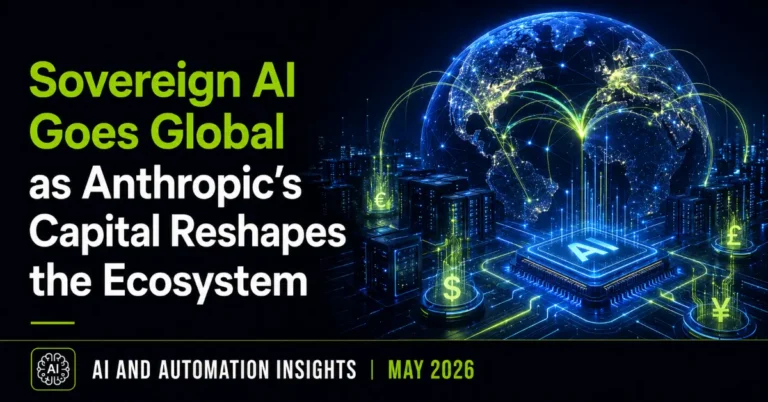
May 2026’s roundup: sovereign AI becomes a genuine global commercial category across nine countries, Anthropic‘s $65B raise reshapes enterprise AI partnerships, AI-RAN advances through Nvidia‘s direct investment in Nokia, and China’s telecom giants launch a consumer AI token economy.

At a glance – AI & Automation Insights for May 2026
- Anthropic closed a $65B funding round valuing the company at $965B, and separately signed a $1.8B, seven-year cloud compute deal with Akamai and a strategic partnership with Fujitsu to deploy Claude to roughly 100,000 employees.
- Sovereign AI became a genuine global category: South Korea applied its Sovereign AI Foundation Model Project to defense, SoftBank plans a sovereign AI data center cloud in Japan, and TELUS‘s Sovereign AI Factory sold out its compute capacity within months of launch.
- Nokia made a $1B equity partnership with Nvidia to embed GPU-powered AI into its 5G RAN, while AT&T and T-Mobile began testing Ericsson‘s AI-native RAN link and Samsung Networks reported its weakest quarter since 5G launched.
- China Telecom, China Mobile, and China Unicom all introduced token-based AI service plans, and Alibaba detailed a semiconductor roadmap through 2028 backed by a $53B infrastructure commitment.
- Eight major US carriers — AT&T, Verizon, T-Mobile, Comcast, Charter, Cox, Lumen, and Zayo — formed C2 ISAC to share cyber threat intelligence in real time as AI-accelerated attacks increase.
- Consumer-facing agentic AI proliferated across telecom: SK Telecom, KT, LG Uplus, Naver, and Kakao all advanced competing Korean-language AI agents, and ElevenLabs surpassed $500M in annual recurring revenue on operator adoption of AI voice agents.
1. Anthropic’s mega-round reshapes enterprise AI partnerships
Three Anthropic-anchored stories landed in a single month:
- Anthropic — funding: closed a $65B funding round, reportedly valuing the company at $965B and surpassing OpenAI per the Financial Times; funds will support safety and interpretability research, expanded compute capacity, and scaling of Claude and associated partnerships.
- Fujitsu & Anthropic: formed a strategic partnership to deploy Claude to roughly 100,000 employees, gain early access to Anthropic models, and integrate them with Fujitsu’s Kozuchi platform and Takane LLM — strengthening Fujitsu’s Forward Deployed Engineer model to deliver AI solutions for regulated sectors in Japan with a focus on compliance, security, and operational reliability.
- Anthropic & Akamai: signed a reported seven-year, $1.8B cloud computing agreement for compute capacity, which Akamai described on its Q1 earnings call as its largest-ever contract with a “leading frontier model provider.”
Why it matters for buyers: capital, an enterprise deployment at scale, and a long-term compute agreement landing in the same month show how quickly frontier-model capital is compounding into platform partnerships. Buyers evaluating any frontier model vendor should expect this pace of capital and partnership announcements to continue, and build vendor-stability assessment into procurement accordingly. → Score vendor stability and delivery capability with the TeckNexus AI Use Case Prioritiser.
2. AI-RAN scales through Nvidia’s platform partnerships
AI-RAN advanced this month through direct chipmaker investment as much as through technology partnership:
- Nokia & Nvidia: Nokia announced a strategic partnership with Nvidia alongside a reported $1B equity investment at $6.01/share, targeting integration of Nvidia’s GPU-powered AI platforms into Nokia’s 5G RAN to expand Nokia’s role in AI infrastructure.
- Ericsson: AT&T and T-Mobile began testing Ericsson’s AI-native link capabilities in the radio access network to optimize performance.
- Nokia: opened a California-based AI Networking Innovation Laboratory to test, integrate, and deploy AI-influenced data-center networking technologies.
- HPE & Nvidia: launched the AI Grid platform aimed at scaling secure edge AI deployments, with TELUS and CityFibre evaluating the solution to enhance customer services.
- Samsung Networks: reported one of its weakest quarters since the start of 5G, reflecting soft demand and limited profitability in the RAN market outside the United States, with peers including Nokia also noting contract losses (Verizon, AT&T).
Why it matters for buyers: Nvidia’s equity stake in Nokia is a materially different signal than a typical technology partnership — it ties a chipmaker’s balance sheet directly to a RAN vendor’s performance. At the same time, Samsung’s weak quarter is a reminder that AI-RAN momentum isn’t lifting every vendor equally; buyers should factor RAN vendor financial health into multi-year architecture decisions, not just roadmap claims. → Map AI-RAN and architecture options against your deployment horizon with TeckNexus Network Planning tools.
3. Sovereign AI becomes a global commercial category
Nine named sovereign AI programs surfaced across seven countries this month:
- South Korea — MSIT: applied its Sovereign AI Foundation Model Project to the defense sector for the first time, emphasizing agentic AI deployed on-premises.
- Nvidia: presented a telco-focused sovereign AI reference architecture featuring an Nvidia-powered AI factory for agentic and generative AI workloads.
- SoftBank: announced plans to build a sovereign AI-focused data center cloud in Japan to support enterprise AI workloads.
- TCS & Mistral: TCS became the first global systems integrator partner for Mistral Forge, setting up a dedicated center of excellence to design, fine-tune, and deploy custom enterprise AI models for BFSI, manufacturing, healthcare, and public-sector clients with a focus on governance, data control, and regulatory alignment.
- Humain & Accenture: will align Humain-operated data centres, cloud platforms, and AI environments with Accenture’s delivery expertise to support Saudi Arabian government and enterprise AI projects from pilot through production.
- Tele2 & Scaleway: launched a sovereign hybrid cloud and AI service for Sweden’s B2B market, combining Tele2‘s private cloud for sensitive data with Scaleway’s European public cloud and AI capabilities.
- Ooredoo & Microsoft: signed a strategic agreement to launch a Digital & AI Transformation Programme in Qatar centered on sovereign and hybrid cloud.
- Versent & AWS: signed a five-year AI and cloud partnership in Australia, with Telstra providing connectivity to support regulated and sovereign workloads.
- TELUS: reported its Sovereign AI Factory sold out its compute capacity within months of launch, alongside 22% year-over-year growth in AI-enabling capabilities for Q1 2026.
Why it matters for buyers: sovereign AI moved from a defense and public-sector niche to a mainstream commercial offering in a single month. For buyers in regulated industries or public-sector contexts, data residency and sovereign compute are no longer differentiators to seek out — they’re becoming table stakes that multiple vendors in your market will already offer. → Find deployment patterns for your sector and region in TeckNexus Vertical Intelligence.
4. China’s telecom giants monetize AI via a token economy
China’s operators tested a genuinely different AI commercial model this month:
- China Telecom, China Mobile & China Unicom: each unveiled token-based service plans, ecosystem alliances, and commercial pricing structures reframing what it means to be a telecom provider in the AI era.
- Shanghai Telecom: introduced token-pricing for AI computing and services with pay-as-you-go pricing (1 yuan = 250,000 token credits) and discounted bulk options, letting customers pay via their phone bill and access 30+ AI models through standard API interfaces.
- China Telecom & China Unicom (Shanghai): introduced token-based consumer packages as a localized commercial offering.
- Alibaba: detailed its Zhenwu M890 AI accelerator, developed by chip unit T-Head, delivering roughly three times the performance of its predecessor with 144GB of on-chip memory built for agentic AI workloads, backed by a $53B infrastructure commitment and a published roadmap extending to the J900 chip in 2028.
- Germany & Spain: opposed a European Commission proposal to bar Chinese technology suppliers from telecom and AI sectors.
Why it matters for buyers: China’s telecom operators are testing pay-as-you-go AI monetization metered directly through existing telecom billing relationships, at consumer scale — a live test most Western operators haven’t attempted. The EU supplier debate is a reminder that geopolitics can shape which of these models buyers outside China will even have access to. → Compare monetization and procurement models with the TeckNexus AI Use Case Prioritiser.
5. AI security and governance mature into shared infrastructure
Governance and security infrastructure matured in two directions at once this month:
- C2 ISAC: eight major US carriers — AT&T, Verizon, T-Mobile, Comcast, Charter, Cox, Lumen, and Zayo — formed the Communications Cybersecurity Information Sharing and Analysis Center, governed by founding-company CISOs and led by a director with CISA and FBI experience, to share cyber threat intelligence in real time and address AI-accelerated attack timelines.
- Verizon: published its 2026 Data Breach Investigations Report, based on analysis of more than 31,000 security incidents, finding that 31% of all breaches now originate from software vulnerability exploitation — surpassing stolen credentials as the leading initial access vector — with generative AI accelerating the shift.
- OpenAI: expanded its Trusted Access for Cyber (TAC) program to Deutsche Telekom, Telefónica, Sophos, BBVA, and Scalable Capital, granting vetted organizations access to GPT-5.5 for cybersecurity applications.
- Palo Alto Networks: agreed to acquire Portkey, developer of a centralized control plane (Agent Gateway) to manage, route, and protect autonomous AI agents in enterprise networks, following prior agentic-AI acquisitions (Koi, CyberArk) to bolster its Prisma AIRS platform.
- EU: the Council of the European Union agreed to ease and delay elements of the AI Act, postponing application of high-risk AI system requirements by up to 16 months, aligned with a broader European Commission push to loosen digital rules.
Why it matters for buyers: shared threat intelligence and vendor-level agent control are scaling on one side, while binding regulatory timelines loosen on the other. For now, industry self-regulation and vendor tooling are moving faster than regulation — worth factoring into your own governance timeline rather than waiting on the EU AI Act’s delayed schedule. → Score vendor security and governance posture with the TeckNexus RFP Scorecard Generator.
6. Consumer-facing agentic AI proliferates across telecom
Consumer-facing agentic AI stopped being a single flagship feature this month and became a crowded field:
- SK Telecom: integrated its Korean-language AI agent A.Auto, powered by its A.X 4.0 LLM, into Renault Korea’s new Palant model, and separately deployed a telco-trained Telco-LLM for agentic customer experience.
- Competing Korean voice AI: launched in parallel by KT (Genie TV AI Agent), LG Uplus (ixi-O call agent), Naver (Clova Note upgrades with speaker recognition), and Kakao (Kanana Omni multimodal model with API beta) — five operators running competing agents in the same market.
- Nokia: launched agentic AI across its fixed-network portfolio (Altiplano, Corteca, Broadband Easy) to automate planning, rollout, operations, and support for fiber and Wi-Fi, targeting over 50% first-contact resolution and roughly 50% fewer return visits.
- CelcomDigi: introduced the ‘Spark’ AI chatbot in Malaysia, unifying in-store, contact center, and app-based support.
- T-Mobile: launched a network-integrated AI live translation service for real-time translation.
- ElevenLabs: surpassed $500M in annual recurring revenue in the first four months of 2026, up from $350M at end-2025, citing increased operator deployment of its AI-powered voice agents, alongside a Series D close adding investors including BlackRock, Wellington, Nvidia, and Santander.
Why it matters for buyers: five South Korean operators alone are running competing voice and multimodal agents in the same market, and ElevenLabs’ revenue growth shows real operator spend following the hype. For buyers evaluating customer-experience AI, the relevant question is shifting from “does this work” to “how do we differentiate” in an increasingly crowded field. → Rank customer-experience AI use cases by impact and feasibility with the TeckNexus AI Use Case Prioritiser.
Every May item, with full source detail, is on the curated AI & Automation Monthly Insights page →
What this means if you’re evaluating AI and automation investments
May’s throughline is that AI infrastructure and AI monetization both graduated from experiment to institution this month — sovereign AI became a checklist item across nine countries, security operators formalized real-time information sharing, and China’s operators began metering AI consumption at consumer scale. That institutionalization has a workforce dimension too: Meta announced roughly 8,000 layoffs (about 10% of its workforce) explicitly to sharpen its AI focus, and AT&T and Verizon together cut 17,700 US positions in 2025, though reporting notes AI adoption inside those organizations remains early — a reminder that AI-linked restructuring is often announced ahead of, not because of, mature AI deployment. Five moves follow directly from the month:
- Build vendor-stability assessment into any frontier-model procurement — capital and partnership announcements are compounding fast, and today’s dominant vendor relationship may shift again within a quarter.
- If you operate in a regulated or public-sector context, expect data residency and sovereign compute to become baseline requirements rather than differentiators — benchmark multiple sovereign offerings in your region, not just one.
- Watch consumption-based AI monetization models (China’s token economy) as a possible template, even if your market isn’t there yet.
- Treat vendor agent-control tooling and shared threat-intelligence bodies as available now — don’t wait on delayed regulatory timelines to formalize your own AI governance.
- Read AI-linked workforce announcements skeptically — several major carriers cut headcount this year while reporting AI adoption is still early, suggesting the two aren’t always as directly linked as announcements imply.
This is the earliest edition currently published in the AI & Automation Insights series — continue the story with our June 2026 roundup: Agentic AI Builds Out Across the Network: AI & Automation Insights, June 2026 →
→ Start with the TeckNexus Intelligence Platform — independent, buyer-neutral tools for AI, ROI, network planning, and RFP decisions, useful to enterprises, vendors, and the broader ecosystem alike.
This analysis is drawn from TeckNexus’s full curated AI & Automation Monthly Insights for May 2026. See every deployment, product, and partnership update.