At a glance – Advanced Connectivity Insights for August 2026
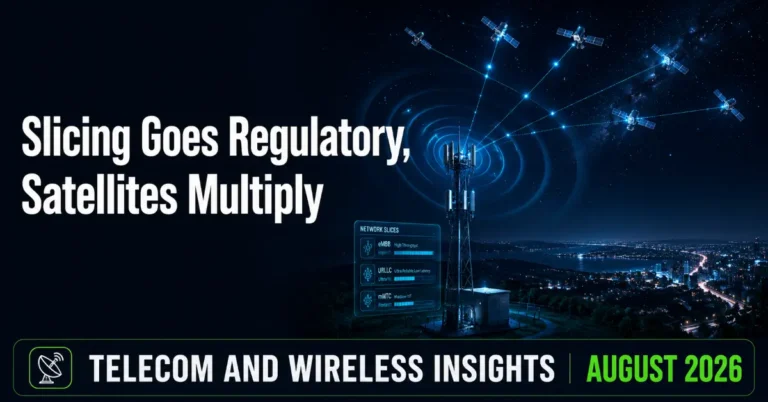
- Network slicing turned commercial, and regulators moved first: EE launched the UK’s first consumer/SMB 5G slicing service, Fast Lane, while India‘s TRAI now mandates per-slice tariffs and disclosed measured speeds.
- AI–RAN validation reached a live commercial network: Ericsson and SoftBank validated an AI-driven RAN scheduler on SoftBank‘s live 5G network in Japan — a first of its kind.
- Satellite and NTN saw capacity growth and consolidation: AST SpaceMobile posted Q2 gains and new FCC test authority, Starlink went live in Vietnam, and Lynk and Omnispace completed their merger as Elveo Mobile.
- Fixed wireless and fiber kept extending reach: Ookla data shows T-Mobile leading US FWA speeds, and Deutsche Telekom agreed to acquire two Polish fibre operators for roughly €1 billion.
- Spectrum policy and consolidation reshaped the map: Charter completed its $34.5B Cox acquisition to form a 45-state footprint, and Grain Management closed its purchase of T-Mobile‘s 800MHz spectrum.
- Vendor partnerships kept the network-intelligence supply chain moving: One NZ and 2degrees plan a jointly owned RAN entity in New Zealand, and Ericsson and Verizon extended private 5G collaboration with early 6G partnerships emerging.
1. Network slicing turns commercial — and regulators move first
Network slicing crossed from technical demonstration into commercial product and regulatory subject matter this month, on two different continents.

- EE (UK): launched Fast Lane, described as the UK’s first commercial 5G network slice for consumers and small businesses — moving eligible users onto a dedicated slice of EE’s 5G+ network during predicted high-demand periods (rush hours, major events) to sustain access for digital ticketing, livestreaming, and video.
- India‘s TRAI: will require telcos to treat each 5G eMBB network slice as a distinct tariff plan, mandating disclosure of measured — not advertised — download and upload speeds for every slice, with a slice deemed non-compliant if measured speeds fall below typical advertised levels. See TeckNexus’s “India Just Set a Precedent for Enforcing Network Slice SLAs.”
- Government of India: separately proposed safeguards for 5G network slicing to protect regular users’ quality of experience, signalling measures to manage prioritisation and QoS so slice traffic does not degrade general mobile broadband.
Why it matters for buyers: India’s move is the first instance of a regulator treating network slices as individually accountable commercial products rather than a technical feature — a precedent likely to shape how slicing SLAs get written elsewhere, and worth tracking even for operators outside India. → Score vendor SLA compliance claims with the TeckNexus RFP Scorecard Generator.
2. AI-RAN validation moves onto live commercial networks
AI-RAN moved from testbeds and trials into validation on a live, in-service commercial network this month — alongside new standards work on how to measure network autonomy at all.
- Ericsson & SoftBank: validated an AI-driven scheduler for link adaptation within the RAN on SoftBank’s live 5G network in Japan — part of Ericsson’s AI in RAN software, applying machine learning decisions directly on baseband equipment in real time. The companies describe it as Japan’s first validation of this type.
- NTT DOCOMO & Samsung: are extending AI-RAN to the device layer, placing on-device intelligence in smartphones to assist RAN optimisation and efficiency within DOCOMO‘s network.
- LG Uplus: proposed and led a new fixed access network fault-management assessment framework that passed TM Forum approval, providing common criteria for evaluating autonomy in fault detection and handling — informing future Autonomous Network Level certification in the fixed access domain.
- TM Forum: clarified, per its autonomous networks taxonomy, that Level 4 autonomy is assessed against defined jobs or scenarios rather than whole networks, while Level 5 spans all scenarios — framing autonomous networks as closed-loop systems that observe, diagnose, decide, and act with reduced human intervention.
- Nokia: asserted that GPU acceleration is required for 6G RAN processing; competing RAN vendors dispute the need, indicating diverging compute roadmaps between GPUs and other accelerators for next-generation RAN.
Why it matters for buyers: moving from testbed to live commercial validation is a meaningfully higher bar than a trial announcement — SoftBank’s live-network result, paired with TM Forum’s clarification that Level 4 autonomy is scenario-specific rather than network-wide, gives buyers a more precise vocabulary for what vendors are actually claiming. → Map AI-RAN readiness against your own network architecture with TeckNexus Network Planning tools.
3. Satellite and NTN: capacity, competition, and consolidation
Satellite and non-terrestrial network activity was dense this month — spanning results, regulatory approvals, consolidation, and direct competitive positioning against terrestrial carriers.
- AST SpaceMobile: reported year-on-year Q2 revenue growth driven by gateway deliveries and US government contract milestones, reiterated 2026 revenue guidance of $150–200 million with a backlog of roughly $1.3 billion, and plans a beta direct-to-device satellite service launch later this year; the FCC separately granted the company temporary authority to test direct-to-device service in the 800MHz band.
- Starlink & SpaceX: activated satellite broadband service across Vietnam and signed a launch contract with VinSpace, while analysts continue tracking Starlink’s “fiber-like reliability” claims as telecom leaders link AI readiness to faster fiber policy.
- Rocket Lab & Iridium: are pursuing a deal aimed at expanding satellite communications services.
- Optus: completed the first phase of Project Aurora, an in-orbit refuelling initiative aimed at extending the operational life of its D3 and other GEO satellites by up to six years.
- Eutelsat: promoted the integration of 5G Non-Terrestrial Networks within the EU’s expanded sovereign satellite initiative, positioned to compete with Starlink and Amazon LEO.
- Lynk & Omnispace: completed their merger and rebrand as Elveo Mobile, planning a 320-satellite LEO constellation for direct-to-device mobile service with commercial launch targeted for early 2028.
- SpaceX: signalled plans to expand from fixed satellite broadband into mobile connectivity services in the United States, prompting analysts to assess the competitive threat to national carriers; the FCC also opened a proceeding to explore direct satellite communications for unlicensed devices.
Why it matters for buyers: the satellite layer is consolidating (Elveo Mobile) and diversifying (AST SpaceMobile, Eutelsat, Optus) at the same time, while regulatory posture on direct-to-device is still being written — buyers evaluating NTN as a coverage extension should treat the vendor landscape as unsettled rather than mature. → Compare satellite and NTN vendor categories with the TeckNexus Technology Selector.
4. Fixed wireless, fiber, and broadband keep extending reach
Fixed wireless, fiber, and subsea investment all advanced this month, with new performance data and a new interoperability standard for next-generation optical transport.
- Ookla: US 5G FWA data found higher performance in urban areas compared to rural, identified T-Mobile as the speed leader, and noted seasonal performance declines during summer.
- Lightcurve: is enhancing its HFC footprint using DOCSIS 3.1+ as an interim step while planning a transition to PON fiber, positioning DOCSIS 3.1+ as a near-term upgrade path toward an all-fiber network.
- Deutsche Telekom: agreed to acquire Fiberhost and Inea in Poland from Macquarie Asset Management for approximately €1 billion, expanding T-Mobile Polska’s fixed-line convergence strategy; Fiberhost operates an open-access fibre network passing over 1.4 million locations.
- PLDT, Globe Telecom & Converge ICT Solutions: jointly submitted a $500 million proposal to the Philippine government for a nationwide domestic submarine cable system.
- NTT, KDDI & Rakuten Mobile: together with four other Japanese firms, jointly developed the newly approved ITU-T Y.3335 standard to support interoperability and broader adoption of next-generation all-photonics networks.
Why it matters for buyers: Ookla’s rural/urban FWA gap and Deutsche Telekom’s fibre acquisition both point the same direction — fixed wireless is a genuine broadband option, but fiber consolidation is still the dominant capital strategy where it’s economically viable. → Model coverage-extension economics with TeckNexus ROI/TCO calculators.
5. Spectrum policy and market consolidation reshape the map
Spectrum policy activity and market consolidation moved in parallel this month, with several long-pending US deals finally closing.
- NTIA: stated that the current administration approved plans to study the 4.4GHz band for potential full-power commercial licensing, submitting a final package to Congress and initiating four concurrent spectrum-repurposing studies tied to 6G.
- WISPA: asked the FCC to revise a draft notice of proposed rulemaking for unlicensed device-to-device spectrum use, arguing certain statements in the draft are inaccurate, unsupported, and inconsistent with the established record.
- The FCC: ‘s latest annual Section 706 report indicates that competitive dynamics are contributing to wider broadband deployment and higher data speeds across the United States.
- Charter Communications: completed its $34.5 billion acquisition of Cox Communications and an all-stock acquisition of Liberty Broadband, consolidating operations into a unified 45-state US cable footprint passing over 70 million locations and serving about 37 million customers — the merged entity adopts Cox Communications as its corporate name while retaining the Spectrum consumer brand; California’s CPUC approved the deal with conditions.
- Grain Management: completed its acquisition of T-Mobile’s nationwide 800MHz spectrum portfolio for $2.9 billion, with T-Mobile receiving all of Grain’s 600MHz licenses in return.
- Vodafone Group: completed the sale of its 50% stake in VodafoneZiggo to Liberty Global for €1 billion and a 10% stake in the newly created Ziggo Group, with proceeds directed toward debt reduction.
- The European Commission: cleared the acquisition of Polish wholesale fibre provider Nexera Holding by Orange Poland and APG Asset Management, finding limited competitive overlap.
Why it matters for buyers: Charter/Cox closing and Grain’s 800MHz acquisition both landed in the same month as NTIA’s 6G-linked spectrum studies — the US spectrum and cable map moved more in August than in most full quarters, worth a fresh look at competitive positioning in any US market you operate in. → Score how a shifting competitive landscape affects vendor and partner selection with the TeckNexus RFP Scorecard Generator.
6. Vendor partnerships and network-intelligence deals
A wide spread of vendor partnerships and network-intelligence deals rounded out the month, from RAN-sharing entities to spatial intelligence platforms.
- One NZ & 2degrees: intend to form RANCo, a standalone, jointly owned infrastructure company comprising their respective RAN assets to provide wholesale RAN services back to both operators — building on an existing limited RAN-sharing arrangement and targeting efficiency gains, faster technology rollouts, and improved network resilience.
- Sunrise & Salt: signed a memorandum of understanding to assess sharing or co-deploying network infrastructure in rural and less densely populated parts of Switzerland.
- Ericsson & Verizon: are extending collaboration around private 5G deployments, while pre-commercial 6G early-access partnerships are forming among chipset makers and network suppliers.
- Amdocs: signed a multi-year managed services agreement with Telefónica Chile to modernise the operator’s technology stack and improve response times, setting groundwork for potential regional collaboration.
- RADCOM: was awarded a multi-year contract by CETIN Networks to deploy end-to-end mobile service assurance across its network, including the radio access network.
- Amantya Technologies: integrated Rypplzz’s software-defined spatial intelligence platform into its 5G Standalone Core stack (UPF, MEC, and RIC) to enable precise 3D positioning and location-aware network functions, targeting scalable, software-only deployment across 5G and future 6G infrastructure.
- NextNav: named Tiami Networks a sensing ecosystem partner to support 5G-powered counter-UAS capabilities leveraging terrestrial PNT and 3D geolocation.
- Component and module updates: Movandi introduced two pin- and feature-compatible frequency synthesizers (MV3564, MV3514) for wireless and AI data connectivity; Quectel launched two Android 16 smart modules for embedded IoT applications; and VIAVI enhanced its Vertex channel emulation platform with 400 MHz bandwidth and carrier frequency support up to 23.6 GHz.
Why it matters for buyers: RANCo and the Sunrise/Salt MOU both point at infrastructure-sharing as a live cost-management lever in smaller, denser markets — worth watching if your own market has similar competitive dynamics. → Compare partner and vendor track records with the TeckNexus Technology Selector.
What Advanced Connectivity Insights for August 2026 means if you’re planning network investment
August’s throughline is commercial and regulatory maturity catching up with technical capability across slicing, AI-RAN, and satellite — while spectrum policy and market consolidation moved faster than usual in the US. Six moves follow directly from the month:
- Treat network slicing as a product with SLA and billing implications, not just a technical feature — India’s TRAI mandate is a preview of where slicing regulation may head elsewhere.
- Benchmark AI-RAN vendor claims against live-network validation, not lab or testbed results — Ericsson and SoftBank’s Japan validation is a meaningfully higher evidence bar.
- Treat the satellite/NTN vendor landscape as unsettled — Elveo Mobile’s merger and multiple parallel FCC proceedings mean today’s leading vendor may not be tomorrow’s.
- Weigh fixed wireless against fiber on a market-by-market basis — Ookla’s rural/urban FWA gap and Deutsche Telekom’s fibre acquisition both point to fiber remaining the stronger investment where it’s economically viable.
- Reassess competitive positioning in any US market touched by Charter/Cox or Grain’s spectrum acquisition — both deals closed this month and materially shift the landscape.
- Consider infrastructure-sharing models for smaller or denser markets — One NZ/2degrees’ RANCo and the Sunrise/Salt MOU both suggest this is a live cost lever, not just a theoretical one.
For this month’s AI-specific deployments and governance developments, see our companion AI & Automation Insights, August 2026 →
For this month’s private network deployment evidence, see our companion Private Network Insights, August 2026 →
Catching up? Last month’s signal is here: Telecom and Wireless Insights, July 2026: Satellite’s Extremes and AI-RAN’s Deployment Gap →
→ Start with the TeckNexus Intelligence Platform — independent, buyer-neutral tools for spectrum, TCO, architecture, and RFP decisions.
This analysis is drawn from TeckNexus’s full curated Advanced Connectivity Monthly Insights for August 2026. See every deployment, product, and partnership update →
The TeckNexus Intelligence Platform is buyer-neutral and TeckNexus-authored. Vendor co-branded Intelligence Packs are labelled as such and kept separate from the neutral core tools.
| RELATED TOOL
Is your network architecture ready for commercial slicing, AI-RAN, and NTN at once? With India setting a regulatory precedent for slicing SLAs, AI-RAN reaching live-network validation, and the satellite vendor landscape still consolidating, buyers are being asked to plan for three fast-moving layers simultaneously. TeckNexus’s Network Planning tools help map architecture options against your deployment horizon, while the RFP Scorecard Generator structures vendor evaluation around SLA compliance, AI-RAN evidence, and coverage-extension economics. |