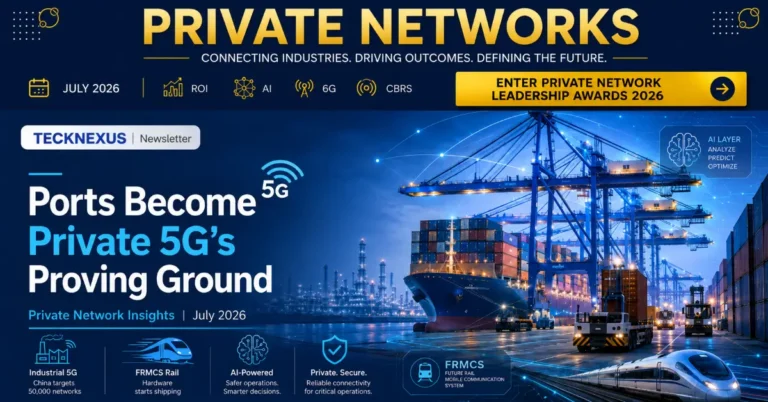
Private Network Insights July 2026’s roundup: ports deliver this month’s deepest deployment evidence, China sets a 50,000-network industrial 5G target, FRMCS rail hardware starts shipping, and private networks add an AI layer across safety and heavy industry.
At a glance – Private Network Insights July 2026
- Ports had their strongest month of deployment evidence yet: Felixstowe runs one of the UK’s largest industrial private 5G networks, the Port of Valencia’s 5GVLCPortLab testbed had five pilots named among the EU’s top 10 innovations, and Thames Freeport, a New Zealand South Island port, and Niral Networks’ logistics platform each added reference points.
- China’s MIIT set a 2030 target of 50,000 industrial 5G private networks as part of an 18-task Industrial Internet policy.
- The Netherlands issued three more 3.5 GHz private 5G permits, taking the reserved-band total to 59.
- Ericsson was selected for mission-critical private 5G to support Queensland’s FRMCS rail rollout ahead of the Brisbane 2032 Olympics, and Comba began sampling FRMCS-ready micro radios.
- AT&T Mexico pushed back on the country’s proposed industrial 5G auction terms, citing fees and participation rules.
- Private networks kept adding an AI layer on top: wearable safety monitoring, edge-AI broadcast, shipyard automation, and RedCap device verification.
1. Ports become July’s proving ground
Ports supplied July’s deepest run of deployment evidence, moving the vertical from occasional case study to a recognizable pattern:
- UK — Port of Felixstowe: confirmed by trade press as operating one of the country’s largest industrial private 5G networks, now delivering site-wide, high-capacity, low-latency connectivity across its operations.
- Spain — Port of Valencia: the Universitat Politècnica de Catalunya-coordinated Horizon Europe IMAGINE-B5G project completed its work on the 5GVLCPortLab private 5G testbed, validating five industrial pilots — UAV-based monitoring, remote control of an unmanned surface vessel, AR-guided maintenance with AI, and integrated security — with the European Commission naming the results among the EU’s top 10 port technology innovations.
- UK — Thames Freeport: activated private 5G and edge computing across the DP World London Gateway footprint to support smart port operations and digitized logistics.
- New Zealand — South Island port: deployed reliable wireless networking across warehouse and logistics operations to improve productivity and safety.
- Supply side — Niral Networks: expanded its cloud-native NiralOS platform for warehouses, logistics hubs, and ports, delivering zero-handoff mobility for AGVs and AMRs, sensor-fusion data transport across cameras, LiDAR, RFID, and IoT, and low-latency support for edge AI analytics, predictive maintenance, and remote crane operations.
Why it matters for buyers: ports now have enough independently reported reference architecture that evaluators no longer need to reason by analogy from factory-floor case studies — coverage, automation, and security patterns specific to port operations are now documented and repeatable. → Model the return with the TeckNexus Ports ROI Calculator, and find deployment patterns specific to your site type in TeckNexus Vertical Intelligence.
2. FRMCS moves from spec to shipped hardware
Rail connectivity moved from framework to hardware this month:
- Ericsson — Queensland, Australia: selected to provide mission-critical private 5G underpinning Queensland’s next-generation rail communications, aligned to the Future Railway Mobile Communications System (FRMCS), ahead of the Brisbane 2032 Olympics.
- Comba Telecom Systems: began sampling compact private 5G SA “micro” radio units operating in the upper n77 and n101 bands, with the n101 variant built specifically for 5G FRMCS rail use cases in space-constrained enterprise and transportation deployments — a sign that FRMCS-ready hardware is now sampling, not just specified.
- Transatel: joined the 5G Automotive Association (5GAA), contributing global MVNO and eSIM lifecycle management expertise to industry work spanning 5G SA, V2X, non-terrestrial networks, private 5G, and future 6G considerations for connected and software-defined vehicles, building on existing connected-vehicle programs with Stellantis, JLR, BMW Group, and Toyota.
Why it matters for buyers: FRMCS is no longer purely a specification exercise — vendors are shipping FRMCS-ready radio hardware and winning named contracts, so rail and transit operators scoping private network procurement should treat FRMCS compatibility as an available requirement rather than a future one. → Size and plan the radio architecture with the TeckNexus Network Planning tool.
3. Regulatory frameworks scale from pilot to target-setting
Spectrum policy moved from establishing frameworks to setting hard numbers this month:
- China — MIIT: released Implementation Opinions for the Industrial Internet, jointly with seven other government agencies, setting a 2030 target of 50,000 industrial 5G private networks, alongside expansion of the national identifier resolution system, roughly five internationally influential integrated platforms, and full integrated-application coverage across 207 industrial sub-sectors — an 18-task plan spanning infrastructure, technology innovation, applications, security, and ecosystem development.
- Netherlands — RDI: awarded three more 3.5 GHz private 5G permits — to ‘s Heeren Loo Zorggroep, Breda Robotics, and Smelt Europe — taking the reserved-band total to 59.
- Mexico — AT&T Mexico: urged the CRT regulator to revise proposed rules for the country’s industrial 5G auction in the 2.3 GHz band, citing high recurring spectrum fees, spectrum cap methodology, exclusion of nationwide operators, and a lack of financial transparency, and is seeking terms broad enough to avoid the low participation seen in prior IFT processes.
Why it matters for buyers: China’s target and the Netherlands’ permit count both signal markets moving from framework-setting into execution — timing that matters for vendors and buyers planning market entry or expansion. Mexico’s pushback is a reminder that auction design still shapes who can realistically participate, and it’s worth watching before assuming access. → Score vendor and market readiness with the TeckNexus RFP Scorecard Generator.
4. Private networks add an AI layer across safety and heavy industry
The base layer this month was still private 5G deployment — AI rode on top of it rather than driving it:
- KT + Samsung: KT rolled out a Safety Management Watch service connecting Samsung Galaxy Watch wearables to its enterprise private 5G network and Samsung’s SmartThings Pro for Safety, aggregating environmental data (temperature, humidity) and worker biometrics (heart rate, activity) for site-wide safety monitoring.
- Fujitsu-led consortium, Japan: Fujitsu, Nautilus Technologies, NRI, IIJ, 1Finity, Ghelia, and M-TEC, working with Mitsubishi Electric under a NEDO project, are trialling a real-time video streaming system for the Kyojo Cup racing series that runs distributed edge AI and on-device inference over a private 5G network to select and deliver race footage with low latency.
- Gunsan shipyard, South Korea: a private 5G and physical-AI plan targeting productivity and worker safety was announced, alongside a separate agreement setting out private 5G network services to digitize on-site operations at the same facility.
- Oil and gas: a sponsored industry piece argued that private 5G’s reliable, low-latency, local connectivity is the foundation AI and IIoT need to scale predictive maintenance, drone inspection, and connected-worker use cases, citing GlobalData’s Q1 2026 survey on rising digital investment.
- Samsung + Hyundai: completed what they describe as the industry’s first Reduced Capability (RedCap) verification on a private 5G network, demonstrating interoperability that should lower the cost and power draw of connecting the sensors and devices these AI use cases depend on.
Why it matters for buyers: none of this month’s AI stories describe AI replacing the network — they describe AI applications (safety monitoring, video analytics, predictive maintenance) that are only viable because a private 5G network is already in place. RedCap verification matters for the same reason: cheaper, lower-power devices widen which AI use cases are economically justifiable on a network you already operate. → Rank candidate AI use cases by impact, feasibility, and payback with the TeckNexus AI Use Case Prioritiser.
5. Deal wins, earnings, and supply-side consolidation
The supply side kept moving this month, from earnings tied to private network revenue through to M&A and market entry:
- Ceragon: reported securing more than USD 10 million in second-quarter private network contracts, driven by demand from public safety, utilities, and smart city projects — one of the few instances this month of a vendor breaking out private network revenue specifically.
- Druid Software: the private 5G core network provider acquired RAN expertise to extend its capabilities beyond core and strengthen end-to-end private 5G delivery.
- Logicalis: invested €8 million to roll out private 5G services for Irish enterprises, enabled by new ComReg local spectrum access rules, partnering with Cisco, Nokia, and Neutral Wireless to deliver design, radio planning, deployment, security, integration, and fully managed services aimed at production-scale enterprise deployments.
- RDI (Netherlands): the permit awards covered above as a policy signal are equally a deal-win story for the three named recipients entering the reserved 3.5 GHz band.
Why it matters for buyers: earnings tied specifically to private network deals, and vendors acquiring capability rather than building it from scratch, both point to a supply side maturing into a distinct commercial category — useful context when scoring vendor stability and delivery capability during procurement. → Score vendors on delivery capability and commercial track record with the TeckNexus RFP Scorecard Generator.
6. Vertical breadth continues: healthcare, utilities, defense, agriculture, government
Beyond ports and heavy industry, July’s deployments filled in reference points across a wider set of verticals:
- Healthcare: COSMOTE implemented a private 5G Standalone network at Aretaeio Hospital, announced by OTE Group’s Business Segment leadership, with deployment scope appearing limited to a single site.
- Utilities: Benton PUD engaged Fullerton Engineering to design and implement a Private LTE network program supporting the utility’s broadband and IT operations.
- Defense: Vodafone Portugal delivered 5G network infrastructure and managed services to support connectivity at military bases and field exercises.
- Government and public sector: Zambia introduced GovLink, a government-owned private 4G LTE network providing secure internet access to hospitals and schools, led by the Smart Zambia Institute with the Ministry of Health, moving from a Copperbelt Province pilot toward nationwide rollout.
- Agriculture: a market report projected the 5G-in-agriculture market growing from $3.88bn in 2025 to $5.11bn in 2026 and $15.18bn by 2030, citing precision agriculture, IoT connectivity, and real-time farm operations as drivers, with Asia-Pacific tipped as the fastest-growing region.
- Also this month: Inwi signalled plans to deliver private 5G solutions targeting manufacturing, logistics, woodworking, and agriculture in Morocco, though the partner and technical details weren’t disclosed.
Why it matters for buyers: buyers in healthcare, utilities, defense, agriculture, and government no longer need to extrapolate from manufacturing or mining case studies — each of these verticals generated its own named deployment or program this month. → Find the deployment pattern closest to your sector in TeckNexus Vertical Intelligence.
Every July item, with full source detail, is on the curated Private Network Monthly Insights page →
What Private Network Insights for July 2026 means if you’re evaluating a private network
July’s throughline is breadth with hardening edges: more verticals are generating real, not hypothetical, deployment evidence, and the regulatory and hardware pieces that used to be “coming soon” — FRMCS radios, China’s numeric targets, RedCap verification — are now shipping or published. Four moves follow directly from the month:
- Benchmark against your actual vertical, not the nearest analogy — ports, healthcare, utilities, defense, and agriculture all generated named reference points this month. Start with Vertical Intelligence and the Ports ROI Calculator.
- If you operate in or serve rail, treat FRMCS-ready hardware as available today, not a future requirement — plan radio architecture accordingly with the Network Planning tool.
- Watch target-setting markets (China’s 50,000-network goal, the Netherlands’ 59 permits) for procurement timing, and don’t assume auction terms will be buyer-friendly by default, as Mexico’s pushback shows.
- Treat AI as an add-on to a private network you already operate, not a substitute for one — rank candidate use cases with the AI Use Case Prioritiser once the network itself is in place.
Catching up? Last month’s signal is here: Adoption Is Settled, ROI Is the Question: Private Network Insights, June 2026 →
→ Start with the TeckNexus Intelligence Platform — independent, buyer-neutral tools for spectrum, TCO, architecture, and RFP decisions.
This analysis is drawn from TeckNexus’s full curated Private Network Monthly Insights for July 2026. See every deployment, product, and partnership update →
The TeckNexus Intelligence Platform is buyer-neutral and TeckNexus-authored. Vendor co-branded Intelligence Packs are labelled as such and kept separate from the neutral core tools.
| RELATED TOOL
Which private network vertical is generating the deployment evidence you need? With ports, rail, healthcare, utilities, defense, and agriculture all adding named deployments this month, the practical question is where your sector’s evidence base actually stands. TeckNexus’s Ports ROI Calculator models the return on crane automation, yard AGVs, smart gates, and connectivity in board-ready, five-year terms, and Vertical Intelligence maps deployment patterns across manufacturing, mining, ports, airports, and utilities so you can benchmark against comparable sites rather than the nearest available case study. |