Intelligence Journeys
AI Use Cases for Utilities
Private Broadband for Utilities

MVNO

July 2026's roundup: ports deliver this month's deepest deployment evidence, China sets a 50,000-network industrial 5G target, FRMCS rail hardware starts shipping, and private networks add an AI layer across safety and heavy industry.
June 2026's roundup: agentic AI moves from pilot to operational core across telecom networks, satellite consolidates through Rocket Lab's $8B Iridium acquisition and SpaceX's $75B IPO, AI-RAN's GPU divide matures into shipping products, US spectrum auctions return after a four-year hiatus, and telecom M&A accelerates globally.
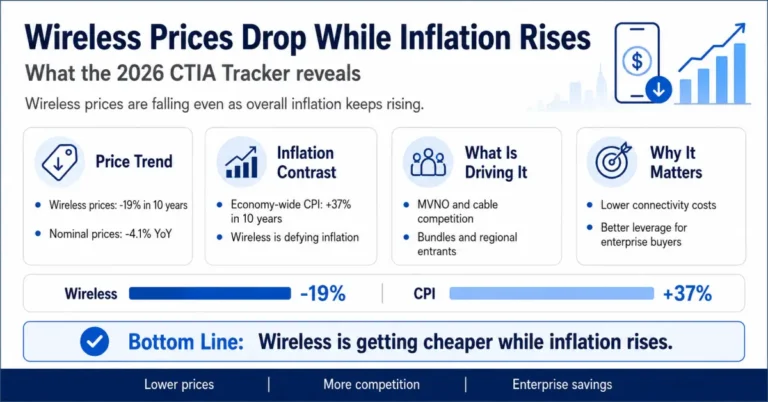
Wireless services are defying U.S. inflation trends in a way virtually no other sector is. According to CTIA's newly released More for Less: 2026 Wireless Affordability Tracker, nominal wireless prices have declined 4.1% over the past year and 19% over the past decade, while the economy-wide CPI rose more than 37% over the same period. Adjusted for inflation, postpaid unlimited plans are down roughly 10% year-over-year, and prepaid options have fallen more than 50% over five years. For enterprise decision-makers, this pricing trajectory represents a structurally favorable condition for mobile workforce and IoT connectivity planning.
The European Commission has approved Orange’s plan to acquire the remaining stake in MasOrange, signaling limited competitive impact and clearing the path for full control in Spain. Orange will purchase the roughly 50% it does not already own in MasOrange from the Lorca consortium for about €4.3 billion. MasOrange was created in 2024 by combining Orange Spain and MásMóvil, and the new deal converts the joint venture into a wholly owned Orange subsidiary. The Commission used its simplified merger review, indicating no structural change in market concentration. Closing is expected before July 2026, after which MasOrange will be integrated into Orange’s operations and financial reporting.
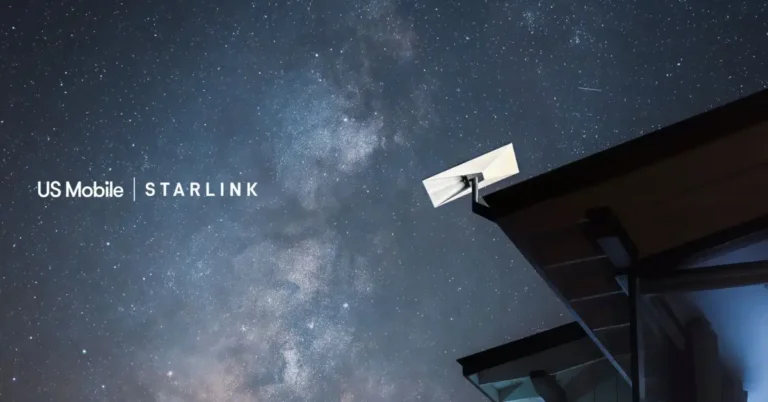
US Mobile and Starlink have launched limited-time bundles that combine Starlink residential service with US Mobile’s unlimited mobile plans under a single account and bill. Entry pricing starts at $47 per month, which effectively blends a $30 Starlink residential tier (targeted around 100 Mbps) with a $17 US Mobile base unlimited plan. Higher Starlink speed tiers are available at $77 per month for a 200 Mbps option and $117 per month for a “Max” service that targets 400 Mbps or more. Compared with Starlink’s typical standalone rates of $50, $80, and $120 for the same speed tiers, the bundles represent meaningful savings for households that want both mobile and home internet.
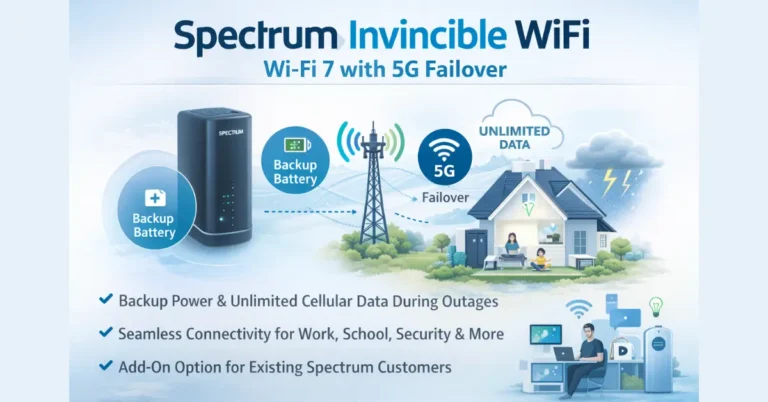
Charter introduced Spectrum Invincible WiFi, a package built around its Advanced Wi‑Fi 7 router paired with an integrated backup battery and an embedded 5G cellular pathway. The system automatically rides through local power interruptions for up to eight hours and, if the wired broadband link drops, switches to cellular with unlimited data until the primary connection returns. The offer targets households running multigig internet and dozens of smart devices, and is positioned as a simple add-on for existing Spectrum customers. Home connectivity has become mission‑critical for work, school, security and telehealth while weather-related disruptions and grid instability are rising.
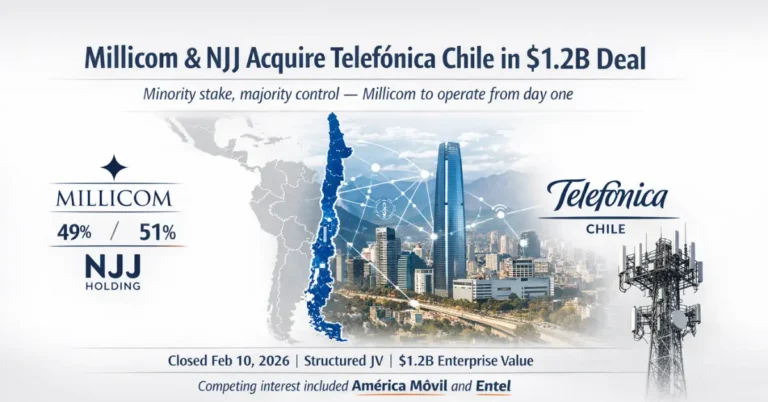
Millicom and NJJ have jointly acquired Telefónica’s Chilean operations in a structure designed to capture upside while insulating Millicom’s balance sheet. Through a jointly controlled vehicle, NJJ holds 51% and Millicom 49% of nearly all of Telefónica’s interest in Chile, with Millicom operating the asset from day one despite its minority stake. The headline value is about $1.2 billion, reflecting a challenged but strategically important footprint in one of Latin America’s most advanced telecom markets. The transaction closed on February 10, 2026, and follows months of speculation that drew interest from other regional heavyweights, including América Móvil and Entel.
The operators that control both dense fiber and performant 5G, and that package them coherently, will set the pace for the next telecom cycle. AT&T’s targets—more fiber passings, higher bundle attach, and measured wireless growth—put it squarely in the camp that sees integrated networks as the winning model. If the company executes on build cadence and cross-sell while keeping experience clean, expect continued share gains in fiber markets and a tougher environment for single-asset competitors. For buyers, the practical takeaway is to lean into converged sourcing now to lock in economics and resiliency as these footprints expand.
France’s three other mobile network operators—Bouygues Telecom, Free-iliad and Orange—have reopened negotiations with Altice to carve up most of SFR, reviving a complex deal that could reshape competition, capex and customer experience across the market. The operators confirmed they are conducting due diligence with Altice after re-engaging in early January 2026, stressing that legal and financial terms remain undecided and that there is no assurance of a transaction. A successful transaction would compress the French market from four to three MNOs, with material consequences for pricing power, 5G/fiber investment, vendor ecosystems and enterprise buyers. Consolidation momentum is building across Europe, evidenced by recent approvals of large transactions with stringent remedies. Altice has been under sustained pressure to reduce debt following restructurings and asset sales.
Comcast is recasting how it engages consumers by rolling out Xfinity Membership, a loyalty experience that ties perks and rewards to broadband, mobile, and media usage while expanding its retail footprint with new Xfinity Stores in South DeKalb, Georgia, and Chehalis, Washington. The strategy is straightforward: keep customers longer by making Xfinity more valuable the more services they use. Xfinity Membership packages ongoing perks and periodic rewards across Comcast’s portfolio, aligning incentives to broadband, Xfinity Mobile (MVNO on Verizon’s network), and NBCUniversal’s media assets such as Peacock.

The FCC has approved AT&T’s agreement to acquire a portfolio of UScellular wireless spectrum licenses for $1.02 billion, advancing AT&T’s mid-band capacity strategy and reshaping competitive dynamics in U.S. 5G markets. The licenses span select UScellular markets, bolstering AT&T’s holdings in areas where UScellular has long operated, including rural and midwestern regions. With FCC consent in hand, the parties can proceed to closing market by market, subject to routine administrative steps and any local obligations. Mid-band spectrum remains the sweet spot for balanced capacity and coverage. This positions AT&T to better support RedCap devices, uplink-sensitive applications, and the early wave of 5G-Advanced features.
Airbus Defence and Space has introduced Agnet Direct, a multi-mode extension to its 3GPP-based Agnet portfolio that keeps teams connected when commercial or private 4G/5G coverage is compromised. Agnet Direct has been validated within France’s Réseau Radio du Futur (RRF), the nationwide secure broadband network for domestic security and emergency services. The solution combines a smartphone running the Agnet application with a smart remote speaker microphone (RSM) to deliver resilient communications across four operational modes. Agnet integrates with existing TETRA and Tetrapol estates, enabling hybrid operations where radio users and smartphone users communicate across shared talkgroups.

Partner Hubs

Download content, access intelligence tools, and hear from executives.

Partner Events

  • M360 ASEAN
  • FutureNet Asia 2026
  • Network X Vienna 2026
Scroll to Top