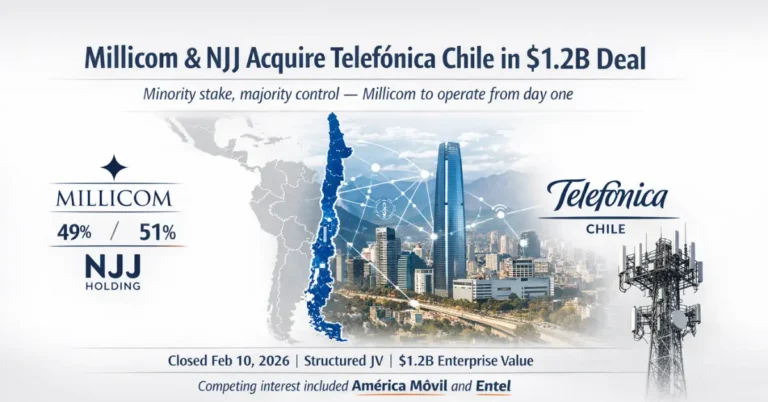
Millicom and NJJ acquire Telefónica Chile in $1.2B non-recourse deal
Millicom and NJJ have jointly acquired Telefónica’s Chilean operations in a structure designed to capture upside while insulating Millicom’s balance sheet.
Deal structure, ownership split, and operating control
Through a jointly controlled vehicle, NJJ holds 51% and Millicom 49% of nearly all of Telefónica’s interest in Chile, with Millicom operating the asset from day one despite its minority stake. The headline value is about $1.2 billion, reflecting a challenged but strategically important footprint in one of Latin America’s most advanced telecom markets. The transaction closed on February 10, 2026, and follows months of speculation that drew interest from other regional heavyweights, including América Móvil and Entel.

Non-recourse payments, earn-outs, and balance-sheet protection
Telefónica receives $50 million at closing and is eligible for deferred and earn-out consideration tied to the asset’s performance and structural value creation, including up to $150 million in additional payments. The acquired company’s existing debt and any consideration beyond the upfront amount are payable from the business’s own cash flows and are non-recourse to Millicom. To stabilize the balance sheet at closing, Telefónica must contribute CLP 79 billion (approximately $92 million). Telefónica Chile reported net debt of €479 million in 2025, underscoring why the buyers favored a ring-fenced approach that avoids immediate consolidation into Millicom’s financials.
Call options enabling year 5–6 path to full control
The shareholder agreement includes a path to eventual full control without near-term leverage: Millicom holds a call option to acquire NJJ’s stake in years five and six at a valuation linked to Millicom’s then-current trading multiples with a 10% discount, payable in Millicom shares or cash/shares. If Millicom does not exercise its option, NJJ can acquire Millicom’s 49% stake on comparable terms. Both entities are ultimately aligned under Xavier Niel’s influence—he controls NJJ and is the largest shareholder in Millicom—streamlining strategic intent while maintaining financing discipline.
Why this $1.2B Chile deal reshapes Latin America telecom
The acquisition advances Telefónica’s LatAm exit and strengthens Millicom’s South American footprint through a capital-light, option-driven structure.

Telefónica LatAm exit and shifting competitive dynamics
Telefónica has been methodically exiting several Latin American markets, including agreements or completed sales in Ecuador, Uruguay, Peru, Argentina, and changes in Colombia. Chile joins that list, reducing Telefónica’s direct exposure while refocusing capital toward core European markets and higher-return assets. For regional competitors and investors, the Chile move reinforces a trend: long-cycle capex and intense price competition have pushed multinationals to streamline portfolios, creating selective opportunities for scale players with operating leverage and local execution strength.
Chile market scale, execution levers, and value creation
Chile remains one of Latin America’s most developed telecom environments: deep mobile and broadband penetration, infrastructure-based competition, strong consumer protection, and continued demand for quality connectivity. Modernization and efficiency gains—across mobile RAN, transport, fiber, and IT/OSS/BSS—represent the near-term levers for Millicom and NJJ. Expect a focus on: targeted 5G upgrades and densification; fiber-to-the-home expansion and fiber backhaul optimization; simplification of legacy platforms; and product rationalization to improve ARPU and reduce churn. With Millicom operating the asset, the buyers can apply a proven playbook while keeping leverage and recourse off Millicom’s balance sheet until performance justifies deeper ownership.
Implications for Chilean operators, vendors, and investors
The structure favors operational turnaround before financial consolidation, creating both competitive pressure and partnership openings across Chile’s telecom value chain.
What Chilean operators and challengers should expect
Rivals should expect a more disciplined competitor focused on cost-to-serve, network quality, and selective growth segments (SMB, enterprise connectivity, cloud adjacency). Pricing skirmishes may give way to quality- and bundle-led differentiation as network KPIs improve. Operators with excess spectrum or underutilized fiber could find new avenues for sharing, wholesale, or MVNO arrangements if Millicom prioritizes capital efficiency over greenfield builds in the first phase.
Opportunities for network and IT vendors in Chile
The buyers’ modernization agenda creates room for RAN swaps or expansions, transport upgrades, and IT stack consolidation. Vendors positioned in 5G radio, packet core evolution, fiber access, DOCSIS/fixed upgrades, and cloud-native OSS/BSS should engage early with outcome-based proposals tied to opex savings and time-to-market. Given the non-recourse structure, commercial constructs that align payments to realized savings or revenue uplift will resonate.
Investor takeaways, governance, and valuation catalysts
The earn-out and option framework caps downside while preserving upside if the turnaround lands. Key valuation catalysts include: sustained EBITDA margin expansion, churn reduction, and capital intensity trending down post-modernization. The year 5–6 option window is pivotal; early execution would signal confidence in durable cash generation and synergy capture. With both buyers linked to Xavier Niel, transparency around related-party processes and performance thresholds will matter for minority investors.
Key milestones to watch in Chile over the next 24 months
Execution signals will appear quickly in network KPIs, capital allocation choices, and competitive behavior.
Near-term operational milestones and market signals
Look for a 12–18 month plan that prioritizes high-ROI coverage and capacity upgrades, customer experience improvements, and simplification of tariffs and product lines. Watch quarterly disclosures for early wins in net adds, ARPU stabilization, NPS, and opex per site. Any network-sharing agreements, selective asset monetizations, or spectrum refarming announcements would indicate a disciplined capital approach consistent with the deal’s protective structure.
Risks and constraints in Chile’s telecom market
Chile’s mature market and rigorous consumer protections can slow pricing recovery and elongate payback periods. Macroeconomic volatility could challenge household spend and enterprise budgets, while legacy IT and fragmented supply chains can delay modernization benefits. Finally, integration and operating control under joint ownership require tight governance to maintain speed and accountability, especially with non-consolidation limiting immediate financial levers.
Bottom line for telecom leaders in Latin America
This is an execution-first, balance-sheet-light bet on Chile’s long-term connectivity demand—and it raises the bar on disciplined M&A in Latin America.
Priority actions for operators, vendors, and investors
Operators should reassess partnership options in Chile—network sharing, wholesale fiber, and enterprise co-sell—before competitive intensity tightens. Vendors must bring modular, opex-anchored modernization offers with measurable KPIs and risk-sharing mechanisms. Investors should track operating control in practice, early unit-economics improvement, and signals around the year 5–6 option—those will determine whether this becomes a platform for consolidation or a contained financial stake with operational uplift.